

From late October to early November 2025, I made a trip to the Republic of South Africa and Namibia. The purposes of this trip were threefold. First, I delivered a presentation at the biennial conference of the International Association of Genocide Scholars (IAGS), held at the Johannesburg Holocaust & Genocide Centre. Second, I conducted research for a comparative study on the historical memory of the Holocaust and of genocide in German South West Africa. Third, I carried out research related to the historical memory of Lithuanian Jews’ role under apartheid and colonial rule in South West Africa.
At the IAGS conference, I gave an oral presentation entitled “Diaspora Nationalism and Collective Memory on Genocide: Exhibitions by American Lithuanians and Their Aftermath in the Homeland.” In Lithuania, which experienced Soviet occupation from 1940 to 1941 and again from 1944 to 1990/91, the repressive policies implemented by Soviet authorities—especially during the Stalinist period—have often been described as “genocide” against the Lithuanian nation, though these policies do not fully conform to the definition of genocide as laid down in the Genocide Convention. The understanding that these policies constituted “genocide” gained momentum domestically in Lithuania in the late 1980s in parallel with the independence movement. If we look back historically, however, this perception had already become widespread among Lithuanian diaspora communities, particularly in the United States, in the immediate post–World War II period.
In my presentation, I focused on the understanding of “genocide” within the Lithuanian American community between the 1950s and 1970s. In particular, I examined the “genocide exhibitions” held in cities across the United States between the 1950s and 1970s by Lithuanians in America, with the cooperation of politicians such as President Richard Nixon and then–Representative Gerald Ford. These exhibitions emphasized human rights violations under Soviet rule and were also used by the Nixon administration as material to justify the United States’ involvement in the Vietnam War. For my analysis, I drew on documentary materials held at the Lithuanian Central State Archives (LCVA) in Vilnius and the World Lithuanian Archives of the Lithuanian Research Center (LTC-PLA) in Lemont, Illinois, USA.
In terms of the relevance to reconciliation studies, this case provides a concrete example of how the politics of memory, discrepancies between international legal definitions and empirical understandings, the influence of diasporas, and interventions by external political actors can affect the social reconciliation through historical dialogue and transitional justice.
After my presentation, I received several questions, but unfortunately I did not have the opportunity to receive productive questions that showed a clear grasp of the core arguments of my presentation. The panel to which I had been assigned consisted of three presentations on quite different themes, and both the chair and the audience appeared somewhat confused. In this presentation I also discussed the involvement of Raphael Lemkin, the jurist who coined the term and concept of genocide, and I had expected that this aspect would attract the interest of genocide scholars. It was therefore very disappointing that I received no questions on this point. One possible explanation is that the abstract I submitted in advance did not make the connection to Lemkin sufficiently clear, and, as a result, scholars who might otherwise have been interested chose to attend other panels. This is something I must seriously reflect upon. I plan to develop the content of this presentation into an article in English and submit it to an international academic journal. If it is published as I hope, I look forward to seeing how the scholarly community responds.
After the conference, I carried out research on the two themes mentioned above. The first was the comparative study of the historical memory of the Holocaust and of genocide in German South West Africa. Recent Holocaust research has increasingly re-examined the Holocaust from the perspective of German “colonial rule” in Eastern Europe. Traditional colonial studies have generally taken as their premise European domination over the so-called Third World or white domination over non-white populations, and they have rarely applied the concept of colonialism to intra-European cases such as the Holocaust. In recent years, however, efforts to reinterpret German rule in Eastern Europe and the Holocaust through the lens of colonialism have begun to offer new perspectives on German policies toward Jews and local societies as well as on the mechanisms of local collaboration.
An important precursor to these developments is German colonial rule in South West Africa (present-day Namibia) and the genocide of the Herero and Nama peoples (1904–1908). Given that repressive policies first implemented in South West Africa in the early twentieth century were later carried over into Eastern Europe during World War II, a comparison of these two cases is indispensable. In terms of historical memory, there is a stark contrast between the two: in the postwar era, while the German government repeatedly engaged in acts of atonement regarding the Holocaust, it did not officially acknowledge responsibility for the genocide in South West Africa until 2021. As a result, the gaps between the memories of perpetrators and victims differ markedly between the two cases. Comparative research on different cases involving the same state is important for examining state responsibility and possibilities for reconciliation, and this was one of the main objectives of this trip.
What I keenly felt in Namibia was the reality of the marginalization of victims’ memories. The Herero and Nama, once among the principal ethnic groups in South West Africa, became minorities in present-day Namibia, in large part because many of them were killed in the genocide. Consequently, the memories of the Herero and Nama are treated as peripheral within Namibian collective memory as a whole. Moreover, in the current situation, where a small number of white Namibians—primarily of German descent—possess a large share of the country’s wealth, I often heard from some descendants of the victims that the Namibian government is under the influence of German-descended whites and that this is one reason compensation for the victims of the genocide has not progressed.
In Swakopmund, a resort city on the Atlantic coast where the genocide museum is located, the city center is filled with local whites and tourists from Germany, while tens of thousands of black residents are relegated to residential areas on the outskirts. Witnessing this situation made me acutely aware of the concentrated nature of wealth. Unlike in the case of the Holocaust, it became clear that the presence of ethnic Germans still living locally in Namibia adds an additional layer of complexity to the situation. During this trip I also visited the National Library and the National Archives of Namibia. Although I did not proceed to the stage of systematically consulting and collecting primary sources, I was able to collect some secondary sources, which I intend to use as a foundation for further research.
In addition, during this trip I conducted research on the historical memory of Lithuanian Jews in Southern Africa, in connection with my previous work on the history and memory of the Holocaust in Lithuania. From the late nineteenth century through the 1930s, emigration of Lithuanian Jews to foreign countries increased. After the United States introduced immigration quotas in 1924, South Africa became one of the main destinations. Today, the majority of Jews in South Africa are of Lithuanian origin. Given that the Jewish community in Lithuania was almost completely destroyed in the Holocaust, contemporary South Africa is now one of the few regions where Lithuanian Jewish communities still exist.
While Jews were a minority in Lithuania, in South Africa they could enjoy their status as white people and some of them came to occupy a segment of the ruling class under apartheid and in the colonial administration of South West Africa after World War II. At the same time, strong antisemitism existed, particularly among Afrikaners, and as a result Jews found themselves in the complex position of being a “minority within the majority.” Within this context, South African Jews’ responses to colonialism and apartheid were diverse. Some accommodated themselves to white society and actively participated in apartheid and colonial rule over black populations and South West Africa. Others, however—including many working-class Jews sympathetic to socialism—sought to resist apartheid in solidarity with black workers. In this resistance, the “memory of victimhood,” including the loss of relatives in the Holocaust in Lithuania, played an important role.
On this trip, I was able to conduct preliminary research at libraries and other institutions that hold many sources on the history of Lithuanian Jews in South Africa. I intend to further develop this theme as a separate research project in the future.
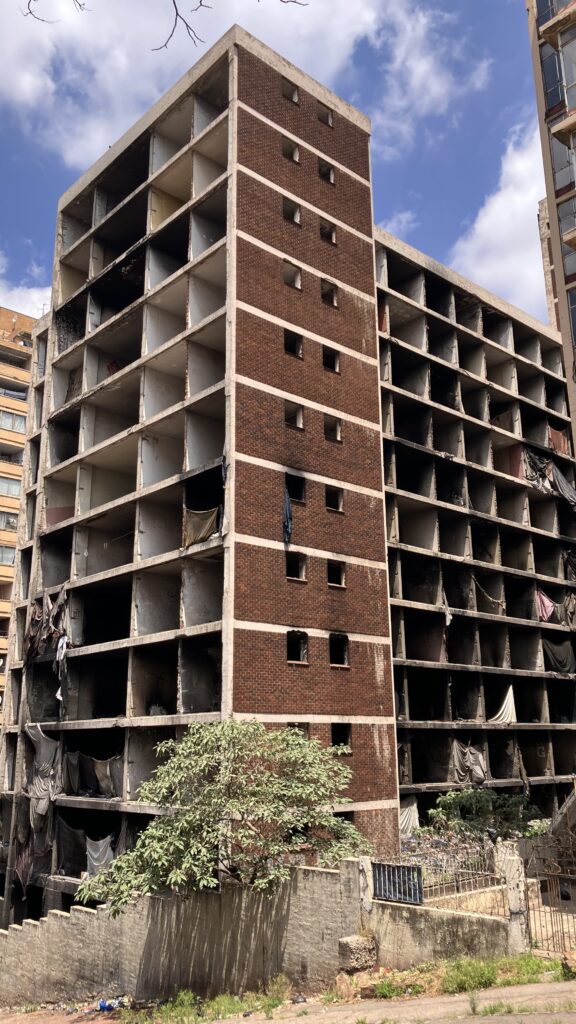
homeless people who sleep here must pay monthly fees to those gangs.
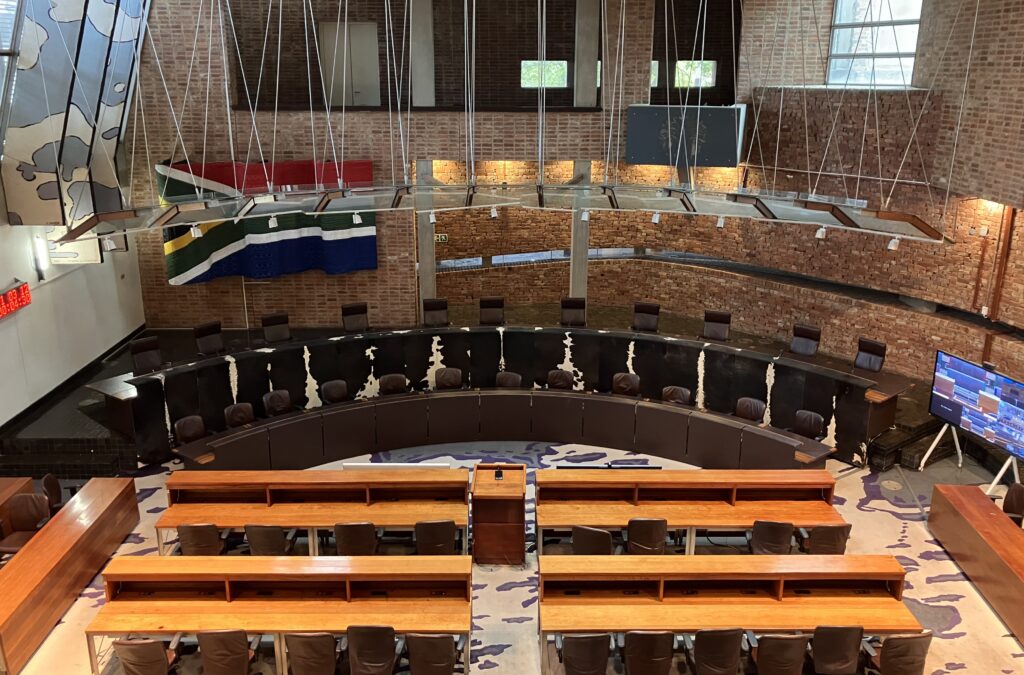

advocating solidarity with Palestinians suffering human rights abuses.
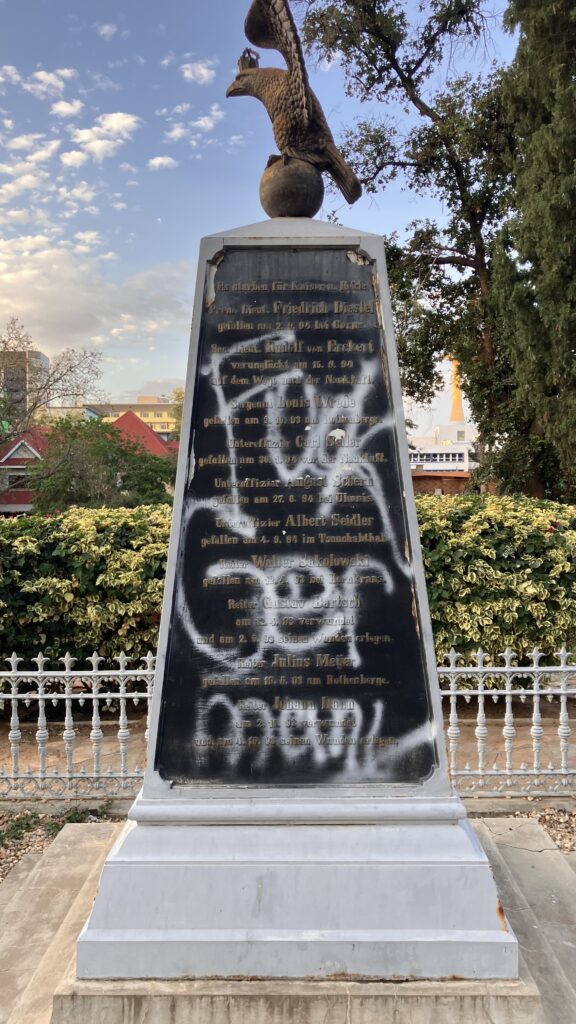
rule. It bore the protest words, like “F*ck Germany” “Rest in Hell”.