I am currently affiliated as a visiting researcher with the Jena Center for Reconciliation Studies (JCRS) at Friedrich Schiller University Jena, as part of the early-career researcher development program of the International Reconciliation Studies Project. In this short essay, I would like to briefly introduce my experiences during the approximately two months since I began my stay in Jena.
Thanks to the generous support of Professor Martin Leiner, my host scholar, and Dr. Laura Villanueva, who leads seminars on reconciliation studies, the research environment was well prepared in advance, allowing me to begin my work immediately upon arrival in Jena.
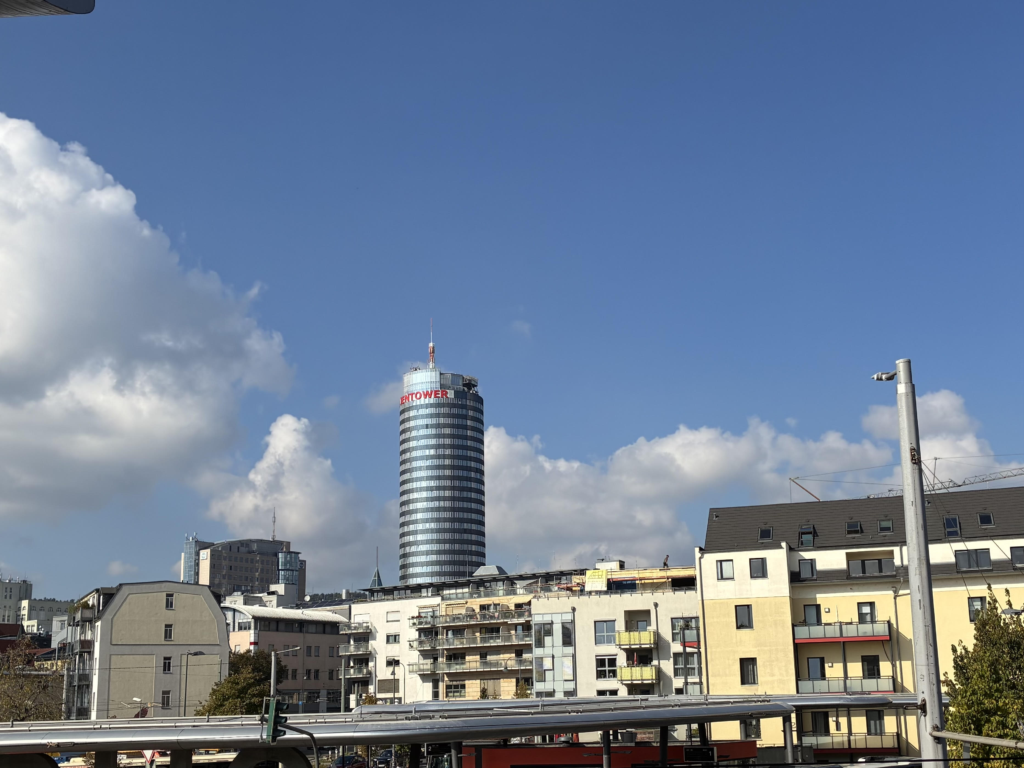
Jena is a small city where multiple libraries and university facilities are concentrated within close proximity, making it an exceptionally conducive environment for research. The JCRS office is located in the Jentower at the center of the city, and visiting researchers are provided with flexible desk space. As a result, I conduct my research there almost every weekday. JCRS brings together a wide range of researchers, from those with academic backgrounds in philosophy and theology to those working in more practice-oriented disciplines. All of them actively engage with discussions from other fields. In this sense, the research environment at JCRS truly embodies the interdisciplinarity demanded by the topic of “reconciliation.”
Since arriving in Jena, I have primarily begun research tracing the philosophical genealogy of violence (and its critique). More specifically, by reading thinkers such as Walter Benjamin and Frantz Fanon, through to Slavoj Žižek, Judith Butler, Achille Mbembe, and Naoki Sakai, I have started to examine the importance of “resistance” in processes of reconciliation between minorities and majorities. This line of inquiry stems from the fact that the exclusion and oppression of minorities tend to be denied, whether consciously or unconsciously. In such circumstances—where even the need for reconciliation itself is not recognized—“causing trouble” and making visible the existence and location of problems becomes a necessary condition for the possibility of reconciliation.
Through this research, as well as through seminars, lecture series, and discussions in the JCRS office (described below), I have reaffirmed that while the inclusion of minorities in existing institutionalized spaces of speech and dialogue is indeed important for the restoration of their rights, these very spaces often harbor unconscious—or structural—forms of oppression and exclusion. I have therefore begun to consider whether the process of reconciliation requires a radical reexamination of the dominant social norms that permeate even these forums of dialogue themselves.
Although this research is still in its early stages, I had the opportunity to present my work at the 1st Reconciliation Week held in late November, where I received a great deal of feedback. This response allowed me to reconfirm the significance of the issues outlined above.
In addition, I participate approximately four to five times per month in reconciliation studies seminars led by Dr. Laura Villanueva. These seminars cover not only the general issues addressed by reconciliation studies and the relevant existing scholarship, but also a wide range of topics including Dr. Villanueva’s own work on the Colombian context.
Furthermore, every Thursday, JCRS hosts a public lecture series on reconciliation. Each week, scholars from various disciplines—such as political science, history, and philosophy—give presentations on reconciliation, allowing participants to continually encounter new perspectives.
In these ways, my stay at JCRS has become an invaluable experience in my academic life. I hope to continue learning a great deal from my time in Jena.