

Satoru MIYAMOTO (Seigakuin University)
At 22:28 on December 3, 2024, a state of emergency martial law was proclaimed. Until that moment, there had been no apparent signs forewarning such a move. As it was already late at night, people did not immediately gather in front of the National Assembly. However, when Lee Jae-myung, the leader of the opposition, called on his supporters via YouTube from inside a taxi to assemble at the National Assembly, people began to gather shortly after 23:00. At 23:04, the entrances to the National Assembly were closed, and from that point onward, entry and exit became impossible without presenting official identification, even for National Assembly members, parliamentary staff, and media personnel. At 23:37, the entrances were completely sealed, and access to the National Assembly grounds from the gates was no longer permitted.
At 23:48, military units began entering the National Assembly compound by helicopter. By that time, National Assembly members had also begun to assemble. At 01:01 on December 4, the National Assembly passed a resolution demanding the lifting of martial law. In response, the military units began to withdraw. It was announced at 05:04 that the Cabinet had approved the motion to lift the state of emergency martial law at 04:30, and the martial law was formally lifted.
Why, then, was this state of emergency martial law declared? This remains unclear. While the proclamation of martial law itself was sudden, the president and the National Assembly had long been locked in repeated confrontation prior to this event. The National Assembly had consecutively passed impeachment motions against senior government officials, while the president had repeatedly vetoed bills adopted by the Assembly. This pattern of mutual obstruction can be described as a series of political “harassments.” The declaration of martial law may have been intended as yet another such maneuver; however, it went beyond the antagonism between the president and the National Assembly and instead generated widespread social turmoil.
This state of emergency martial law constitutes an important political event, but it is also merely one point within the broader trajectory of confrontation between the president and the National Assembly. When political events are analyzed as isolated points, abstracted from temporal continuity, subsequent developments become difficult to anticipate. Such point-based analysis is referred to as static analysis, with Zeno’s paradox being a well-known example. In reality, time never ceases to flow. Political events are continuations of preceding processes and inevitably extend into subsequent developments. An approach that understands time as a continuous flow is known as dynamic analysis. From this perspective, even after the lifting of martial law, social disorder was bound to persist. Indeed, following the termination of the emergency martial law, South Korean politics and society fell into even greater confusion. The term “democracy” seems almost grotesquely ironic in describing the situation.
The Yoon Suk-yeol administration, established through the 2022 presidential election, represents a divided government in which the president’s party and the party controlling the National Assembly differ. Consequently, confrontation between the president and the legislature is structurally embedded. In South Korea, the People Power Party, to which the president belongs, is regarded as a conservative force, while the Democratic Party of Korea, which holds a majority in the National Assembly, is considered progressive. Conservative forces enjoy strong support in the Gyeongsang region in southeastern Korea, whereas progressive forces draw their support primarily from the Jeolla region in the southwest. This regional polarization was clearly manifested in the 2022 presidential election.
A South Korean journalist once jokingly remarked to me that the Korean Peninsula has entered a “New Three Kingdoms Period.” The original Three Kingdoms period refers to ancient times when numerous small polities competed for dominance, with Silla and Baekje surviving as territorial states, while Goguryeo expanded southward from the northern part of the peninsula. According to this tongue-in-cheek analogy, some 1,400 years later, Goguryeo has become North Korea, Silla has become the ruling People Power Party, and Baekje has become the opposition Democratic Party of Korea. Indeed, Silla had its capital in what is now Gyeongsang Province, and Baekje had its capital in present-day Jeolla Province. In this sense, the geographical bases of political support appear to align remarkably well with the notion of a “New Three Kingdoms Period,” although, of course, there is no academic basis for such a comparison.
Nevertheless, just as Goguryeo, Silla, and Baekje each possessed distinct founding myths, the conservative People Power Party and the progressive Democratic Party of Korea ground the legitimacy of democracy in fundamentally different historical origins. Conservative forces locate the origin of democracy in the May 10, 1948 election for the Constituent Assembly, conducted immediately prior to the establishment of the state, and derive democratic legitimacy from this narrative of state founding. Progressive forces, by contrast, locate the origin of democracy in the Gwangju Uprising of May 1980 and derive legitimacy from a democratization narrative rooted in popular resistance. In this respect, the two camps resemble separate states founded upon different myths of origin. Before even speaking of inter-Korean unification, South Korea has yet to achieve domestic unity. It remains far from domestic reconciliation.
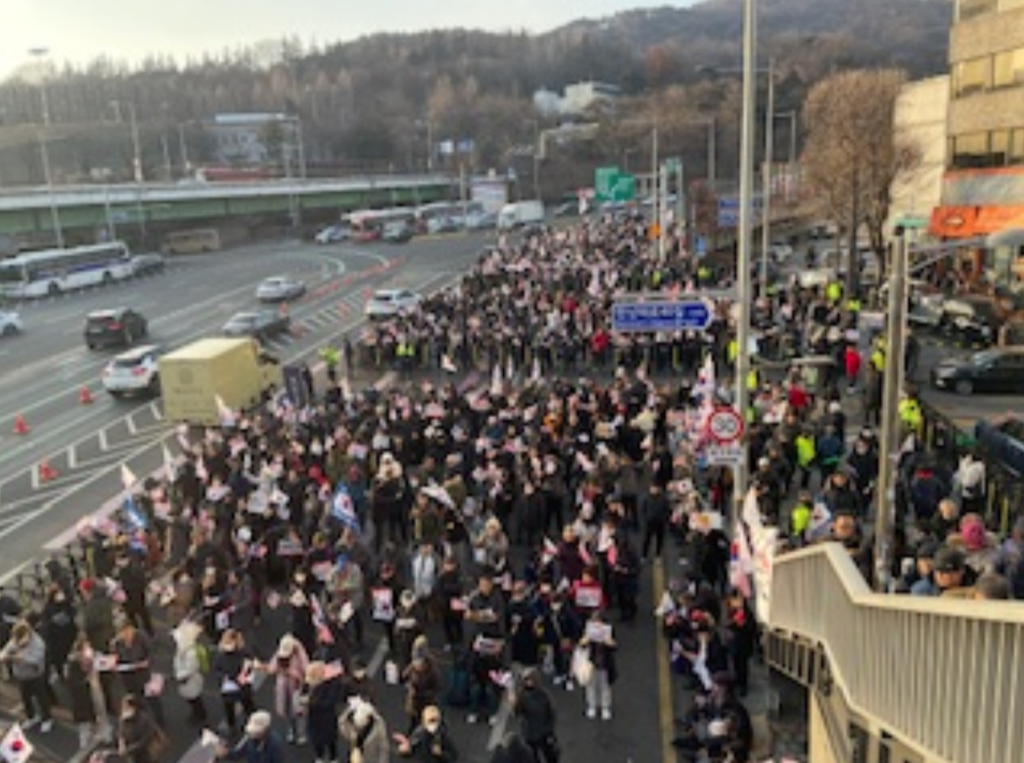
(Photograph by the author, January 1, 2025)
The mutual denunciations exchanged between conservatives and progressives are themselves deeply unbecoming. The president accuses the National Assembly of dictatorship, while opposition lawmakers in the Assembly label the president a dictator. In contemporary South Korea, the term “dictatorship” has lost any substantive meaning and has been reduced to a mere insult hurled at one’s political adversaries. Both the president and members of the National Assembly are elected through democratic elections and implement policies through established legal procedures; under such conditions, it is difficult to describe either as a dictatorship. The opposition condemns the declaration of emergency martial law as unconstitutional, while the presidential side retorts that it falls within the constitutional powers of the president. Observing this exchange, one is compelled to conclude that it is no longer law that governs South Korean society, but rather accusation and violence.
Moreover, both conservative and progressive forces are utterly convinced of the righteousness of their own cause. The justice of law is nowhere to be found. Yet there is no greater evil than the conviction of one’s own righteousness. No creature is more cruel, despicable, or grotesque than a human being who believes himself to be just. Killing one’s enemies becomes a source of pride; the destruction of property becomes an object of boastfulness. Political leaders incite the masses by appealing to “justice,” urging them into the streets, while simultaneously taking pleasure in the belief that their own justice is validated by the sheer number of supporters. President Yoon Suk-yeol, who barricaded himself inside the presidential residence and refused arrest, may well exemplify this phenomenon. For the masses, complex and demanding democratic deliberation is incomprehensible; violence and shouting become their primary texts. In South Korea, where such mass actions are celebrated as expressions of democracy, it appears as though democracy is believed to be something that can only be won through harming others and destroying property. From this perspective, the attack on the Seoul Western District Court by demonstrators in the early hours of January 19, 2025 was an inevitable outcome. For the masses, such behavior has even come to resemble a form of fashion.
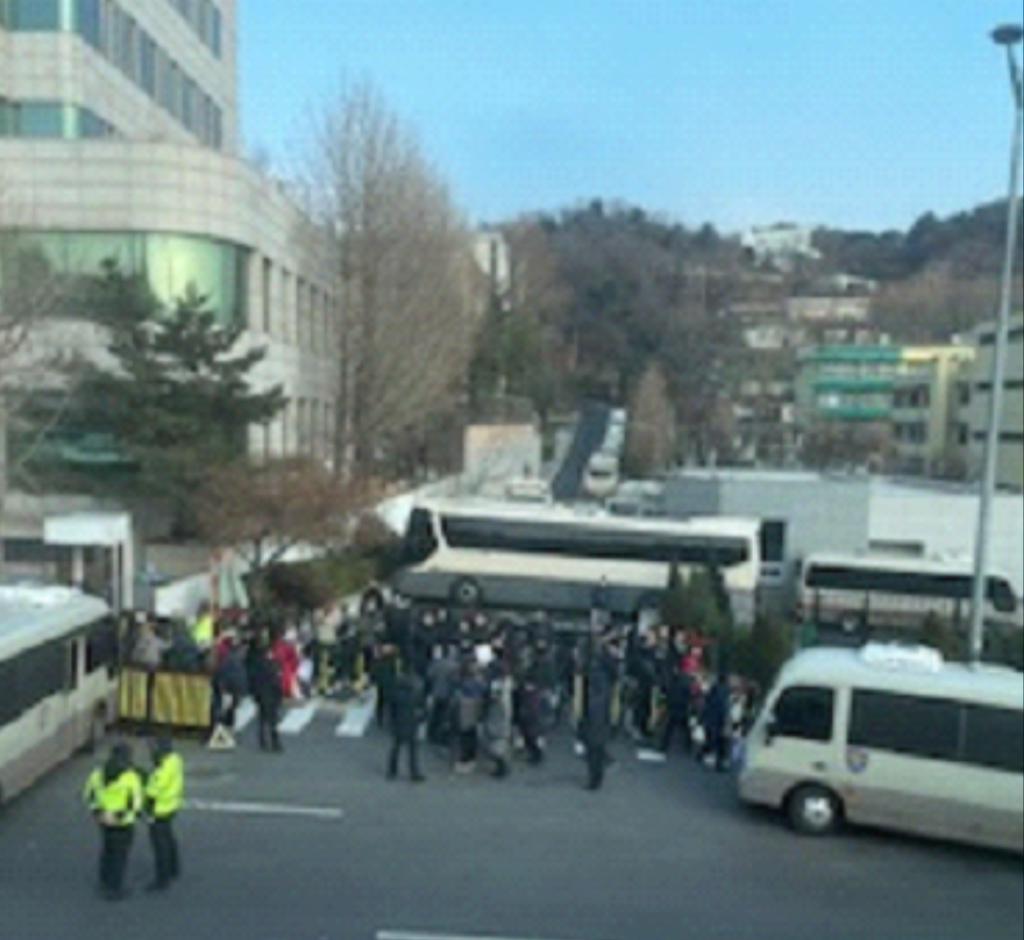
(Photograph by the author, January 12, 2025)
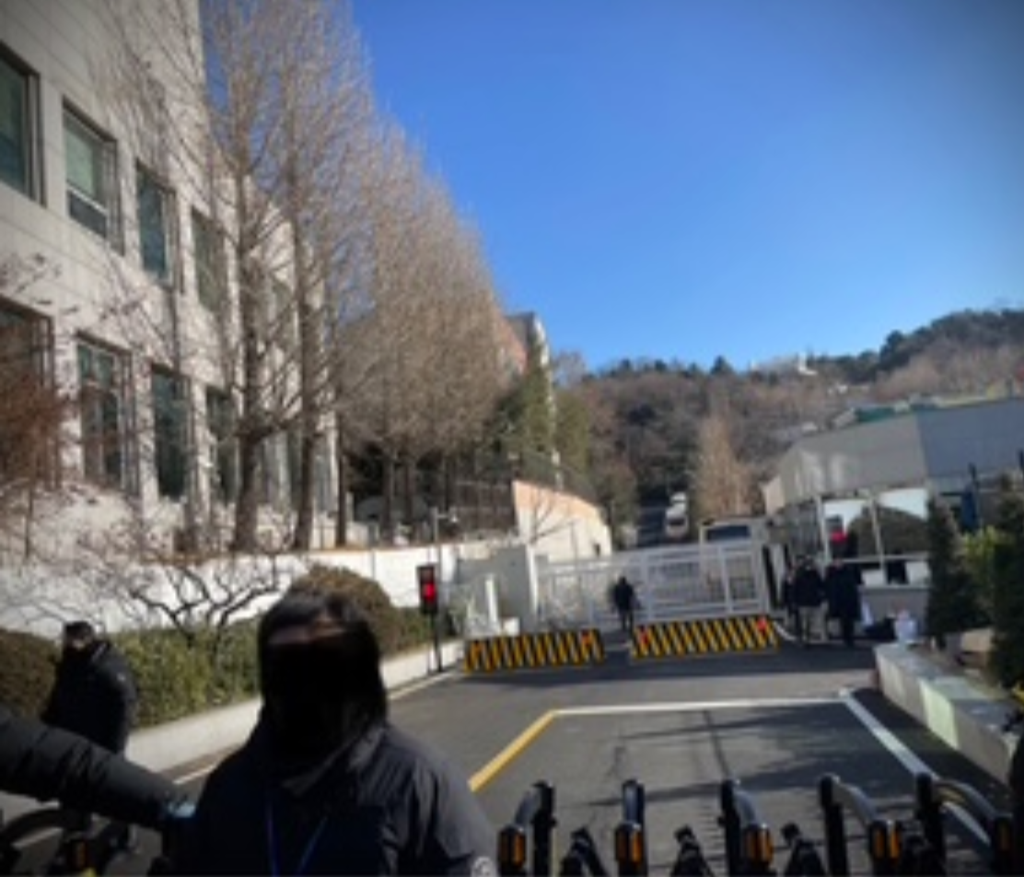
(Photograph by the author, January 15, 2025)
A retired senior South Korean politician, observing the recent clashes between supporters of the president and those of the National Assembly, lamented what he described as a profound absence of intellectual capacity. His remarks can be summarized as follows.
They speak of “conservatism” and “progressivism,” yet they have made no effort to study what conservatism or progressivism actually seeks to achieve. Their sole objective is to hurl vulgar insults at their opponents, inflame hatred, and ultimately destroy the other side. How many among them have seriously studied Marxism–Leninism? How many have engaged with modern economic theory? They act not on the basis of intellect, but of emotion; they are beasts driven by instinct rather than reason.
On December 7, President Yoon Suk-yeol offered an explanation for the declaration of emergency martial law that appeared to accept YouTube-based fake news at face value. Lee Jae-myung, the leader of the Democratic Party of Korea, and President Yoon alike seem unable to disengage from YouTube. This, in itself, appears to demonstrate the extent to which popular anti-intellectualism has spread throughout South Korean society.
“The foolish learn from experience, the wise learn from history,” a saying attributed to Otto von Bismarck, former Chancellor of the German Empire, is often invoked. Yet in South Korea, those who loudly invoke “history” are not learning from it; rather, they are instrumentalizing history to legitimize their own sense of justice. Conservative forces locate the origin of democracy in the founding of the state, while progressive forces ground democratic legitimacy in a narrative of democratization that begins with the Gwangju Uprising. Each side treats its preferred historical narrative as the sole foundation of justice. The reason contemporary South Korea appears divided as though it were two separate countries lies precisely in this dynamic. Both camps have mobilized the history of democratization to justify their own righteousness and have sought to demonstrate that righteousness through force in the streets. The South Korean public did not defend democracy. Conservatives and progressives alike sought only to defend their own versions of justice, merely hoisting democracy as a banner. The consequence has been the emergence of a political and social condition in which even domestic reconciliation remains unattainable.