It has now been five months since I began my research stay at the Jena Center for Reconciliation Studies (JCRS) at Friedrich Schiller University Jena, and the autumn–winter semester has just come to an end. The various academic activities I have been continuously engaged in since my arrival—such as the reconciliation studies seminar led by Dr. Laura Villanueva, the weekly lecture series organized by JCRS, and an interdisciplinary seminar in religious education and geography that I have been allowed to join externally—have all reached a natural pause. Through these seminars, I have been able to gain a wide range of insights across disciplinary boundaries.
In particular, Dr. Villanueva’s seminar provided an in-depth understanding of the history of reconciliation studies as a discipline, its relationship to adjacent fields, and various case studies in which reconciliation has been—or continues to be—a central issue. Under her supervision, I am currently writing a paper on reconciliation studies, which is now close to completion. It is fair to say that this paper would not have been conceivable without the extensive background knowledge I acquired through the aforementioned seminars.
Although I will refrain from discussing the details prior to publication, the paper attempts the following: within reconciliation studies, there is a self-reflexive concern regarding how the term “reconciliation” might obscure existing structural asymmetries. Taking this concern as a starting point, my paper engages with the critique of nationalism by Naoki Sakai, a historian of Japanese intellectual history who works on postcolonial issues in Japan, as well as Achille Mbembe’s concept of “borderization,” through which he reconstructs political philosophy from the perspective of colonial critique and decolonization. By using these frameworks, I examine how the division between “us” and “those who are not us” is constructed by so-called First World nation-states, accompanied by the exercise of exclusionary violence by the former against the latter. Drawing inspiration from Mbembe, I conceptualize this process as “borderization,” and analyze the mechanisms through which such exclusionary violence is justified and rendered exempt from accountability. By considering both the imaginary and material dimensions of this division, I believe the paper develops a provocative and meaningful argument.
My academic background, from my undergraduate thesis through my doctoral studies, has primarily focused on modern Japanese philosophy, especially the work of Nishida Kitarō. While I have occasionally incorporated perspectives from contemporary political philosophy, critical theory, and postcolonial theory into my work on Japanese philosophy, I had never written a paper that centrally engaged with these theoretical frameworks themselves. For this reason, writing the present paper has been a significant challenge. However, through my research activities at JCRS—not only participation in the seminars mentioned above, but also interactions with fellow researchers and participation in academic conferences as discussed below—I feel that I have been able to break out of my previous intellectual framework and produce this work.
Taking advantage of my residence in Germany, I have participated not only in seminars and events at JCRS and Friedrich Schiller University Jena, but also in academic conferences and events held elsewhere in Europe. I would like to briefly describe these experiences below.
The first conference I attended during this research stay was the Annual Conference of the Association of Social Science Japan Studies 2025, held at the University of Vienna from November 7 to 9, 2025. The theme of this year’s conference was “(Un)Democratic Futures: Japan and the Global Trajectories towards an (Un)Equal World.” Although the conference primarily focuses on social scientific approaches to Japan, participants’ concerns were not confined to “Japan studies” in a narrow sense. Rather, while focusing on Japan, many presentations addressed the global crisis of democracy. In addition to empirical sociological and historical approaches, there were also presentations grounded in political and social theory, allowing for rich interdisciplinary discussions. The topics themselves ranged widely, including issues such as Japanese nationalism and gender inequality, making the conference particularly stimulating.
A common challenge faced by researchers abroad is the potential loss of connection with academic communities in Japan. However, since this conference focuses on Japan studies, it brought together prominent scholars from Japan, enabling interaction not only with European researchers but also with Japanese scholars. Moreover, opportunities to engage with such scholars are often limited even within philosophical conferences in Japan, making this conference particularly valuable for building transnational research networks spanning Japan and Europe.
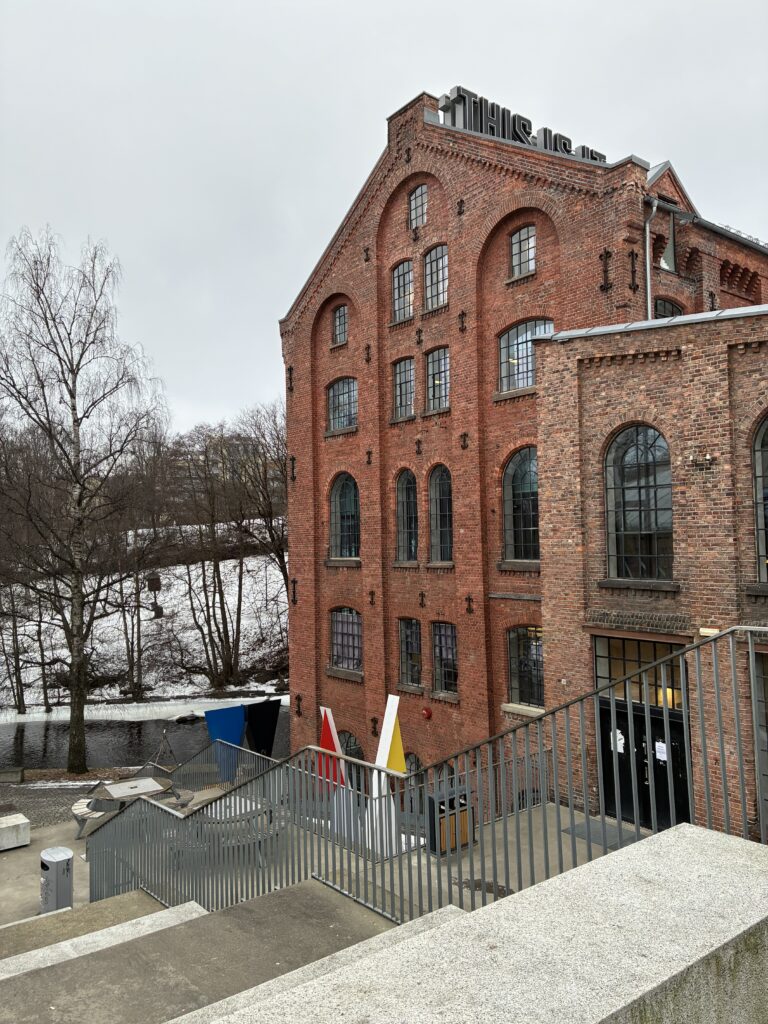
Another event I attended was the Artistic Research Week 2026: Spaces to Remember – Times to Reconcile, held at the Oslo National Academy of the Arts from January 20 to 23, 2026. This event featured a lecture by the internationally renowned anthropologist Tim Ingold, as well as presentations by artists engaged in artistic and political practices in places such as Gaza and Cairo, and practitioners working from anarchist perspectives to support refugees. These experiences were highly stimulating. Particularly memorable was a panel on “anger” by textile researchers on the final day. This panel emphasized not only the negative aspects of anger—such as its potential to lead to violence and destruction—but also its positive and creative dimensions, such as its capacity to reveal structural inequalities, identify problems, and articulate needs. This perspective seems closely related to the concern mentioned earlier: that the term “reconciliation” may obscure structural asymmetries. In this way, the discussions at this event offered significant intellectual insights.
Looking ahead, I intend to continue actively participating not only in seminars and events at JCRS but also in other academic conferences, in order to further deepen my knowledge and broaden my perspectives.
※Translated by Chat GPT (Original Language: Japanese)