The Association for Asian Studies (AAS) 2026 Annual Conference was held in Vancouver, Canada, from March 12 to 15, 2026. This conference, consisting of several hundred panels and a wide range of related events addressing various aspects of Asia, represents one of the most prominent international academic gatherings in the field. Having the opportunity to participate in this conference was an exceptionally stimulating and intellectually rewarding experience for an early-career researcher, providing numerous valuable insights.
The panel in which I participated as a presenter was entitled “Reframing and Remembering the Past: State Diplomacy, Private Donations, and UNESCO Disputes in Japan–Korea Cultural Heritage Relations.” The session was chaired by Professor Toyomi Asano, the principal investigator of our project. The presenters included Professor Yuko Nagasawa, a leading scholar of Korean-related cultural property issues and the organizer of the panel, Professor Jihon Kim, who has been actively engaged with the Korean National Commission for UNESCO, and myself. The panel also welcomed Professor Elif Kalaycioglu, widely recognized in the fields of international politics and heritage studies, as the discussant. While it would be desirable to introduce the details of each presentation and the subsequent discussion, the present report focuses primarily on my own presentation and the related question-and-answer session.
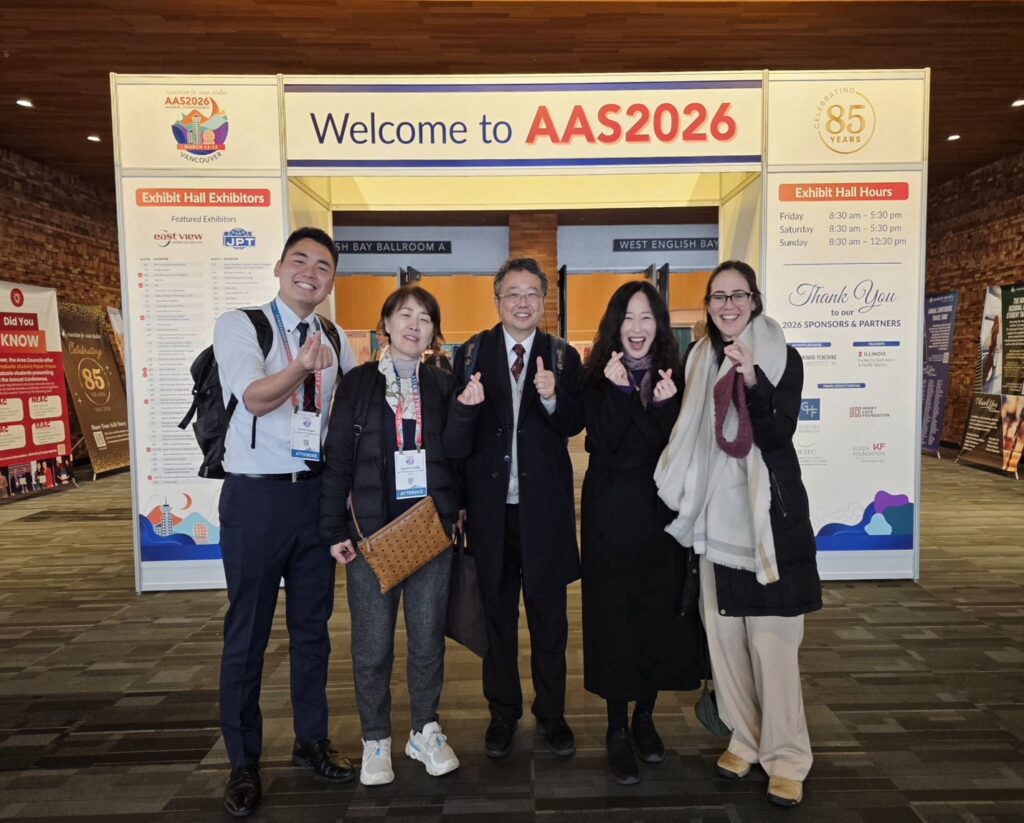
Ikegami, Dr. Yuko Nagasawa, Prof. Toyomi Asano, Dr. Jihon Kim, and Prof. Elif Kalaycioglu
My presentation was entitled “Public Concern in the Japan–South Korea Cultural Property Issue: Conditions of ‘Problematization’ in Media Discourse.” In my research, the “Japan–South Korea cultural property issue,” in its narrow sense, refers to cultural objects that were brought from the Korean Peninsula to Japan during the colonial period, remain in Japan today, and are subject to demands for repatriation to their country of origin. Cultural property is not merely an object of individual appreciation; rather, it becomes meaningful only when collective value is attributed to it. In this sense, it is fundamentally social-constructivist in nature. Based on this premise, my research examines the Japan–South Korea cultural property issue through the dynamics that constitute the respective “imagined communities” of Japan and South Korea.
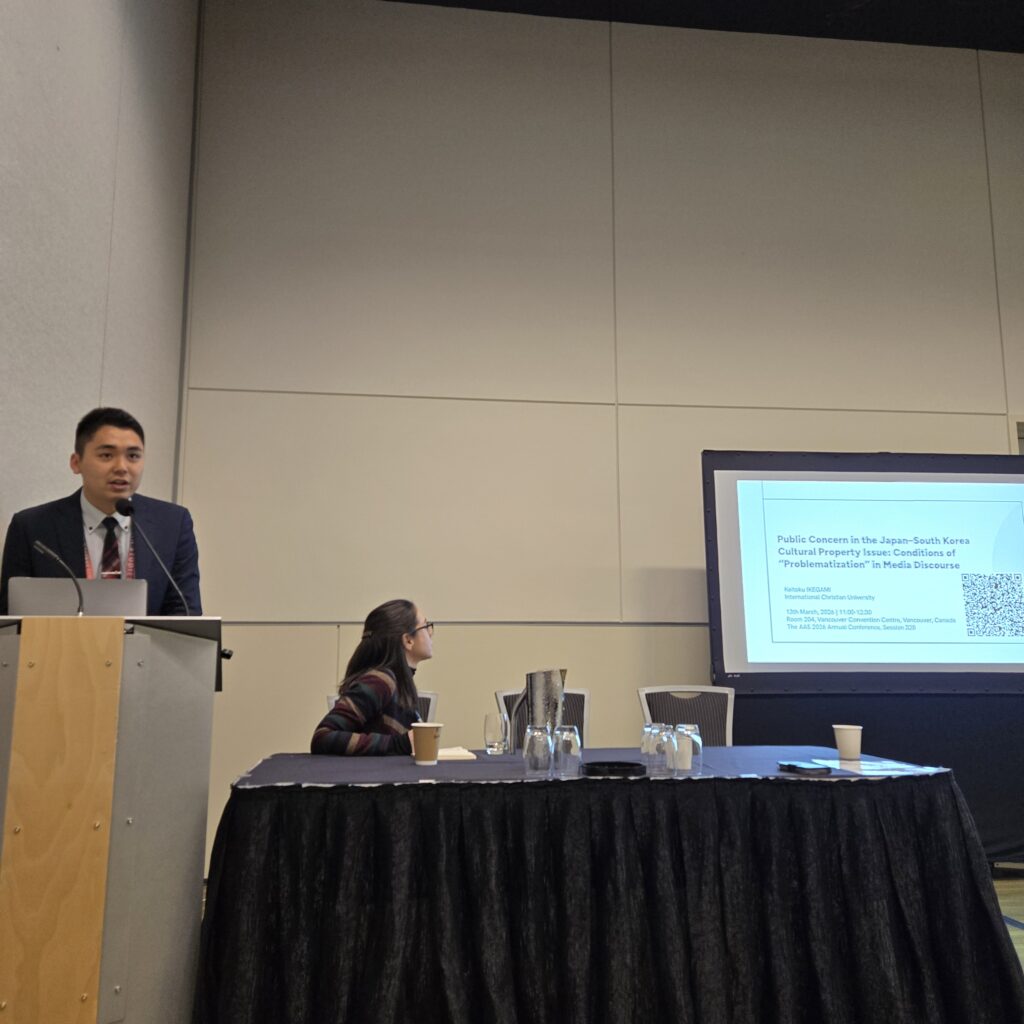
In this presentation, I conducted a comparative analysis of two cases: the Ogura Collection and the Tsushima Buddha statue. Through this comparison, I examined how particular cultural properties emerge as public issues in Japan and South Korea, and under what conditions such problematization occurs. The former case concerns a collection encompassing cultural objects from antiquity to the modern period, which were transported to Japan during the colonial era and are currently housed at the Tokyo National Museum. The latter concerns a Buddhist statue produced on the Korean Peninsula during the medieval period, transported to Japan in the early modern era, and subsequently used within religious practice at a Japanese temple.
The central argument of my presentation was that the manner in which these two cases became public issues within Japanese and South Korean public opinion is closely linked to the national discourses and collective memories that sustain the respective imagined communities of the two countries. In the case of the Ogura Collection, the issue is represented as a matter of significant national concern in South Korea, where efforts to address the “negative heritage” associated with colonial rule remain a major societal priority. In contrast, in Japan—where historical interpretations emphasizing the positive aspects of modernity often prevail, and where the colonial dimension associated with modernization is frequently rendered less visible—the issue has received relatively limited public attention.
In the case of the Tsushima Buddha statue, however, a different pattern emerged. In Japan, where adherence to international law and the maintenance of a reputation as a responsible member of the international community constitute an important aspect of national self-understanding, a certain degree of public momentum in favor of returning the statue became visible. In South Korea, by contrast, public opinion was sharply divided regarding the legitimacy of its return. One position emphasized compliance with international law and supported repatriation, while another regarded the statue’s historical removal as an unjust act associated with wakō piracy in the early modern period, further linking the issue to the broader historical experience of modern colonial rule and opposing its return.
These observations demonstrate that cultural property issues may emerge in different forms. In some cases, such as the Ogura Collection, they appear as conflicts between nation-states—that is, as confrontations between the dynamics that constitute each collective entity. In other cases, such as the Tsushima Buddha statue, they manifest as conflicts within a nation-state, involving contestation over the very foundations that sustain the collective itself. This finding illustrates how cultural property functions as a medium through which otherwise invisible national values and collective memories within imagined communities are materialized and made visible. Accordingly, if reconciliation between Japan and South Korea is to be seriously considered, it is of great importance to analyze cultural property issues from this perspective.
Professor Kalaycioglu, serving as discussant, raised several important questions. The first concerned the fundamental issue of how reconciliation should be defined, particularly in relation to justice. Reconciliation is often contrasted with justice, and their relationship is frequently understood as inherently contradictory. Borrowing Professor Asano’s formulation, reconciliation may be understood as a process that produces a certain degree of social order—what might be described as a form of “predictability for the future”—a process that inevitably involves some degree of restraint in the pursuit of justice. History has repeatedly demonstrated that the pursuit of justice has brought about major social transformations, and therefore the relationship between justice and reconciliation cannot be resolved easily. The Japan–South Korea cultural property issue is likewise frequently framed within the context of pursuing justice and has been actively advanced through real-world activism. In this respect, the question raised regarding the definition of reconciliation in relation to justice provided both a critical and constructive perspective that will significantly inform the further development of my research.
Within the International Reconciliation Studies Project, reconciliation is conceptualized across three levels: intergovernmental reconciliation, reconciliation between nations (peoples), and reconciliation among citizens. Particular emphasis is placed on reconciliation between nations, understood as the process through which the underlying dynamics that constitute national communities undergo reciprocal transformation within states that have been in conflict. Reconciliation, therefore, does not simply refer to the superficial resolution of disputes or the implementation of friendly policies. Although the concept of justice maintains a strong normative status, its specific meaning may change across time and space. In the conception of reconciliation employed in this research, the meaning of justice itself is understood as potentially subject to transformation. The coexistence of multiple forms of justice, and the recognition of their fluid and evolving nature, constitutes a distinctive feature of this conceptual framework.
Professor Kalaycioglu also raised the question of how local-level reconciliation cases should be evaluated. In the Tsushima Buddha case discussed in this presentation, Japanese and Korean temples that had initially been in sharp conflict gradually developed a more conciliatory relationship through several years of dialogue and negotiation. Ultimately, the Japanese temple permitted religious ceremonies in Korea involving the statue, and after the statue’s return, a replica was provided—demonstrating the emergence of reconciliation-oriented practices at the local level. However, when evaluated from the national-level perspective that constitutes the primary focus of this presentation, the impact of such local reconciliation practices remained limited in the context of reconciliation between nations.
First, the developments did not exert sufficient influence to transform public opinion in either Japan or South Korea; that is, local-level practices did not translate into national-level transformation. This does not imply an insurmountable divide between local and national dimensions. Rather, it suggests that local-level reconciliation may still influence national discourse if appropriately connected to broader public narratives. This raises an important question: under what conditions can local-level reconciliation exert influence at the national level? Second, although conciliatory relationships were established at the level of practice between the temples, the underlying perceptions of the statue and associated historical understandings remained unchanged. From a perspective that defines reconciliation as reciprocal transformation among actors, it is therefore difficult to conclude that full reconciliation had been achieved in this case. This observation indicates that legal and political outcomes do not necessarily lead to changes in historical consciousness. Precisely for this reason, attention to transformations in individual and collective historical narratives remains of central importance.
Although numerous additional questions and comments were raised during the discussion, limitations of space prevent their full introduction here. Nevertheless, they were highly stimulating and provided valuable guidance for the further development of my research. Finally, participation in this conference proved highly beneficial not only for intellectual development but also for the formation of international research networks. The panel brought together scholars with whom opportunities for interaction within Japan are relatively limited, and several receptions were held in the evenings. In particular, the Graduate Student Reception on March 12 provided an opportunity to engage with early-career researchers from diverse international and interdisciplinary backgrounds, enabling the establishment of new research networks. On a personal level, as I am planning a future research stay in South Korea, this occasion also allowed me to meet colleagues who may provide support during my time there and to obtain valuable practical information. I would therefore like to conclude by expressing my sincere gratitude to Professor Toyomi Asano, principal investigator of the International Reconciliation Studies Project, and to all those who made this invaluable opportunity possible.