Hisashi Shigematsu
(Research Fellow CPD, Japan Society for the Promotion of Science;
Partnership Associate Professor, Vytautas Magnus University;
Researcher, Meiji Gakuin University)
In the latter half of September 2025, I took part in a summer school held in Washington, D.C., and Arlington, Virginia. The program was conducted mainly at George Mason University’s Carter School for Peace and Conflict Resolution in Arlington, with portions held at the Embassy of Japan in the United States, the German Marshall Fund of the United States, and the National Museum of African American History and Culture. Because I have been conducting a long-term research stay in Lithuania, this summer school was my first opportunity to meet most of the project members in person and exchange views. I also met directly with stakeholders at the Carter School—an affiliated institution of our International Reconciliation Studies project—and discussed reconciliation studies and related topics. In addition, at the National Museum of African American History and Culture I had the good fortune to hear a number of valuable remarks from Professor Toshihiro Higuchi of Georgetown University and others.
During the first two days of the summer school, four professors from the Carter School led workshops. Here I would like to note the differences from the content of lectures at the previous year’s summer school held at the Jena Center for Reconciliation Studies (JCRS) at Friedrich Schiller University Jena. Given the nature of reconciliation studies, an interdisciplinary approach is inevitably required, and both at Jena and at the Carter School there was a shared emphasis on interdisciplinarity. At Jena, however, specific cases to be addressed were first set, and then interdisciplinary and practice-oriented approaches were examined in that sequence to solve those cases. By contrast, at the Carter School, several of the speakers addressed reconciliation from the vantage point of their particular disciplinary homes—such as education or philosophy. From a research perspective, undertaking research on the premise of practical contribution can introduce problems for scholarship (I discussed this in detail in my report on the previous year’s summer school). Therefore, I viewed positively the Carter School faculty’s stance of first grounding themselves in their own disciplines and then applying them interdisciplinarily.
The final two days of the summer school coincided with the Carter School’s Peace Week, within which our project members were given the opportunity to present. In my presentation, in connection with my research on historical memory in Central and Eastern Europe, I attempted a “taxonomy of taxonomies” concerning the forms of historical memory. Specifically, I argued that we should analytically separate two dimensions: the “content” dimension—what historical facts are emphasized—and the “form” dimension—whether multiple memories are permitted. Professor Karina Korostelina of the Carter School, who served as commentator, strongly agreed on the need to distinguish content and form, and further suggested organizing them in a two-dimensional, four-quadrant table with each as an axis. However, once multiple memories are permitted in terms of form, multiple contents necessarily come into being as well, so they can never be captured by locating that content somewhere within a two-dimensional, four-quadrant table. It was precisely because this is evident that I did not pursue such a schema, and thus Professor Korostelina’s suggestion, regrettably, was not one I could adopt. That said, upon reconsideration afterward, I realized that if I reorganized the framework using a stepladder tournament-style diagram, it would become clearer as a diagram. That realization, too, was made possible by the opportunity to present during Peace Week and to receive Professor Korostelina’s comments.
During this summer school I also visited the United States Holocaust Memorial Museum and the National Museum of African American History and Culture. I have visited the Holocaust Museum many times, so I did not gain anything particularly new there. At the National Museum of African American History and Culture, I asked Professor Toshihiro Higuchi about questions I had long held regarding slavery and the abolitionist movement in the United States, and thanks to his very careful explanations my perspective broadened. However, my time in the museum was short, and it was unfortunate that I could not see everything.
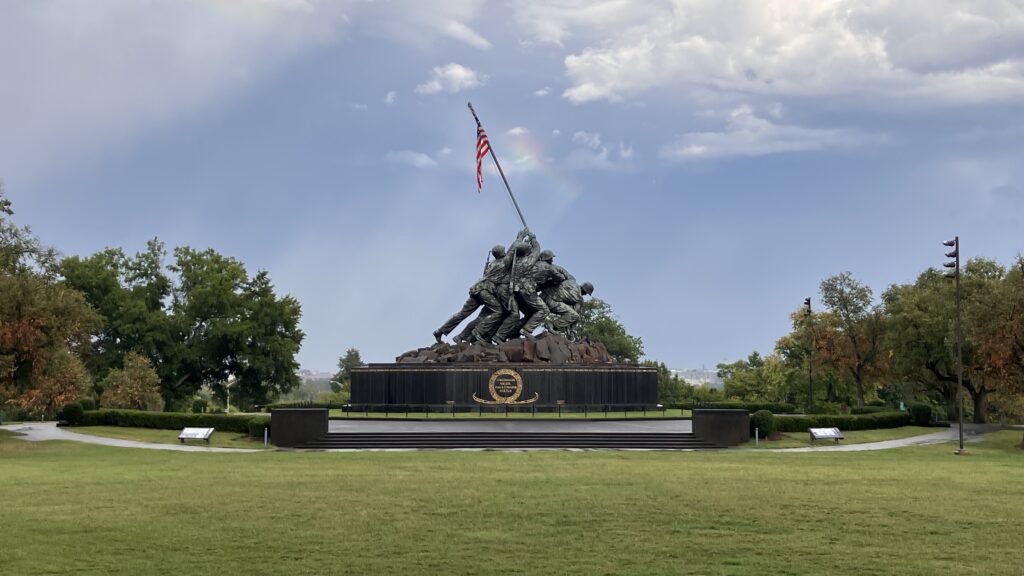
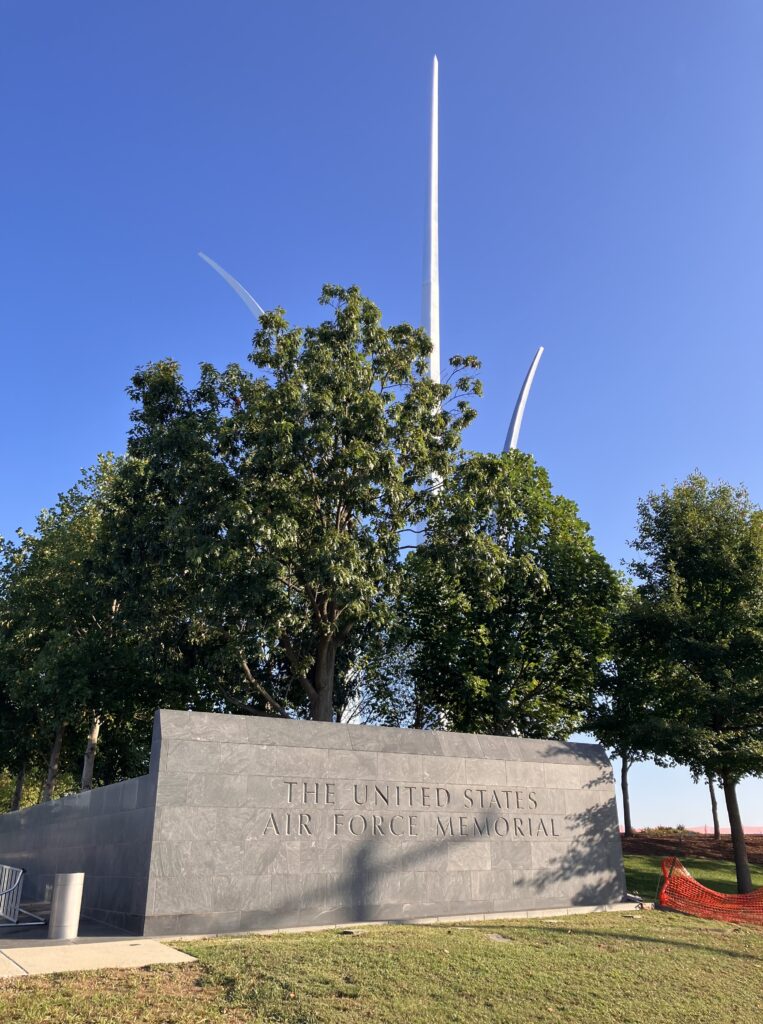
Washington, D.C.’s National Mall and Arlington National Cemetery contain a very large number of historical monuments. During my stay I visited as many as time allowed, and what struck me was the significant difference from Europe. The German-born historian George L. Mosse points out in his book Fallen Soldiers: Reshaping the Memory of the World Wars that, after the World War I, monuments to soldiers who died for their countries were built one after another in Germany and other European states. However, this served to heighten nationalism in each country and culminated in the World War II. For that reason, after the World War II the construction of such monuments did not advance (with Russia/the Soviet Union—celebrating victory in the “Great Patriotic War”—as an exception, where many monuments honoring the sacrifices of soldiers and civilians were erected). While seeing numerous monuments in Washington, D.C., and Arlington that honor the sacrifices of American soldiers in the World War II, the Korean War, the Vietnam War, and so forth, I was led to think that, compared with Europe, the situation in the United States with respect to historical memory resembles Russia’s. In particular, I felt that monuments concerning the World War II share many points of similarity with monuments found in Russia and the former socialist bloc. For those of us engaged in reconciliation studies, we ought to be self-aware that the role such monuments play in glorifying the war dead can further amplify nationalism and valorize the sacrifices of soldiers in the wars yet to come.