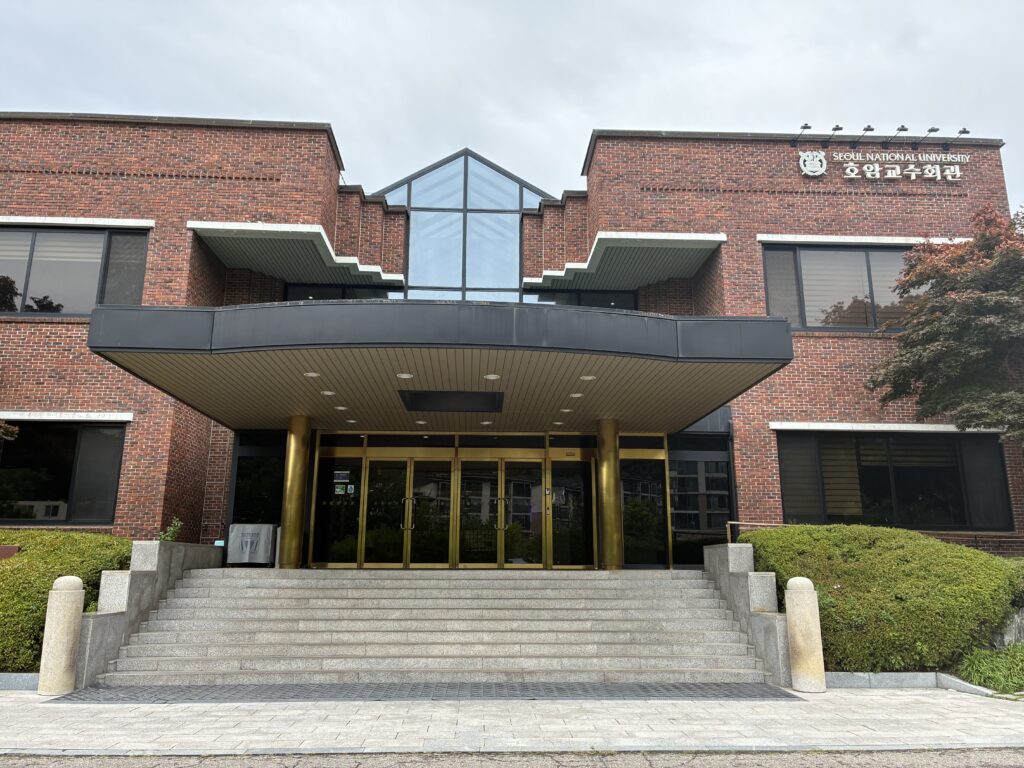
I participated in the 6th Annual Conference of the International Association for Reconciliation Studies, held in Seoul, South Korea, from July 14 to 18, 2025. The conference featured numerous stimulating presentations, in keeping with the subtitle “Bridging a Division.”
Given my background in philosophy, it was striking that the majority of participants were from other academic fields. As a result, I had the opportunity to meet many researchers for the first time and to encounter topics and research approaches that I had not previously engaged with. Moreover, during the breaks between sessions and the excursion program to the Korean Demilitarized Zone (DMZ), I enjoyed engaging discussions with such scholars, which proved to be highly stimulating. I sincerely hope that this conference will serve as a catalyst for continued interaction and the construction of a new research network.
My own presentation was held on the third day of the conference, July 16. It was part of a four-person panel titled “Framework of Reconciliation.” In my view, the panel primarily featured theoretically oriented presentations.
The title of my presentation was “The Contingency as the Condition of the (Im)possibility of Reconciliation: Contribution of Political Philosophy to Reconciliation Studies.” This was my first formal academic conference presentation since completing my doctoral program, and I took on the challenge of departing from my previous specialization in modern Japanese philosophy to examine “reconciliation” through the lens of postcolonial theory. Specifically, the presentation drew on the political philosophies of Naoki Sakai, a prominent postcolonial theorist in the field of Japanese intellectual history, and Judith Butler, a leading figure in feminist theory, to question the framework of the nation-state.
In doing so, the presentation addressed the questions: “What kind of practice should reconciliation be?” and “What are the conditions for such reconciliation?” While I must omit the finer details due to space constraints, the presentation ultimately argued that reconciliation must not be a pre-established harmonious practice, but rather an open-ended process that remains perpetually open to contingency.
The Q&A session lasted about 15 minutes and took place after all four presenters had completed their presentations. The format allowed each presenter to respond to a common question from their own perspective. This made for a refreshing and intellectually engaging exchange. Through this format, the differences in each presenter’s approach became more clearly discernible. In this regard, the conference offered not only insights into research content but also valuable lessons for organizing academic workshops in the future.
Having concluded the description of my own presentation, I would next like to briefly introduce a presentation that left a particularly strong impression on me. That presentation was delivered by Dr. Norihiko Tsuneishi, a member of Waseda University’s Project on International Reconciliation Studies. For a summary of the presentation, I would kindly refer readers to Dr. Tsuneishi’s own conference report. Here, I would like to highlight the aspects I found particularly intriguing from my perspective.
Dr. Tsuneishi’s presentation, entitled “Humorous Propensity: Trans-textural Reading of the Disabled, Encountered, and Unended in the Postcolonial World,” explored the theme of reconciliation through a trans-textual reading of several literary works. While Dr. Tsuneishi did not explicitly frame his argument in these terms, I interpreted his presentation as examining how dialogue, open to contingency, can lead to healing, recovery, and reconciliation—an approach that resonated deeply with my own presentation. Furthermore, Dr. Tsuneishi discussed the importance of the “body” in such dialogues, a point I also found compelling. This is because the body was precisely the topic I had to omit from my presentation due to space limitations. The Practices of reconciliation strongly involve people’s emotions and affects. Therefore, in thinking about reconciliation, it is essential to engage not only with the rational aspects of human beings but also with embodied affect. Following the presentations, we discussed during the break the possibility of organizing a panel together for next year’s IARS conference.
What I have described above represents only a small portion of the rich experiences I gained through my participation in the conference. Nevertheless, I hope it conveys just how meaningful this experience was for me.
Finally, I would like to express my deep gratitude to Professor Toyomi Asano and Dr. Hajime Onozaka, who led the members of the Waseda University’s Project on International Reconciliation Studies during the conference. I am also sincerely grateful to Dr, Hiroko Kawaguchi, who, despite not attending the conference herself, provided indispensable administrative support amid her busy schedule.