1.Introduction: Exploring the Diversity of Reconciliation
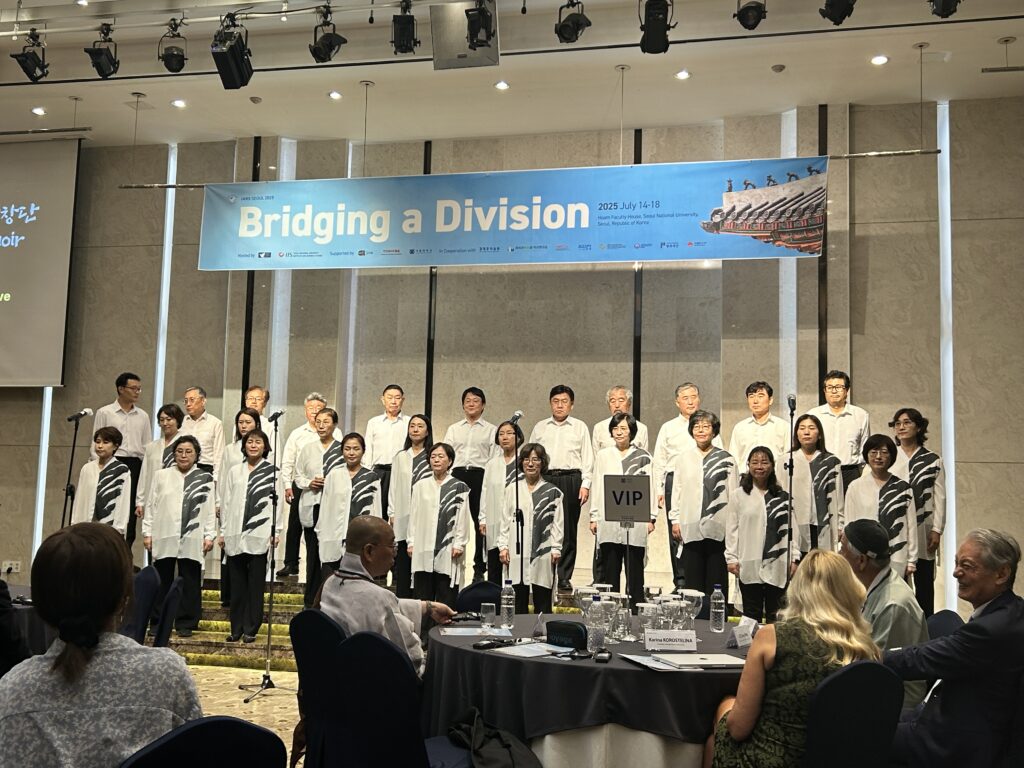
In July 2025, I had the opportunity to participate in the International Association for Reconciliation Studies (IARS) conference held in Seoul, South Korea, as a member of the International Reconciliation Research Project. The conference featured a wide range of presentations addressing reconciliation among various actors between nations, ethnic groups, and individuals, using diverse disciplinary approaches such as history, sociology, philosophy, and psychology. Engaging with these theoretical and practical approaches allowed me to recognize that reconciliation is not a fixed or settled framework, but rather a dynamic process that is still in the making. Through discussions with other scholars, I came to strongly feel the potential for reconciliation to develop as a distinct academic field of “reconciliation studies” with meaningful social implications.
What left a particularly strong impression on me was the keynote address delivered by Professor Lee Jong-won (Waseda University) during the opening ceremony. At the beginning of his talk, Professor Lee pointed out that in situations of deeply intractable problems (aporia), justice has often been neglected in favor of social compromise. He explained that conventional models of reconciliation have primarily taken the form of what might be called as “agreement-based reconciliation,” including moral reconciliation through apologies from perpetrators to victims, or reconciliation through the establishment of the rule of law and liberal institutional frameworks. However, he cautioned that these approaches often risk imposing certain values or forcing solutions.
As an alternative, Professor Lee proposed what can be called “process-oriented models of reconciliation,” such as agonistic reconciliation, which opens space for confrontation and deliberation with others, and interdependent reconciliation, which is grounded in the mutual recognition of parties as indispensable to each other.
He further noted that, in the post-Cold War era, the global spread of human rights norms has increased the need to incorporate previously marginalized people as equal members of political communities (i.e., the state), and that reconciliation has emerged as a critical agenda within this context. In such political processes, reconciliation is no longer a one-time agreement but rather a continuous process that unfolds through repeated acts of narrative and practice, constructing a shared sense of “we” between states, and between individuals. These arguments strongly resonated with the themes of my own research presentation, which I will discuss in the following sections.
2. Narratives of the Descendants of the Donghak Peasant War
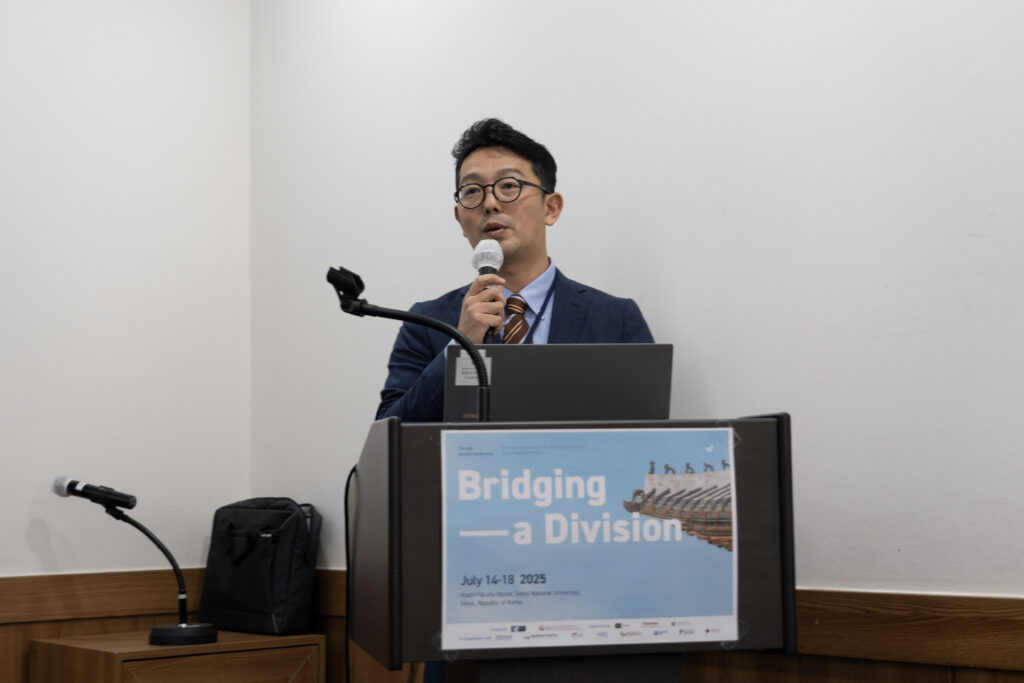
My research presentation, titled “The Struggle for Recognition and the Barriers to Reconciliation: The Donghak Peasant War Descendants in Post-Democratization Korea,” focuses on the continued public narratives of the descendants of the Donghak Peasant War in South Korea after democratization. The starting point of this study is a central question: why do the descendants continue to speak out, even after the state officially recognized the Donghak Peasant War as a legitimate struggle for justice and national sovereignty?
In the Donghak Peasant War of 1894, large numbers of peasants rose up against the ruling class and foreign domination. However, the uprising was brutally suppressed by the royal army and the Japanese military, resulting in many casualties. For a long time after the war, the participants were labeled as “rebels,” excluded from the official national narrative, and subjected to social marginalization. Gradually, however, from the 1960s onward, the Donghak movement underwent a process of reevaluation, and in 2004, a special law was enacted officially restoring the honor of the Donghak army and recognizing its legitimacy.
Nevertheless, the descendants have continued to insist that the meaning of their ancestors’ struggle be reaffirmed and publicly acknowledged by the government and society. I analyze this phenomenon from the perspective of competing national memories. National memory is not monolithic; rather, it is shaped dynamically through the intersection and sometimes the contestation of official, vernacular, and individual memories. Based on this framework, I hypothesized that the descendants’ narratives and the state’s official discourse regarding Donghak might be in tension or conflict.
However, upon examining testimonies collected from the 1990s through the 2020s, I found that the relationship between the state’s narrative and the descendants’ voices had shifted. Rather than exhibiting ongoing conflict, their narratives had gradually come to resonate with and reinforce each other. For example, the descendants’ earlier statements, such as “We are proud that our ancestors fought for justice,” had evolved into claims like “Donghak is the origin of Korean democracy,” showing a shift from familial pride to assertions of national legitimacy.
What is particularly notable is the near absence of direct references to perpetrators, such as the Joseon government forces, the ruling yangban class, or the Japanese military. The narratives largely lack elements such as demands for apology or the pursuit of accountability, thereby diverging from conventional models of reconciliation based on a victim–perpetrator dichotomy.
The descendants’ repeated assertions that their ancestors were on the side of justice and that they themselves are the rightful successors are not only demands for state recognition, but also acts of self-affirmation. Their continued narration serves as a repeated practice of verifying their own legitimacy: “We are allowed to speak,” “We deserve to be recognized by the nation.” In this sense, the descendants’ narratives do not merely seek external validation but also function as a way to position themselves within history.
Through concrete practices such as promoting historical education, collecting archival materials, and engaging in local community activities, the descendants actively seek to integrate the once-silenced memory of Donghak into the public sphere. These efforts suggest that reconciliation should not be seen as a one-time political agreement, but rather as a continuous process enacted through the repetition of testimony and narrative. In this light, the case offers theoretical and empirical insights into a “process-oriented model of reconciliation.”
3. Future Directions and Reflections
During the Q&A session following my presentation, two essential questions were raised. The first concerned whether the descendants’ continued demands for recognition could genuinely be considered a form of reconciliation. The second asked whether this case is exceptional or whether it offers insights that could be generalized to other contexts. At the heart of both questions lies a fundamental inquiry: can this case truly be understood as a practice of reconciliation?
Regarding the first question, I believe it can be interpreted within the framework of the “process-oriented model of reconciliation” proposed by Professor Lee Jong-won in his keynote address. That is, reconciliation is not a singular event or final agreement, but a dynamic and ongoing process in which state recognition and testimonial affirmation by descendants circulate and reinforce each other. From this perspective, the descendants’ continuous narratives can be understood as one form of this process.
As for the second question, namely, whether the absence of a clearly defined perpetrator makes this case unique, I would argue that it invites a reconsideration of the assumption that reconciliation must necessarily involve dialogue between perpetrators and victims. In this sense, the case has broader theoretical relevance. What this example suggests is that the act of narrating itself can function both as a way of repositioning oneself in relation to others, and as a process of re-affirming one’s own historical existence. In other words, it can be understood as a form of reconciliation with the self. From this perspective, reconciliation does not always require a clearly identified perpetrator; rather, the act of repeatedly telling one’s story and situating oneself within history may itself constitute a meaningful practice of reconciliation.
Viewed this way, the practice of narrating one’s past can be interpreted as a form of reconciliation that, as Professor Lee suggested, contributes to the reconstitution of a shared sense of “we” within the political community. Moving forward, I hope to further explore how such narrative practices may facilitate inclusion within collective memory and generate new frameworks for recognition. Through this, I aim to expand the conceptual boundaries of what reconciliation can mean.