

CIES 2026: Re-examining Education and Peace in a Divided World
March 28 – April 1, 2026 | San Francisco, California
NGUYEN Viet-Du
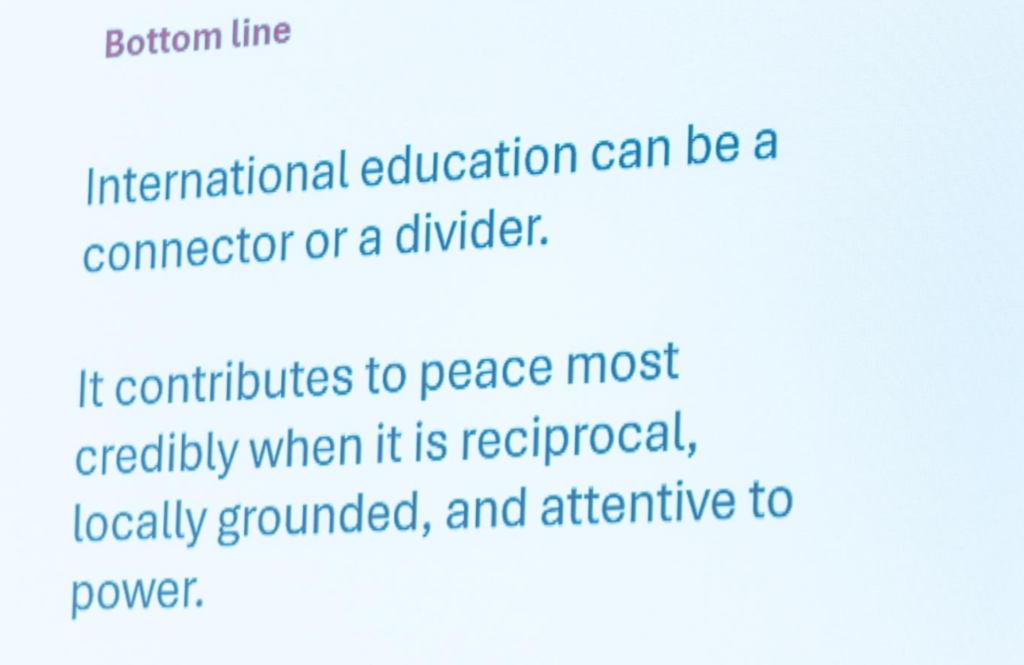
The 70th Annual Conference of the Comparative and International Education Society (CIES) centered around the theme of “Re-examining Education and Peace in a Divided World”, could not have been more timely, nor more difficult to inhabit honestly. In the last few years, we have witnessed the escalating of global armed conflicts, destruction of international order, polarization, and democratic backsliding. As stated in the UNESCO preamble — “since wars begin in the minds of men, it is in the minds of men that the defenses of peace must be constructed”— educators and educational researchers need to reflect on whether education itself has been able to live up to its normative role in fostering peace. Education is not neutral. As Bush and Saltarelli have argued, it has two faces — capable of connecting communities across divides or deepening the divisions between them. Prof. Reimers put it plainly in one Presidential Invited Symposium: international education contributes to peace most credibly when it is reciprocal, locally grounded, and attentive to power. When those conditions are absent, education may produce something that looks like progress but functions as indifference. What follows reflects three questions that emerged for me across the week — about identity, about agency, and about the silences that may ultimately constrain what education can do.
Identity
From reconciliation (Bar-Tal & Bennink, 2004; Kelman, 2004) to peacebuilding (Lederach, 1997), identity has been central to how scholars understand conflict and what sustainable peace actually requires. But recent evidence is more troubling: across most world regions, national identity and broader identifications tend to work against each other rather than reinforce one another (Li et al., 2025). So, the question is: can international education genuinely produce integrated and inclusive identities. My own presentation at CIES 2026 addressed this question with evidence from 301 ASEAN students in Japan, supplemented by 69 in-depth interviews. The findings offered both hope and challenges. The hope, it suggests, is that national, regional, and global identities do together, not at each other’s expense. About two-thirds of students showed genuinely integrated identities — keeping a strong national sense while also building regional (ASEAN) and global belonging. This is a meaningful finding against the backdrop of Li et al. (2025), because it suggests that under certain conditions, international education can produce the kind of inclusive identity configuration that peace education and reconciliation scholars identify as a condition for sustainable peace.
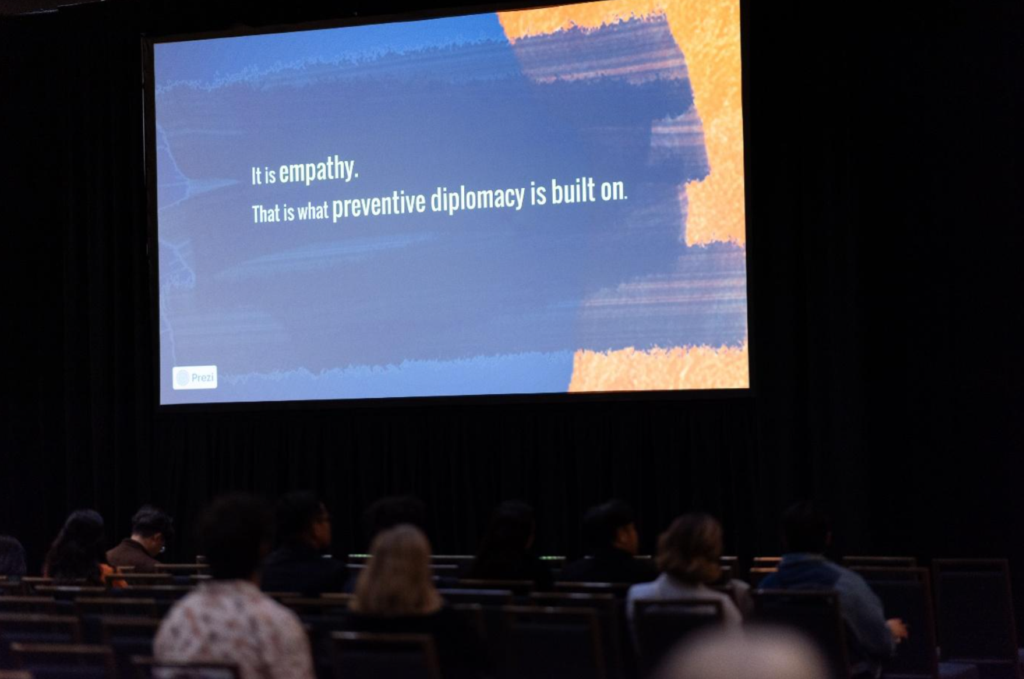
What actually drove this development, however, was not knowledge, but feeling. This finding tracks a broader shift in peace education scholarship. For over a decade, scholars such as Michalinos Zembylas have argued that education for peace has been too rationalist — treating peace as something students can know their way into rather than something they must feel their way into. Dr. JungHyun Jasmine Ryu, speaking at the Presidential Invited Symposium on International Education as Preventive Diplomacy for Peace, extended this critique into international education specifically. She argued that the field has failed to cultivate empathy, and that empathy has in fact never been explicitly named as a goal of the field.
My research provides empirical evidence for this critique by pointing out a persistent gap: ASEAN students reliably developed cognitive understanding of broader communities, but the affective sense of actually belonging to them lagged behind. I termed this the competence–belonging gap. This gap, I argue, points to a deeper question about how global citizenship education is framed. UNESCO (2015) defines global citizenship as “a sense of belonging to a broader community and common humanity” — placing belonging, an affective state, at the very center of the concept. Yet the concept of global citizenship is almost entirely operationalized through knowledge, skills, and competencies. I also observed this problematic framing across the CIES 2026 program. Sessions on global citizenship education consistently foregrounded competencies, behaviors, and skills. Sessions explicitly about belonging, by contrast, were overwhelmingly about local contexts — school belonging, refugee belonging, minority belonging. Sense of belonging to broader communities — the affective dimension that UNESCO’s own definition places at the center — rarely appeared as an object of inquiry.
Agency
Even when students develop genuine belonging to broader communities, another challenge emerges: the agency bottleneck. This concern was sharpened for me by Monisha Bajaj’s keynote, “Peace Education in Precarious Times,” which placed agency at the center of what peace education must cultivate when the conditions for peace themselves are uncertain.
Bajaj’s address resonated with research I am currently developing on how identity expansion may foster orientations toward peace. In that study, I traced three domains of peace-relevant orientation among ASEAN students in Japan: cognitive-reflexive (how they understand conflict and historical complexity), relational-emotional (how they connect across national boundaries through friendship and empathy), and agentic (whether they move toward active engagement with peace-relevant issues). The three developed unevenly. Cognitive-reflexive orientation came most readily; relational-emotional orientation was emerging but real. Agentic orientation, however, was consistently the weakest — students expressed intentions in conditional, aspirational language (“I would like to,” “maybe someday”) that rarely translated into action. International education, even under favorable conditions, appeared to cultivate understanding and feeling while leaving action largely untouched.
Bajaj’s (2018) conceptualization of transformative agency helps explain why. Among the dimensions she identifies, the one most visible in my data was what she calls relational agency — the capacity cultivated through dialogue and cross-boundary friendship. What was largely absent was strategic agency — the capacity for power analysis, for thinking structurally about why conflicts persist and who benefits from their persistence. Without that structural dimension, relational connection may not travel far beyond the campus. This is not a failure of students. It is, again, a design question: if international education is to develop agency that contributes to peacebuilding, it needs spaces where questions about power, interest, and the persistence of violence can be asked openly.
The Silences
Perhaps the most unsettling personal observation at the conference was the silence. The conference opened in San Francisco one month after the United States and Israel launched a war against Iran. By the opening ceremony on 28 March, thousands had been killed, millions displaced, and the war was still ongoing. Yet the conflict was not named in the opening or closing remarks. After the opening, a participant took the microphone and voiced what many in the room were clearly thinking: given the theme of the conference and the moment in which it was being held, why had the war not been mentioned once in any of the opening speeches? If we, as educators and researchers, do not find the voice to say what is happening, what do we expect of our students? The room applauded. Her question pointed to a pattern that could be observed during the conference. Across several sessions I attended, presenters and discussants returned to the same problem of what cannot be said in classrooms, for example, how topics related to Palestine have been taboo in American schools.
These silences can be understood through Johan Galtung’s (1990) lens. Cultural violence — any aspect of culture that makes direct or structural violence appear natural, or at least unremarkable — operates alongside structural violence, the institutional arrangements that distribute harm unevenly across groups. The two reinforce each other and produce silence. This silence is not conflict avoidance. It is a form of violence. The question then becomes: if even peace education cannot free itself from such violence, how can we expect education to end the violence it claims to address?
References:
Bajaj, M. (2018). Conceptualizing transformative agency in education for peace, human rights, and social justice. International Journal of Human Rights Education, 2(1), Article 13. https://repository.usfca.edu/ijhre/vol2/iss1/13
Bajaj, M. (2026, March 28–April 1). Peace education in precarious times [Keynote address]. 70th Annual Conference of the Comparative and International Education Society, San Francisco, CA, United States.
Bar-Tal, D., & Bennink, G. H. (2004). The nature of reconciliation as an outcome and as a process. In Y. Bar-Siman-Tov (Ed.), From conflict resolution to reconciliation (pp. 11–38). Oxford University Press.
Bush, K. D., & Saltarelli, D. (2000). The two faces of education in ethnic conflict: Towards a peacebuilding education for children. UNICEF Innocenti Research Centre.
Galtung, J. (1990). Cultural violence. Journal of Peace Research, 27(3), 291–305. https://doi.org/10.1177/0022343390027003005
Kelman, H. C. (2004). Reconciliation as identity change: A social-psychological perspective. In Y. Bar-Siman-Tov (Ed.), From conflict resolution to reconciliation (pp. 111–124). Oxford University Press. https://doi.org/10.1093/acprof:oso/9780195166439.003.0006
Lederach, J. P. (1997). Building peace: Sustainable reconciliation in divided societies. United States Institute of Peace Press.
Li, X., Meng, X., Ruiz, R. A., Wang, J., & Liew, J. (2025). Types of relations between national identity and global identity and their associated factors: A scoping review. International Journal of Intercultural Relations, 105, Article 102142. https://doi.org/10.1016/j.ijintrel.2025.102142
Reimers, F. M. (2026, March 28). [Invited remarks]. In K. Kuroda (Organizer), International education as preventive diplomacy for peace [Presidential Invited Symposium]. 70th Annual Conference of the Comparative and International Education Society, San Francisco, CA, United States.
Ryu, J. J. (2026, March 28). Crossing borders without crossing boundaries: Empathy and the missing narrative of international education [Invited presentation]. In K. Kuroda (Organizer), International education as preventive diplomacy for peace [Presidential Invited Symposium]. 70th Annual Conference of the Comparative and International Education Society, San Francisco, CA, United States.
UNESCO. (1945). Constitution of the United Nations Educational, Scientific and Cultural Organization. https://www.unesco.org/en/legal-affairs/constitution
UNESCO. (2015). Global citizenship education: Topics and learning objectives. https://unesdoc.unesco.org/ark:/48223/pf0000232993
Zembylas, M. (2015). Emotion and traumatic conflict: Reclaiming healing in education. Oxford University Press.