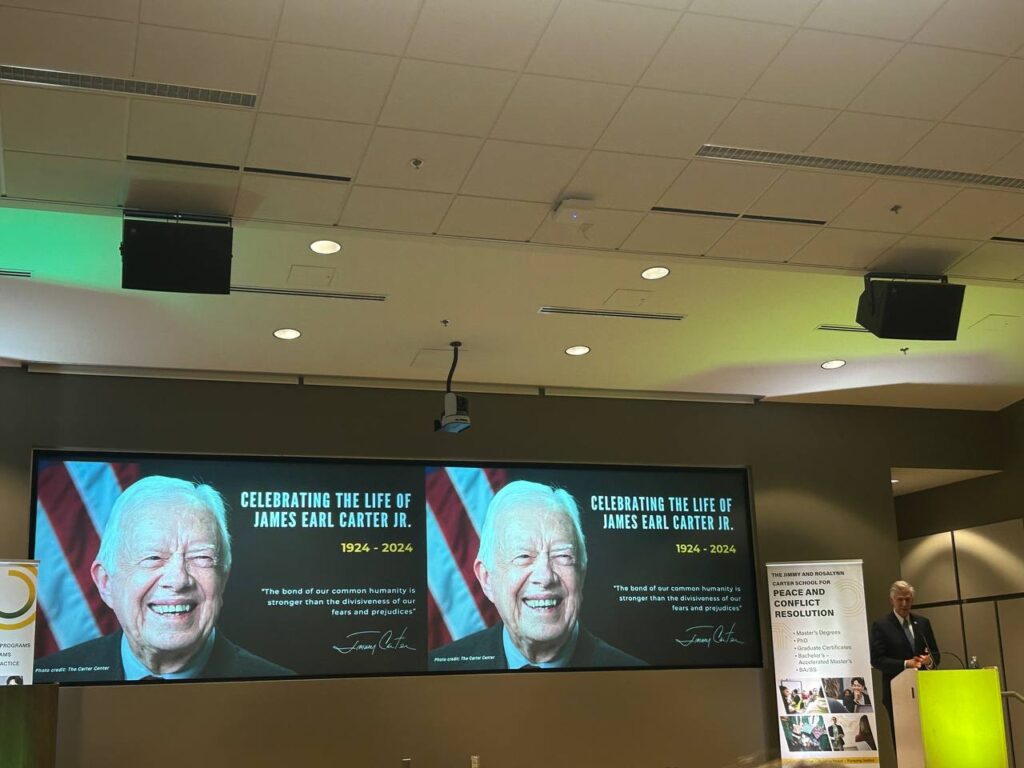
I am in my second year as an Affiliate Faculty member at the Jimmy and Rosalynn Carter School for Peace and Conflict Resolution1 at George Mason University, working under the supervision of Professor Karina Korostelina. The Carter School is consistently ranked among the top programs in the United States for conflict resolution, and its location in the Washington, D.C. metropolitan area puts it at the intersection of academic research and policy practice in ways that few institutions can match.
The Carter School regularly organizes Peace Week, a semi-annual series of seminars, workshops, panel discussions, and guest lectures. These events bring together faculty, practitioners, and scholars from around the world to address urgent questions in conflict resolution, peacebuilding, and governance. It is a space where the questions that haunt ongoing struggles can be examined with the rigor and comparative depth they demand. One lecture that left a particularly strong impression on me was delivered by Dr. Thania Paffenholz, whose talk was titled “Rethinking Peace in an Age of Geopolitical Rupture.2”
She is an award-winning peace researcher with over thirty years of experience advising on peace processes in several countries, including Myanmar. Among the lecture points she gave, what struck me was the concept she termed “cosmetic peace inclusion”. This cosmetic peace inclusion means the practice of involving actors in peace processes in ways that appear participatory but lack substantive engagement with those who hold genuine legitimacy on the ground. Therefore, she warned that the international community must learn to recognize who has legitimacy, not merely who is available, and that failing to make this distinction risks producing peace architectures that are structurally hollow.
She also drew attention to the global wave of Gen Z movements that have emerged with or without external intervention. Her reference to the September 2025 Nepal movement was particularly instructive. Dr. Paffenholz’s point was clear: The Gen Z movement, like the movement in Nepal, arises from domestic conditions of structural grievance, and it does not wait for the international peacebuilding apparatus to authorize or facilitate it. An important lesson for scholars and practitioners is that our frameworks must account for the agency and legitimacy of such movements, rather than treating them as disruptions to be managed. This example clearly aligns with the Spring Revolution in Myanmar led by Gen Z.
Dr. Paffenholz’s emphasis on ground-level legitimacy and structural grievance also directly addresses the situation I focus on in my research and engage with in Myanmar. The legitimacy issue, who has the moral and political standing to define justice in the aftermath of atrocity in Myanmar, led me to my first article, “Analyzing Post-Revolution Transitional Justice Policy in Myanmar: Threats and Opportunities.3” Since 2021, the Spring Revolution in Myanmar has brought immense changes to Myanmar’s landscape, with new stakeholders, alongside instability, warfare, thousands of fatalities, millions displaced internally, and the aerial bombardment of residential dwellings. Victims of such calamities seek and advocate for transitional justice that delivers justice for the affected individuals. Dr. Paffenholz’s warning about cosmetic inclusion became analytically urgent when I considered the transitional justice framework produced by the National Unity Consultative Council (NUCC), a body in which I have served as a Councilor.
This article provides a critical review of that policy, drawing on primary data sources and existing literature on transitional justice theories. This critical examination of Myanmar’s post-revolutionary transitional justice policy offers multiple benefits and values for retributive and restorative justice. The research finding is that the NUCC’s transitional justice has genuine normative value in holding perpetrators accountable. However, the article identifies external challenges rooted in the current political landscape, including the ongoing armed conflict, the fragmentation of legitimate authority, and the absence of an enforcement mechanism. The article examined Dr. Paffenholz’s insistence on substantive legitimacy, not cosmetic legitimacy, whether the revolutionary governance that produces transitional justice frameworks is real and applicable on the ground, or merely aspirational declarations that risk becoming the kind of hollow peace architectures she warned against.
Moreover, the notion of power vacuum, in other words, hollow peace architectures, raises another concerning question about institutions. In a post-revolutionary situation in Myanmar, even if a genuine peace settlement were to be reached in the country, what kind of parliamentary design would be capable of guaranteeing ethnic equality to safeguard ethnic minority rights from the majority’s dominance under a democratic veneer? This question became the foundation of my second article, “Federalism Reimagined: Designing Equal Parliamentary Representation in Post-Coup Myanmar.4” This article elucidates an institutional design that ensures equal representation in the parliament within the context of Myanmar’s emerging federal democratic system.
Since the establishment of the country in 1948, ethnic equality and self-determination have been ignored, which has led to a protracted war. The third military coup in 2021 brought this equality struggle into a new and urgent phase. This article presents a critical examination of recent efforts to achieve federalism, assessing new political dynamics and new stakeholders, along with their challenges and opportunities, in establishing equal representation in parliament rather than accepting existing models wholesale. The article argues for a new, tailored federal model that seriously accounts for the specific configurations of ethnicity, territory, and historical grievance in Myanmar and offers a credible institutional pathway toward sustainable peace.
This article recognized Dr. Paffenholz’s structural critique of the peace process design, which applies with equal force at the level of constitutional architecture: a representation that appears inclusive but lacks genuine parity is a significant example of cosmetic inclusion. It is here that I find Professor Korostelina’s identity-based reconciliation theory particularly instructive. Her dual recategorization model proposes that reconciliation does not require the erasure of existing ethnic identities nor the artificial construction of an entirely new one. Rather, it envisions a process in which ethnic identities are preserved and affirmed while a broader civic national identity is cultivated alongside them. Based on Professor Korostelina’s work, I wrote an article, “Beyond Ethnic Division: Searching for a New Identity for Myanmar’s Reconciliation.”
In Myanmar, the genocide of the Rohingya people has rightly drawn international attention. Yet the Rohingya situation, as grave as it is, represents only one dimension of a deeper, systemic crisis. The conditions that produced the genocide, the denial of identity, the weaponization of citizenship, and the military’s monopoly over who counts as a legitimate member of the national community are the same conditions that have been sustained inhumane, unequal, and unjust structures affecting all ethnic groups in Myanmar. At its core, this is an identity crisis, one that no single court ruling or peace agreement can resolve on its own.
This article argues that searching for a solution to the ethnic identity conflict requires moving beyond primordial ethno-nationalism and instrumentalist manipulation towards a constructivist approach of dual recategorization. Drawing on Korostelina’s identity-based reconciliation theory5, which examines how the dual recategorization model, one that preserves existing ethnic identities while cultivating a broader civic national identity, offers a viable path toward reconciliation in Myanmar, which is still in the middle of armed revolution. This article proposes three interconnected Constitution-related reforms: recognition of Myanmar as a multi-nation secular state, development of a civic national identity embedded in the constitution, and amendment of the 1982 Citizenship Law to bring it in line with international human rights norms.
This article emerged not only as an intellectual exercise but also as a practical proposal: if the revolutionary moment Myanmar is currently living through offers any constitutional opening, the dual recategorization framework provides the normative and institutional vocabulary to make that opening count. Pursuing peace is a noble calling, but for those who live within its absence, it is not an abstraction; it demands resilience, practicality, and a perseverance that refuses to surrender to despair. This is the spirit I bring to my work at the Carter School, and the spirit I carry home to Myanmar.
※1 https://carterschool.gmu.edu
※2 https://www.linkedin.com/in/thania-paffenholz-6b67a0212/recent-activity/all/
※3 This paper is submitted to the International Journal of Transitional Justice and being under reviewed.
※4 This paper will be included as a chapter in Federal Design in Myanmar, edited by Michael Breen and Soe Htet, as part of the Federalism and Internal Conflicts book series by Springer Nature. It is expected to be published in May 2026.
※5 https://www.vr-elibrary.de/doi/10.13109/9783666560330.105