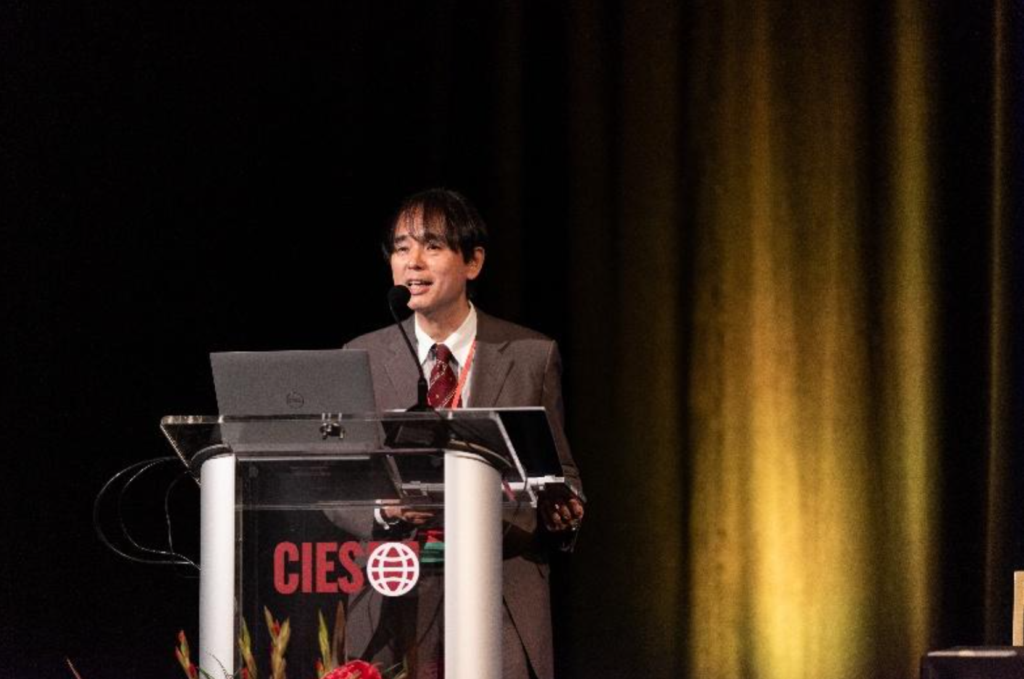
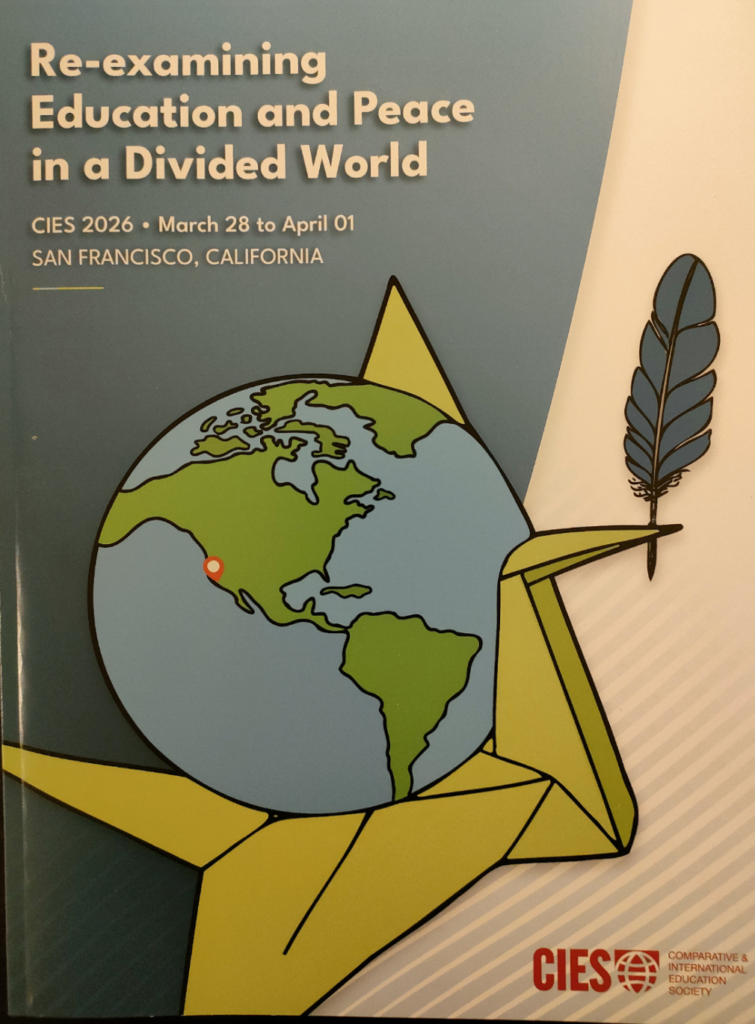
From March 28 to April 1, 2026, the 70th Annual Conference of the Comparative and International Education Society (CIES)—headquartered in Pittsburgh and with a membership of approximately 5,000—was held in San Francisco, bringing together around 3,000 participants from across the world. The conference theme was “Re-examining Education and Peace in a Divided World.” As CIES President-Elect and the principal organizer of the conference, I had the honor and responsibility of planning and leading this milestone gathering.
This theme was not chosen by chance. It grew out of a long-standing set of questions that I have carried as a scholar of education situated within an independent graduate school of international relations—a somewhat unique academic position. It was also deeply informed by the many insights I have gained through my involvement in the International Reconciliation Studies Project. In addition, as CIES marked its 70th anniversary, I wished to return to one of the primordial and historical concerns of our field: the question of peace. In this sense, CIES 2026 was not only an international conference in the field of comparative and international education, but also a valuable occasion to reflect anew on the possibilities and limitations of education in relation to peace and reconciliation.
Today’s world faces multiple and overlapping forms of division: armed conflict, political polarization, contested historical memories, social inequality, migration and refugee crises, and the erosion of trust both within and across societies. In such a context, the relationship between education and peace can no longer be treated merely as an idealistic or symbolic concern. It has become an urgent academic, ethical, and practical question not only for educational researchers, but for all those engaged in education. Education has often been expected to foster mutual understanding, dialogue, and social cohesion. At the same time, however, education can also reproduce exclusion, intensify narrow forms of nationalism, and deepen division. Confronting this dual nature of education was one of the central concerns of CIES 2026.
The conference therefore did not simply seek to reaffirm the idea that “education contributes to peace.” Rather, it aimed to examine critically the mechanisms through which education may contribute to peace, the conditions under which it may fail, and the kinds of knowledge, policy, and practice that are necessary if education is to support reconciliation. This perspective strongly resonates with the concerns of the International Education Group within the International Reconciliation Studies Project, which focuses on education as a practice deeply involved in the formation of people’s memories, values, emotions, and identities.
One session that was particularly important to me was the Presidential Invited Symposium held on the first day of the conference, “International Education as Preventive Diplomacy for Peace,” co-organized with the Japan Comparative Education Society. In this symposium, we traced the history of international education through institutions and initiatives such as the International Bureau of Education, UNESCO, and the Fulbright Program, and reflected on how international education has sought to humanize international relations and contribute to peace. At the same time, we asked whether international education can be understood not merely as an ideal, but as a concrete form of “preventive diplomacy” that helps to prevent conflict and build trust.
Through this discussion, I was reminded once again that ideals alone are not sufficient if we are to speak meaningfully about the contribution of international education to peace. We need more refined theoretical and empirical inquiry into the conditions under which international educational exchange, international cooperation in education, inter-university networks, knowledge diplomacy, and the global governance of education can foster mutual understanding, build trust, and ultimately contribute to the cultivation of peace. This agenda is closely connected to the broader task of rethinking international education from the perspectives of reconciliation and peacebuilding, which lies at the heart of the International Reconciliation Studies Project.
Throughout the conference, many important discussions unfolded around education and peace. In the Kneller Lecture, “Comparative and International Education to Promote Understanding and Peace: Maintaining Aspirations despite Challenges,” Professor Mark Bray of the University of Hong Kong examined how scholarly communities in comparative and international education, including CIES and UNESCO, have contributed to international understanding and peace, while also addressing their limitations and challenges. In the keynote address, “Peace Education in Precarious Times,” Professor Monisha Bajaj of the University of San Francisco powerfully demonstrated that peace education cannot be separated from questions of violence, inequality, human rights, and social justice. These lectures reminded us that peace education is not simply an education of “harmony” or “goodwill,” but an education that must confront structural injustice and difficult histories.
The symbolic dimensions of the conference were also deeply meaningful. The CIES 2026 logo featured an origami crane designed by Ms. Sofya Ikeda, daughter of Dr. Rita Nazeer-Ikeda, who is also a member of the International Reconciliation Studies Project. The origami crane symbolizes the Hibakusha’s (atomic bomb survivors) prayer for peace, and it was profoundly connected to the conference theme. A Peace Activity Booth was also set up at the conference venue, where participants folded origami cranes while reflecting quietly on peace. In the midst of a busy international conference, this physical and contemplative activity seemed to remind us that peace is not merely a concept to be discussed, but a practice to be remembered, learned, and shared.
I was also very pleased that many colleagues associated with the International Reconciliation Studies Project participated in CIES 2026. Through their presentations, discussions, session leadership, and many forms of exchange, perspectives from international reconciliation studies were brought richly into the conversations of comparative and international education. In particular, the active engagement of young scholars and students from Japan and Asia who participated through the project seemed to me an important step toward carrying forward discussions on comparative and international education and reconciliation to the next generation.
On a personal level, CIES 2026 became one of the most unforgettable experiences of my academic life. Organizing and leading a large-scale international conference was a major responsibility, and it was not without anxiety. Yet, with the support of Rita-san, as well as many colleagues, students, and partners, we were able to bring the conference to a successful close. Above all, I was deeply encouraged by seeing scholars, practitioners, and students from around the world engage seriously with the relationship between education and peace. I was reminded that even in a divided world, an academic community can still serve as a space for dialogue and mutual support.
Through CIES 2026, I became even more convinced that research on education and peace must be further developed within the framework of international reconciliation studies. We need to examine not only educational policies and institutions, but also memory, identity, emotion, justice, and the lived experiences of people in contexts of conflict and division. It is also important to connect theory and practice, academic research and policy, and international debate with the experiences of local communities. Education alone cannot realize peace. Yet without education—understood as a practice that nurtures knowledge, relationships, values, and imagination—it is difficult to envision sustainable peace and reconciliation.
Finally, I would like to express my heartfelt gratitude to all the members of International Reconciliation Studies Project, Dr. Rita Nazeer-Ikeda, Dr. Jasmine Ryu, Dr. Lauren Nakasato, Dr. Chau Cao, Dr. Nguyen Viet Du, Mr. Keitoku Ikegami, Ms. Li Naxin, Ms. Huijia Teh, and Ms. Pham Huong, who participated in CIES2026. I am also deeply grateful to Professor Toyomi Asano and Professor Hiroko Kawaguchi for supporting their participation.
The theme of CIES 2026 drew significant inspiration from the intellectual environment nurtured through the International Reconciliation Studies Project. I sincerely hope that the dialogue on education, peace, and reconciliation that began in San Francisco will continue to develop further within the project in the years to come.