

The Comparative and International Education Society (CIES) held its 70th conference in San Francisco from March 28 to April 1, 2026. The conference was hosted by the Society’s President, Professor Kazuo Kuroda. I had the honor of serving in several roles, including Chair of the Organizing Committee, Senior Conference Coordinator, and Member of the International Advisory Board.
One of the privileges I was given was to organize the Presidential Invited Symposia, which featured a curated series of ten special panels that directly engaged with the conference theme, “Re-examining Education and Peace in a Divided World”.
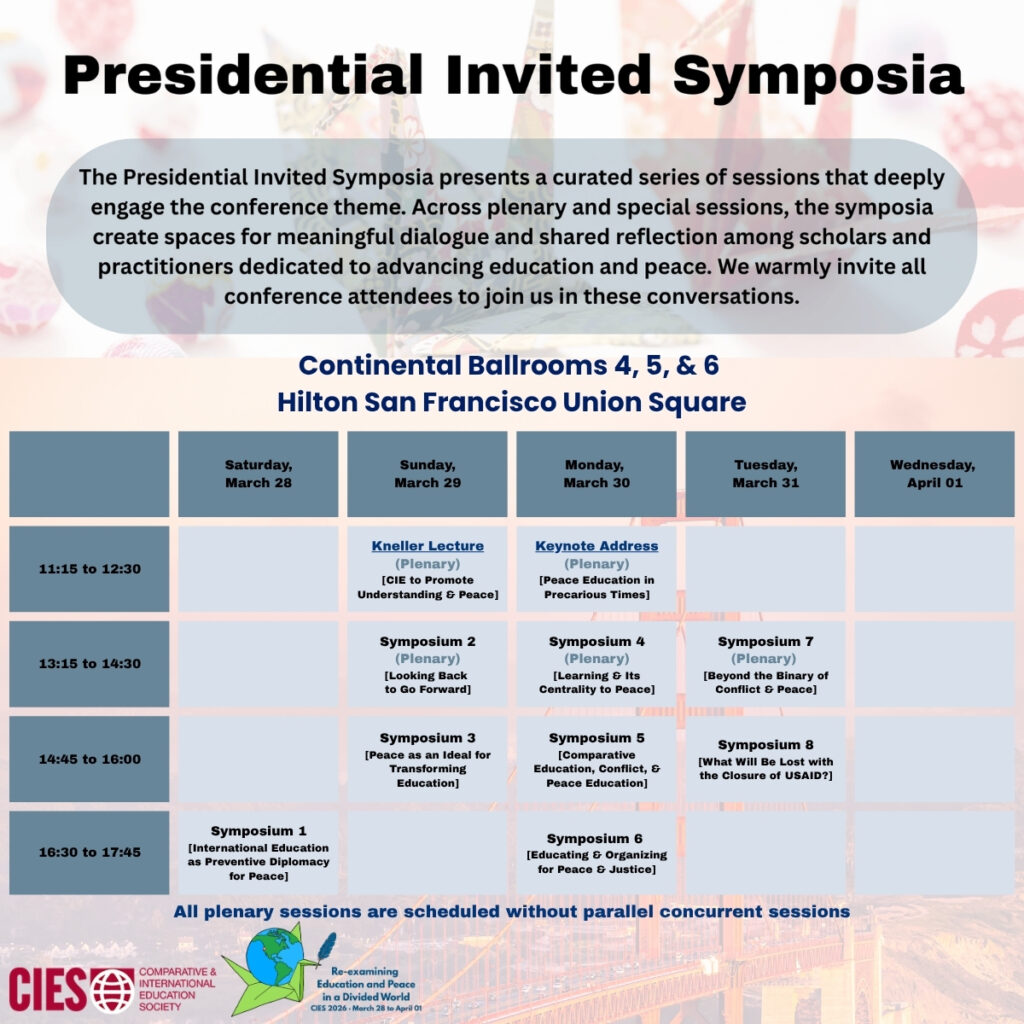
Source: Created by Author, for the CIES
Plenary Symposium – Beyond the Binary of Conflict and Peace
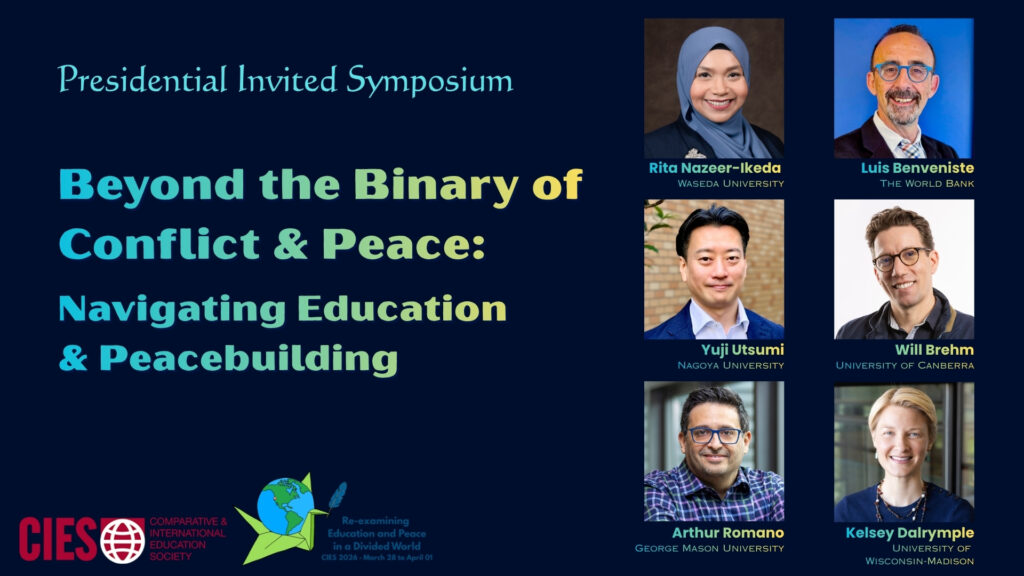
As part of the symposia, I also had the opportunity to conceptualize and lead the plenary session titled “Beyond the Binary of Conflict and Peace: Navigating Education and Peacebuilding”. The central argument of this panel was that comparative and international education scholarship has long relied on binary and linear constructs to make sense of conflict and peace. These constructs frame educational responses along several axes, including emergency intervention versus peacebuilding, fragile versus stable contexts, and reconstruction versus broader development. While analytically convenient, such categorizations fail to capture the complexities that research increasingly reveals. Education does not operate in distinct, sequential phases but in complex connections between conflict and peace.
Aligned with this overall argument, I invited panelists who could draw on perspectives from international education, conflict resolution, and peacebuilding. Collectively, we examined the intersections of justice, identity, power, and politics, and the importance of multi-actor agency.
Source: Created by Author, for the CIES
- Dr. Luis Benveniste, Global Director for Education at the World Bank, spoke on Classrooms for Peace and Prosperity: The World Bank’s Education Programs in Fragile and Conflict-Affected Countries
- Dr. Yuji Utsumi, Professor at Nagoya University, spoke on Safeguarding Learning and Building Community Resilience: Lessons from Conflict-Affected Countries
- Dr. Will Brehm, Associate Professor at the University of Canberra, spoke on Repatriation or Political Theatre? How the Return of Stolen Artefacts Can Distort History but Support Reconciliation
- Dr. Arthur Romano, Associate Professor at George Mason University, spoke on Urban Peacebuilding in a Time of Revolt: The Case for City-Wide Learning Systems
- Dr. Kelsey A. Dalrymple, Assistant Professor at the University of Wisconsin-Madison, spoke on Beyond the Binary of Healing and Harm: Reimagining Social and Emotional Learning in Crisis Contexts
Unfamiliar Peace: Re(Framing) Education with Reconciliation and Peacebuilding
In my opening address, I built on the central argument by focusing on reconciliation and peacebuilding. The work of Friedrich Hölderlin, who once wrote, “Versöhnung ist mitten im Streit und alles Getrennte findet sich wieder” (Reconciliation is in the midst of strife, and all that is separated finds itself again), sets the premise (Jena Center for Reconciliation Studies, n.d.). This foundation, which Martin Leiner built into the orientation of reconciliation studies, plants the seed of an unfamiliar way of thinking about reconciliation, education, and what it means for human beings to flourish together. It is the orientation that keeps possibilities alive when hatred seems absolute, and separation seems permanent. I expounded on three characteristics of this premise: the expansion of reconciliation’s dimensions beyond the state-to-state level; reconciliation as relational agency for transforming lives; and the pluralistic nature of reconciliation as a universal human endeavor, expressed through countless cultural vocabularies.
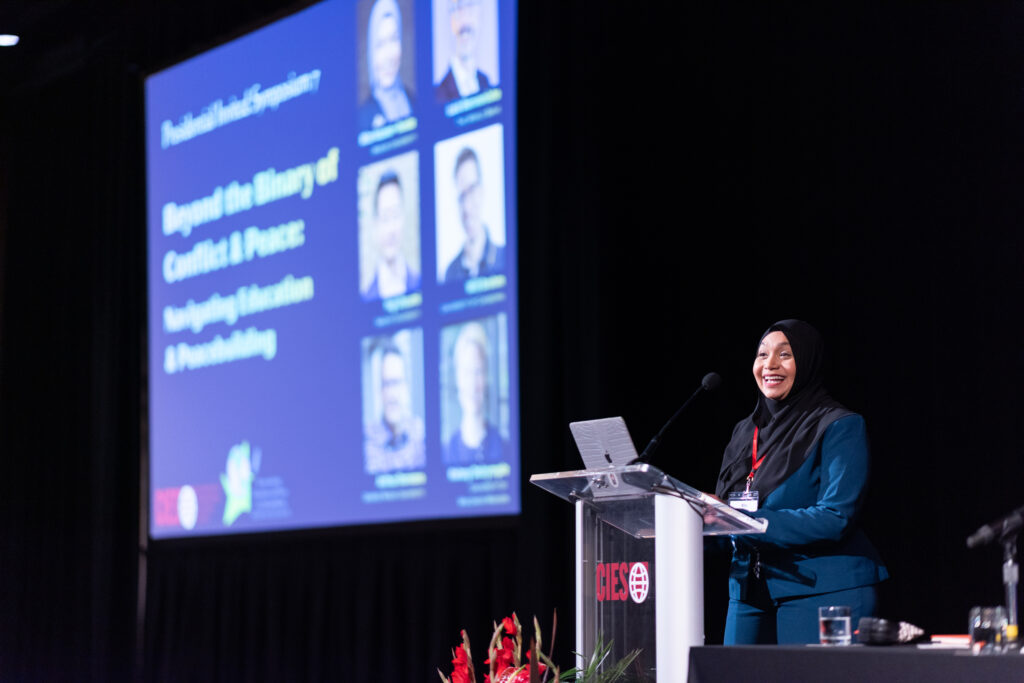
Photo Credit: Dr. Nguyen Viet Du
This mindset shift has a direct influence on education as the sector’s renewed focus on human flourishing takes hold. Galtung nudged us in this direction in his earlier works, explaining how violence in various forms is an obstacle to human development (Galtung, 1969; Galtung, 1970). However, for decades that followed, education policies in many places have been shaped by the human capital approach, orienting systems toward preparing young people for the labor market (Klees, 2016).
Yet, the OECD acknowledges that progress has been uneven. Stagnant PISA results reveal a persistent gap between the supply of educated graduates and the demands of rapidly advancing technologies, while the challenge of closing the equity gap remains largely unresolved. “Education for human flourishing, in broadening and rebalancing human capabilities, restoring meaning to human lives and creating fair and sustainable models for the future, may be our best shot at controlling it…” (OECD, 2025, p.16). This is promising for those of us working in education, peace, and reconciliation studies. Making human flourishing a central focus will give it greater traction in research and policies.
Comparative and International Education at a Crossroad
This shift towards human flourishing was reiterated in many sessions across the conference. Although the term itself was not consistently used verbatim, the idea underpins many discussions. The three interdependent approaches to peace (i.e., peacekeeping, peacemaking, and peacebuilding) (Galtung, 1976) have made a comeback and become more pressing, especially when framed within the context of the current state of polycrises, or as the keynote speaker, Professor Monisha Bajaj, described as “precarious times”. In these times, Bajaj argued that student agency, enabled through peace education and its educators, offers tools to both cultivate and challenge knowledge, skills, and values.
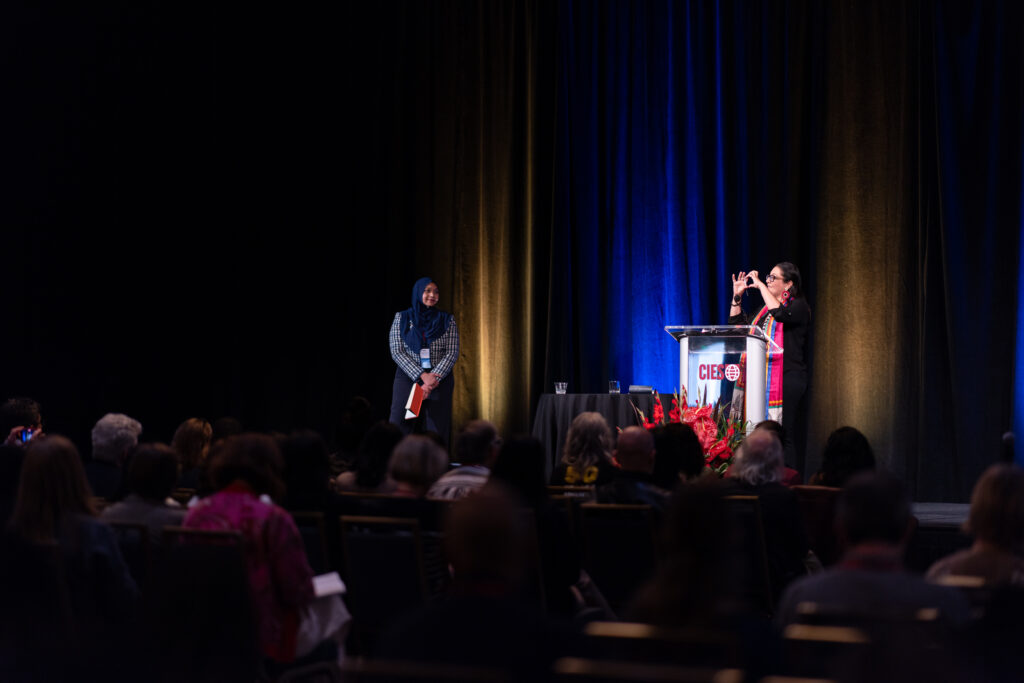
Photo Credit: Dr. Nguyen Viet Du
This is an extension of Professor Mark Bray’s keynote address the previous day, in which he highlighted how the current dominant discourse in education (i.e., as a tool for economic growth) falls short of acknowledging injustices, violence, and the environment. On this trajectory, peace cannot be achieved sustainably, at least not effectively through education.
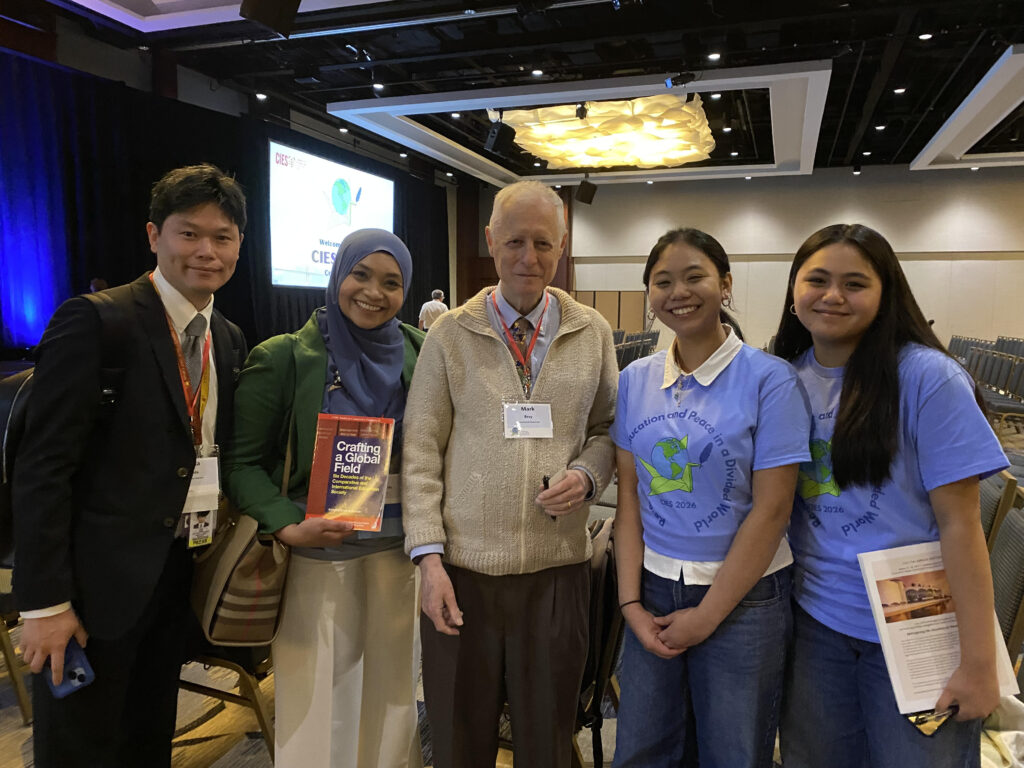
Photo Credit: Professor Mark Bray
Reflections and Inspirations
Reflecting on the academic discussions at the CIES 2026 conference, I have gathered three key insights. First, confronting conflict and its roots in violence, no matter how uncomfortable, is an indispensable step toward building sustainable peace. Second, the transformative potential of education cannot be underestimated, but it also cannot be taken for granted – it cannot be assumed that education in all its forms will lead to peace. Third, education that is transformative and effective in building peace needs to be purposeful and bold in critiquing what does not work and in creating new paths amid contemporary opportunities and constraints.
These insights strengthen the conceptual framework and thinking behind the upcoming book in the International Reconciliation Studies Series, for which I serve as Lead Editor. They show that the paths ahead for reconciliation and peacebuilding in international education are plural, not singular, because educating across divides must be anchored in context and not a one-size-fits-all approach. At the core of this, however, is the human thirst to flourish and fight for peace in a world facing polycrises.
Selected References
Galtung, J. (1969). Violence, peace, and peace research. Journal of Peace Research, 6(3), 167–191. https://doi.org/10.1177/002234336900600301
Galtung, J. (1970). On the future of human society. Futures, 2(2), 132–142. https://doi.org/10.1016/S0016-3287(70)80005-2
Galtung, J. (1976). Three realistic approaches to peace: Peacekeeping, peacemaking, peacebuilding. Impact of Science on Society, XXVI(1/2), 103–115.
Jena Center for Reconciliation Studies. (n.d.). Which is JCRS peculiar approach to reconciliation? Retrieved from Jena Center for Reconciliation Studies website: https://www.jcrs.uni-jena.de/154/what-is-reconciliation-about
Klees, S. J. (2016). Human capital and rates of return: Brilliant ideas or ideological dead ends? Comparative Education Review, 60(4), 644–672. https://doi.org/10.1086/688063
OECD. (2025). Education for Human Flourishing. Paris: OECD.