

Participating in the 7th Annual Conference of the International Association for Reconciliation Studies (IARS) 2026, held at Nicosia University, marked an unforgettable milestone in my academic journey. At the outset, I extend my deepest gratitude to Professor Toyomi Asano, the project leader, as well as to the senior fellows and all the organizing committee members for providing me with this precious opportunity and for managing the complex preparations with great precision.
First, I would like to briefly outline the content of my presentation. The title of my presentation was “The Politics of ‘Forgiveness’: Anticolonial Movements and Moral Re-Armament (MRA) in Late Colonial Kenya.” This study critically examines how universal, moral vocabularies such as “reconciliation” and “forgiveness” can become complicit in maintaining political power and dominant structures, using the suppression of the Mau Mau uprising in 1950s colonial Kenya as a case study.
The MRA, which began in the United States in the 1930s as a Christian-based moral movement, became deeply intertwined with anti-communist ideology during the Cold War and expanded into a global network. Advocating the “Four Absolutes”—Absolute Honesty, Absolute Purity, Absolute Unselfishness, and Absolute Love—the movement rejected “political solutions” such as class struggle or national independence movements. Instead, they emphasized “individual inner change,” arguing that personal, internal transformation and forgiveness were indispensable prerequisites to reconciliation with other individuals or ethnic groups.
In 1955, Japanese MRA activists, including survivors of the atomic bomb, visited Kenya as part of a global tour. At that time, the British colonial government was detaining tens of thousands of Kenyans suspected of involvement in the Mau Mau uprising in detention camps, implementing a “spiritual rehabilitation program” aimed at forcing ideological conversion. The colonial administration invited these Japanese MRA activists into the camps and commissioned them to conduct persuasion programs for the detainees.
The core of this program was a re-packaged “template of forgiveness” filtered through the experience of postwar Japan. According to the memoir of Mohamed Mathu, a former detainee, a Japanese woman activist took the stage and tearfully shared how she overcame her intense anger and resentment toward the United States after the atomic bombing of Hiroshima through MRA’s “love.” She then implored the Kenyan audience that “this exact same brotherly love can heal the rift between European settlers and Kenyans.” Mathu testified that while he felt a strong sense of dissonance, he was profoundly shaken by the emotional power of her narrative.
This “politics of forgiveness” did not conclude with Kenya’s independence in 1963. Rather, it was institutionally inherited as the official slogan “Let us forgive and forget” by Jomo Kenyatta, the first president, who rushed to build the post-colonial state. It served as a “performance of stability” to secure domestic political order and attract Western investment and foreign aid, functioning as a sophisticated technology of governance to mask the continuation of colonial-era inequalities.
The above constitutes an overview of my presentation. The key insights offered through this presentation were “further robust development of the argument” and the question “What is the MRA doing now?” precisely illuminated the importance of connecting historical data to contemporary application, rather than treating history as a static, closed archive. Because my analysis was focused primarily on the historical descriptions of the 1950s and 1960s, it highlighted an exciting opportunity to strengthen the bridge connecting historical critique to the question of modern agency.
The audience sought to understand how this historical “technology of governance” morphs into modern structures, and how current reconciliation initiatives continue to navigate the fine line between genuine structural healing and ideological silencing. Encountering this new dimension was highly inspiring; it provided the essential analytical tension that turns a descriptive history into an active, critical contribution to Reconciliation Studies.
This intellectual tension found its living resonance when I stepped outside the conference halls and explored Nicosia. In the municipal museum, I encountered colonial-era administrative artifacts from 1907: a tariff of fares for public carriages issued by the Municipality of Nicosia and the cover of a vital statistics registry. Crucially, these daily administrative documents were printed in three languages: English, Greek, and Turkish (written in Arabic script).
【Image 1】
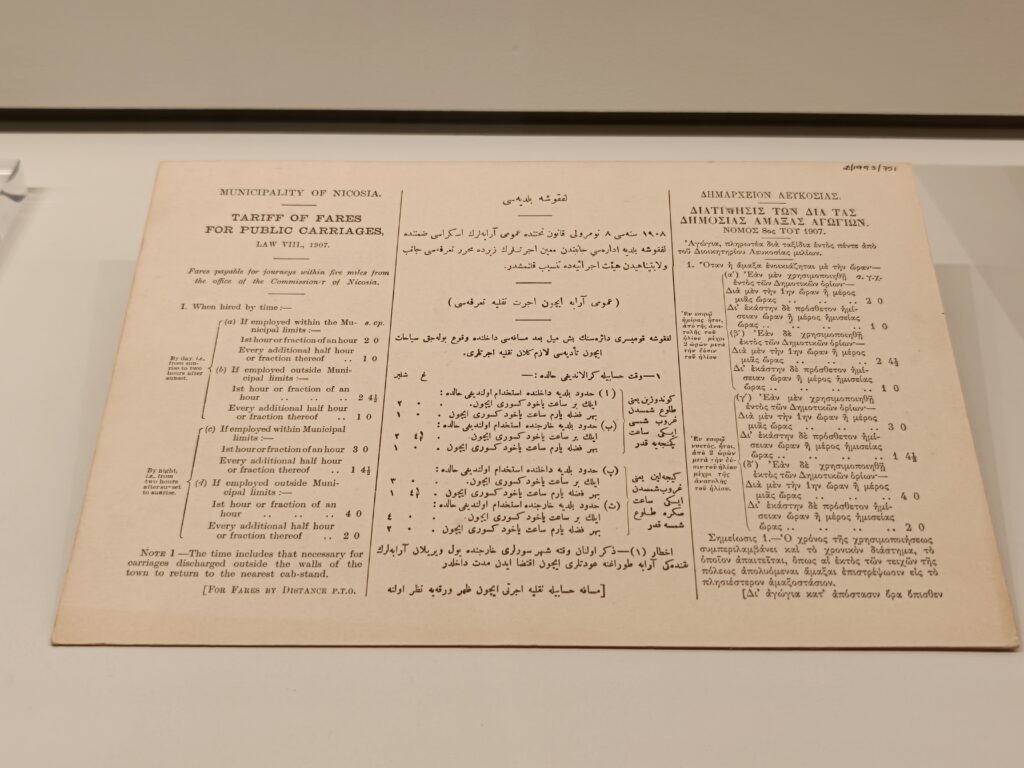
Image 1: A tariff of fares for public carriages issued by the Municipality of Nicosia in 1907 during the British colonial era, printed in English, Greek, and Turkish (in Arabic script).
【Image 2】
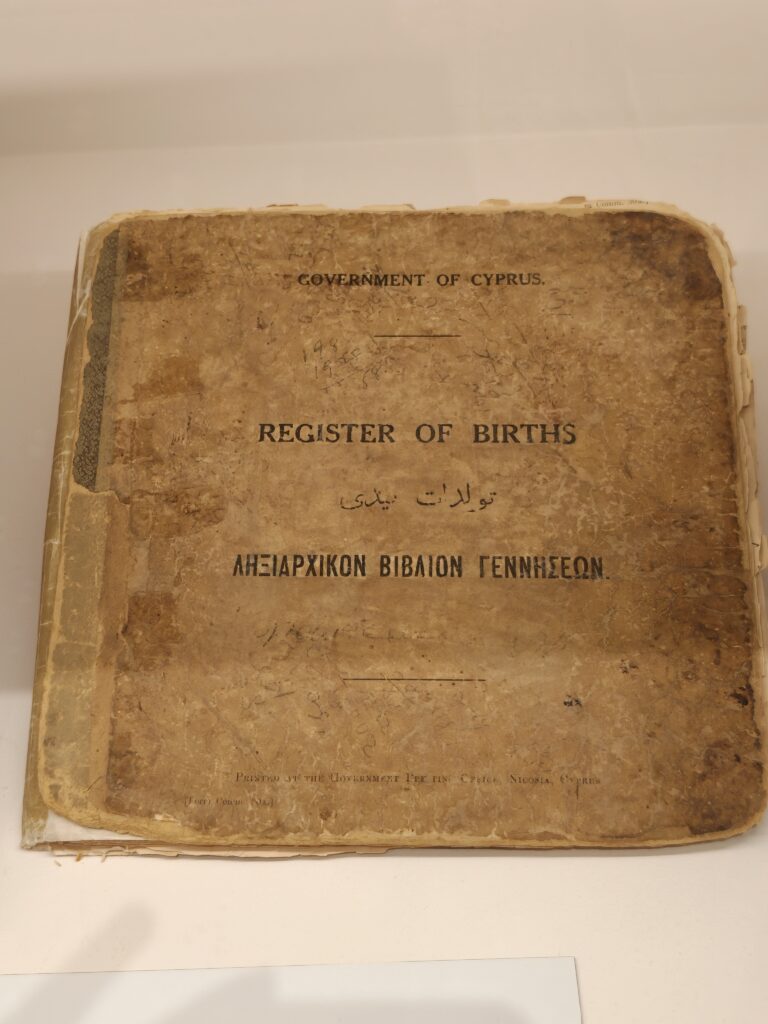
Image 2: The cover of a vital statistics registry from British colonial Cyprus, demonstrating the same trilingual print.
At first glance, the juxtaposition of these three languages on daily administrative documents felt remarkably familiar, reminiscent of the African school syllabi I examine in the Kenyan archives, which juxtapose English, Swahili, and Kikuyu. However, reflecting deeply on the “structural disparities between languages” revealed a decisive divergence in colonial technologies of governance, proving that British imperialism cannot be treated as a monolithic entity.
In colonial Kenya, the imposition of a trilingual structure in education—such as prioritizing Kikuyu over English for African students—was designed to prevent the emergence of an educated African intellectual class, effectively containing and segregating local populations. Consequently, local African vernaculars were systematically excluded from formal colonial administrative documents in Kenya. Instead, publications in these local languages were strictly limited to religious texts, such as the Bible, or rudimentary textbooks. Conversely, the trilingual print on Cypriot tariffs and registries indicates that the British Empire was compelled to incorporate the pre-existing presence and geopolitical weight of the Greek and Turkish linguistic communities directly into the machinery of state administration. The varying presence of local languages in colonial documents eloquently illustrates how imperial infrastructures maintained distinctly different gradients of hegemony and structural inequality across regions.
However, the contemporary reality of Cyprus added a profound layer of complexity to this historical linguistic hierarchy. Later, I observed a local civic choir performing a repertoire where songs were beautifully rendered in Turkish, Greek, and English.
【Image 3】
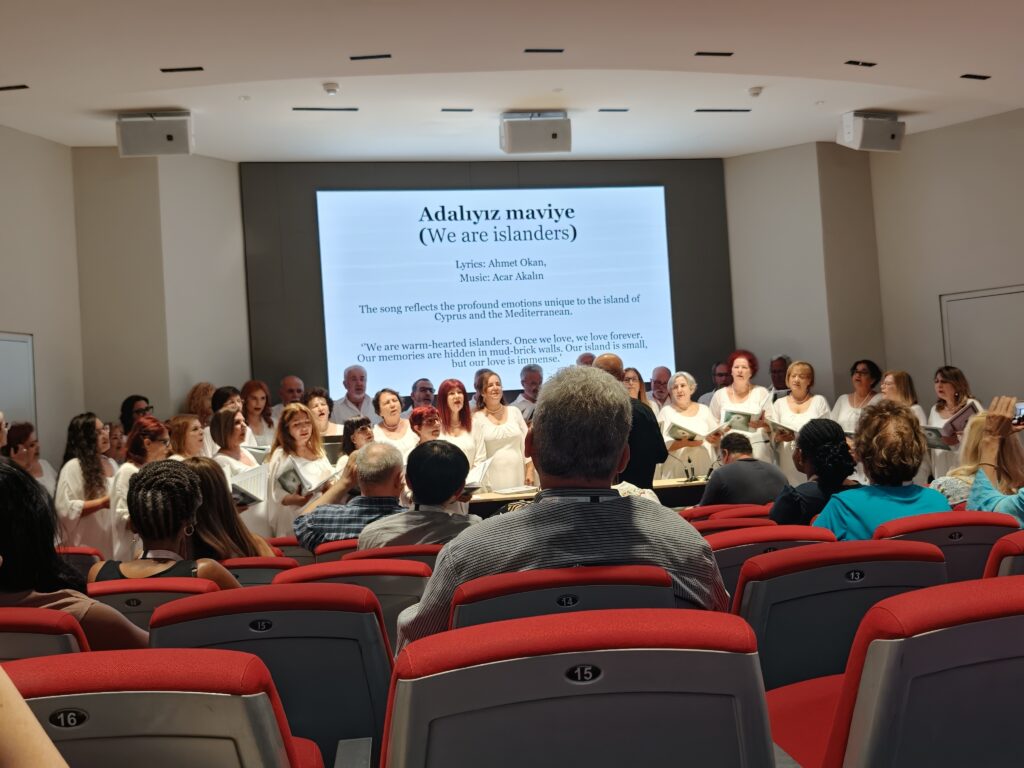
Image 3: A local civic choir performing in Nicosia, transcending historical divisions by singing in three languages.
The presence of English here was no longer merely a ghost of colonial domination; instead, it functioned alongside the languages of the once-conflicting communities as a shared, pragmatic vehicle for artistic expression and grassroots dialogue.
The choir did not perform a sanitized version of “harmony.” Rather, by singing in all three tongues, they actively acknowledged the scars of British rule and the deep Greek Turkish communal division, while simultaneously repurposing those very linguistic layers to forge an ongoing, grounded space for mutual recognition. This eloquently illustrates how the linguistic infrastructure of imperial rule maintained distinctly different gradients of hegemony and structural inequality between languages across regions.
Through the insights gained from this conference and the people of Cyprus, I have renewed my determination to further deepen the core historical analysis of this research and refine my argument for submission to the Journal of Eastern African Studies, a leading international journal in East African history. While pursuing a rigorous, linear historical methodology demanded by peer-reviewed articles, I strongly believe that stepping further into personal reflection allows a scholar to stand actively at the intersection of historical lessons and lived contemporary reality.
Tracing the transnational journey of moral vocabularies teaches us that peacebuilding is never an innocent moral endeavor; it is a site of continuous, dynamic political negotiation in concrete societies. Moving forward, I am deeply committed to ensuring that this historical exploration of Kenya’s past remains in permanent, active dialogue with the fragile, multilingual harmonies of the present.