1. Summary of the Presentation
My study examined the Amami Islands — an archipelago of approximately 104,000 people administratively incorporated into Kagoshima Prefecture — as a historically constituted space of exception in the sense theorized by Giorgio Agamben (1998; 2005). Against the backdrop of a growing body of scholarship in postcolonial and Indigenous studies that has increasingly turned its attention to Japan’s internal peripheries, the paper argued that Amami’s persistent economic marginalization — per capita income standing at approximately 74.5% of the national average, welfare recipient rates more than double the national figure — is not an incidental outcome of geographic remoteness, but the sedimentary accumulation of structurally reproduced mechanisms of exclusion that have operated continuously since the Satsuma domain’s colonial annexation of the islands in 1611.
Two empirical cases were developed to substantiate this theoretical claim. The first concerned the Divided Budget Policy (1888–1940) and the Sugar Consumption Tax Act (1901–1928). Under this administrative framework, Amami’s fiscal affairs were deliberately segregated from those of mainland Kagoshima despite formal incorporation within the same prefecture. Tax revenues generated almost exclusively through sugar production — constituting up to 60–70% of the islands’ total fiscal output — were extracted centrally, while development allocations were systematically withheld. Kagoshima prefectural records from circa 1894 make the logic explicit: Amami’s budget was to be treated as a separate account, insulated from mainland expenditure. The per capita development budget disparity in 1925 — ¥7.60 for mainland Kagoshima against ¥0.64 for Amami — illustrates the structural dimensions of this policy. Amami was, in Agamben’s terms, an ‘inside outside’: formally included within the sovereign order as a revenue-generating territory, yet held outside its redistributive and developmental protections.
The second case examined the experience of Amami no Genbaku Otome — young women, many of them displaced Oshima Tsumugi weavers, mobilized under the Joshi Teishintai (Women’s Volunteer Corps) and sent to Mitsubishi munitions factories in Nagasaki, where they were exposed to the atomic bombing of August 9, 1945. Postwar, Amami’s administrative severance under U.S. military government (1945–1953) placed its hibakusha outside the reach of Japanese relief legislation for over four decades. These women had been conscripted as imperial subjects yet were abandoned as political subjects the moment their administrative liminality rendered compensation inconvenient. This constitutes, I argued, a paradigmatic instance of what Agamben theorizes as the reduction to bare life (zoē): biological existence stripped of the political standing (bios) through which claims on the state are rendered legible.
Taken together, the two cases reveal a durable pattern of governmentality operating through administrative design rather than mere neglect: a logic in which Amami’s inclusion within the Japanese state has been perpetually conditioned on its simultaneous exclusion from the protections that formal membership should entail.
2. Questions and Discussion
The chair of the panel has introduced “Formosan Ideology” (Rwei-Ren Wu, 2003), a work examining colonial subjectivity and ideological formation in Taiwan, as a potentially productive interlocutor for the theoretical framework developed here. The suggestion was well-taken: Taiwan’s experience of overlapping colonial jurisdictions and the ideological formations those produced share structural affinities with Amami’s condition of layered administrative liminality. Incorporating such comparative material into future iterations of the paper would allow for a more rigorous triangulation of the exception concept across distinct postcolonial contexts within East and Southeast Asia.
A second and more searching line of inquiry pressed on an acknowledged tension in the paper: the relative absence of Amami islanders’ own subjectivity, agency, and resistance within a framework that might otherwise render them primarily as objects of sovereign power rather than as political actors in their own right. The question prompted me to reflect on evidence gathered during my own fieldwork that had not been foregrounded in the presentation.
Three cases are worth elaborating here.
First, in the 1990s, Amami Ōshima became the site of what is believed to have been Japan’s — and possibly Asia’s — first ‘rights of nature’ litigation, in which local communities invoked the natural environment itself as a legal subject in order to contest state-sanctioned development projects. This legal strategy was, in the context of 1990s Japan, extraordinarily ahead of its time, anticipating by decades the global mainstreaming of rights-of-nature frameworks now observable in jurisdictions ranging from Ecuador to New Zealand. Crucially, this juridical move also functioned as a displaced assertion of local self-determination: unable to contest the state through conventional channels, islanders mobilized the language of ecological personhood to articulate claims to autonomous governance that could not easily be dismissed. Second, during the period of U.S. military administration (1945–1953), Amami islanders, deprived of economic support, infrastructural investment, and institutional opportunity, organized a territory-wide petition campaign demanding reversion to Japanese sovereignty. The campaign achieved a signature rate of approximately 98% — a figure that, whatever its meaning within the particular political conjuncture of the occupation period, testifies to a remarkable capacity for collective political mobilization under conditions of extreme administrative abandonment. Third, during the same period of U.S. governance, the structural lag in educational provision — the mainland had already introduced the 6-3-3 system, while Amami remained without equivalent resources — prompted local schoolteachers to undertake clandestine crossings to Kyushu in order to smuggle textbooks and curricular materials back to the islands. This act of educational contraband was simultaneously an act of political refusal: a rejection of the educational dispossession that administrative liminality had imposed, and a grassroots commitment to ensuring that Amami’s children would not fall irreversibly behind.
These three cases complicate and enrich the Agambenian framework in productive ways. They suggest that the zone of exception is not simply a space of passivity or bare life, but one in which political subjectivity is continually reasserted — often through oblique, displaced, or extralegal channels precisely because the conventional channels of political recognition have been systematically foreclosed. The challenge for future research will be to theorize these forms of subaltern agency without either romanticizing them as unambiguous resistance or collapsing their significance into the very logic of sovereign exception they seek to exceed.
Related to the second point, another particularly generative critique was about the theoretical framework itself. It was suggested that, precisely in relation to the question of islanders’ subjectivity and agency, and in ways that also resonate with the comparative case of “Formosan Ideology”: Achille Mbembe’s concept of necropolitics may offer a more apposite theoretical lens than Agamben’s alone. Where Agamben’s framework risks positioning those within the zone of exception primarily as objects of sovereign power, living rendered bare, stripped of political standing, Mbembe’s elaboration of the colonial and postcolonial condition attends more rigorously to the ways in which political subjectivity, resistance, and collective life-making persist and are actively produced even within spaces defined by extreme domination and administrative abandonment. The three cases of subaltern agency developed in my response, includibg the rights-of-nature litigation, the 98% reversion petition, and the clandestine educational networks, sit more comfortably within a Mbembean frame than a purely Agambenian one, insofar as they gesture toward what Mbembe theorizes as the irreducibility of human agency within regimes of death-worlds and managed precarity. I find this critique compelling, and intend to incorporate a sustained engagement with Mbembe’s framework into the book project that this paper contributes toward.
A further argument developed in discussion concerns the politics of memory and generational rupture. The cohort of islanders who lived through the wartime and immediate postwar period carries an embodied knowledge of Amami’s history as a site of opportunistic imperial inclusion and exclusion. Therefore, the knowledge that informs their reading of contemporary developments such as the remilitarization of the islands from 2019 onward, carried out without Free, Prior and Informed Consent (FPIC) in explicit violation of the norms to which Japan is formally committed. For the postwar generation, however, raised within the developmental imaginary of the post-reversion period, this four-hundred-year continuum of structural domination has become largely illegible. This generational occlusion — the progressive disappearance of the critical historical memory that would allow contemporary islanders to situate current political developments within the longer arc of colonial governance — constitutes, I argued, the most significant structural difference between Amami and those islands that fall under Okinawa Prefecture’s jurisdiction, where a more robust public culture of historical consciousness has been maintained.
3. What Cyprus Taught Me
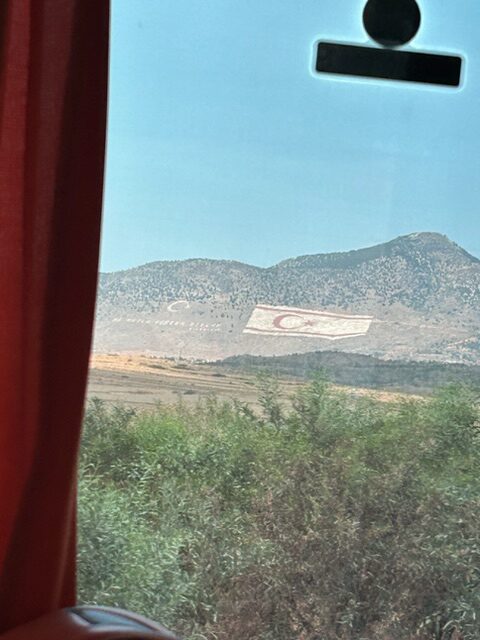
This visit offered unexpectedly productive material for the arguments developed in the paper. On the final day, participants visited Famagusta in the north. Beyond the palpable sense of cultural difference from the south, the bus journey itself already seemed to embody the island’s political condition, passing through the checkpoint that marks the de facto boundary of the Turkish Republic of Northern Cyprus, a state recognized by no country other than Turkey. The landscape along the way was striking: the Turkish Cypriot flags painted in monumental scale across the mountain range, visible from across the island. A researcher of Greek origin responded to this sight with undisguised resentment. The directness of that emotion was, itself instructive.
A landscape in which the suspension of one sovereign order and the imposition of another has been inscribed as symbol onto the terrain, the mountain becoming a sort of medium of political claim. Witnessing this, I found myself wondering whether the anger it provoked was simply personal feeling or nationalism, or whether it was perhaps something else: an emblem of what might be called the “embodied memory” of a community for whom dispossession remains spatially present, written into a place one cannot choose not to see.
What also stays with me is a conversation in Famagusta. I was sitting alone with an ice cream when a young man came up and started talking. He mentioned that his mother had moved from the south to the north at the time of the division. When I asked whether she ever thought about going back, he smiled. “After all this time,” he said, “her family is here, her work is here, her friends are here. There is not really anywhere to go back to.” In that moment, I had the sense of witnessing something that no theoretical framework quite prepares you for: the way that even the deepest political ruptures and their wounds are, over time, gradually metabolized into the ordinary rhythms of a life lived forward.