

From 19 to 22 June 2026, I took part in the 7th Annual Conference of the International Association for Reconciliation Studies (IARS), held in Nicosia, Cyprus, and gave a research presentation on the opening day. This essay reports on the presentation, and then on what I learned from the conference and from my stay in Nicosia.
1. Summary of the Research Presentation
My presentation was titled “The ‘Japanese’ Who Remained in Vietnam after 1945, and Their Families: How They Were Silenced — and How That Silence Was Partly Unsilenced.” I place “Japanese” in quotation marks because the group included people mobilized from colonial Korea and Taiwan.
The “Japanese” who remained are estimated at 700 to 800, and some 600 are said to have joined the Việt Minh (League for the Independence of Vietnam) and fought in Vietnam’s war of independence. Most were men, and many married Vietnamese women and started families. Their experiences were diverse and resist any single account; in the presentation, however, I took up two contrasting trajectories: the families of the North, torn from their fathers in 1954, and the families who moved to the South, only to be uprooted from Vietnam from 1978 onward.
In July 1954, the Geneva Accords were concluded, bringing the Indochina War to a ceasefire. Their role now over, the “Japanese” were urged by the Vietnamese side to return, and were repatriated to Japan between 1954 and 1961. Those in the first repatriation, in 1954, were not permitted to take their Vietnamese families with them. Of the 65 who returned alone at that time, we do not know for certain how many left families behind in Vietnam. It seems clear, however, that no small number of families were torn from their fathers and left behind in the North.
Others, meanwhile, did not return to Japan but moved with their families to southern Vietnam. The Geneva Accords designated the 17th parallel as a provisional military demarcation line and stipulated that the forces of the Democratic Republic of Vietnam regroup to its north, and the French Union forces to its south. Until that regroupment was complete, civilians, too, were permitted to move to whichever side they wished. The “Japanese” and their families who moved south in this period lived through the Vietnam War in the Republic of Vietnam (South Vietnam). When the war ended some twenty years later, in 1975, and the country was reunified the following year, the “Japanese” families had no choice but to repatriate to Japan. From 1978 onward, Vietnamese wives and children born and raised in Vietnam also came to “return” to Japan. Thus the families of the North were torn from their fathers and remained in Vietnam, while the families of the South were uprooted from Vietnam and crossed over to Japan.
In the presentation I drew on Michel-Rolph Trouillot’s argument — that power enters the four moments of historical production, the making of sources, of archives, of narratives, and of history, and thereby “silences” the past — to trace how the contrasting experiences of the northern and the southern families were alike silenced, both in Vietnam’s national narrative and in the history of Japan–Vietnam relations.
In recent years, however, that silence has begun to be broken in part. In March 2017, the Emperor and Empress of Japan (now the Emperor Emeritus and Empress Emerita) visited Vietnam and met the “torn-apart” families of the North. For the northern families, the silence is being broken — unsilenced. The silence of the southern families, by contrast, remains untouched. The very act of breaking the silence is producing an asymmetry. Such was the gist of my presentation.
In the Q&A, one participant commented that even those who never became the object of official documentation might still appear in records of some kind — criminal records held by judicial authorities, for example. Rather than only reading meaning into the fact that they were silenced, I hope also to comb through the sources and trace their footsteps across records. I am grateful for a comment so rich in suggestions for my future research.
2. What I Learned from the Conference and from Nicosia
2-1. The yearning for reunification and “time”
In the Q&A after one presentation, a comparison was drawn between the divisions of the Korean peninsula and of Cyprus. The two cases differ in many respects, but what came to my mind as I listened was one thing they share: the length of “time” that has passed since division. The division of the Korean peninsula has already exceeded seventy years; that of Cyprus now spans half a century.
In Vietnam’s case, the division of North and South, sealed in 1954, lasted a little over twenty years, until reunification in 1976 — about thirty years even counting from Japan’s defeat and Vietnam’s declaration of independence in 1945. Divided Vietnam was full of families torn between North and South. Reunification was never a mere political slogan: it was also people’s earnest longing to see their separated family again.
Looking at the Vietnamese case alone, one is apt to take such longing for granted. Yet the lived sense that one’s family — one’s homeland — lies just across the boundary fades as the generations turn. Once division has settled into a “negative peace” and the generations have changed, calling forth a popular yearning for reunification becomes far more difficult. I realized anew the profound significance of the “time” after the division.
2-2. Building person-to-person trust as a practice of reconciliation
Cyprus is a place where that post-division “time” is passing before one’s eyes. Indeed, the people I was able to talk with in the streets, in my limited time there, seemed to accept division as a given reality.
At the venue of IARS Cyprus 2026, by contrast, I met many Cypriots who long for reconciliation.
In the keynote discussion on the opening day, the Chief Negotiators of the Greek Cypriot and Turkish Cypriot communities took the stage together. Beyond the substance of the debate itself, what left a strong impression on me was how plainly the two trusted each other — as counterparts, and as friends.
A civic bicommunal choir whose members come from both communities sang traditional Cypriot songs in both Greek and Turkish; the same melodies, I was told, have long carried lyrics in the two languages. The last piece they sang was an original song titled “We are islanders.” When I spoke to the singers as they came off the stage, one of them said to me: “Watching us sing, you couldn’t tell who was Greek and who was Turkish, could you? Because we are all Cypriots.” There is such a thing as Cypriotness, they told me.
At the session of the Committee on Missing Persons in Cyprus (CMP), we were introduced to the work of archaeologists, forensic scientists, and psychologists from both communities, who together excavate the remains of those who went missing in the conflict, identify them, and report their findings to the families. Cooperation across the communal boundary, they said, poses no difficulty: “We are field colleagues — sometimes we do not even need to talk.”
Watching these people at work and hearing them speak, I came to feel that, even as “time” hardens division into place, the process of building person-to-person trust across the boundaries of groups is a practice of reconciliation — one that resists the passive acceptance of the status quo.
How the divergence in sentiments I sensed between the people in the streets and the people at the conference will unfold from here, I do not yet know. I will keep watching the choices the people of Cyprus make.
Finally, I would like to express my heartfelt thanks to everyone involved in running the conference, and to all who made this invaluable opportunity possible.

Photo 1: A keychain from a coffee shop in Nicosia’s old city, in the circular shape of the old city walls. At its center is the whole island of Cyprus.
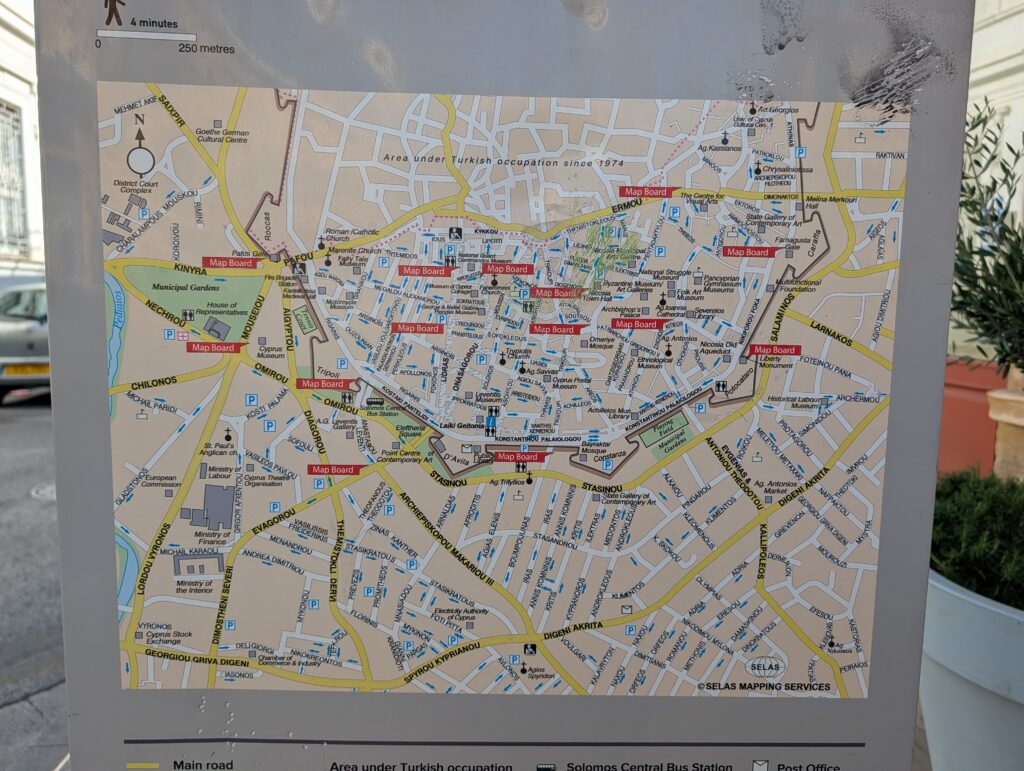
Photo 2: A map of Nicosia’s old city on a street information board on the southern side. The contrast is striking between the information-packed south and the north, marked only “Area under Turkish occupation since 1974.”
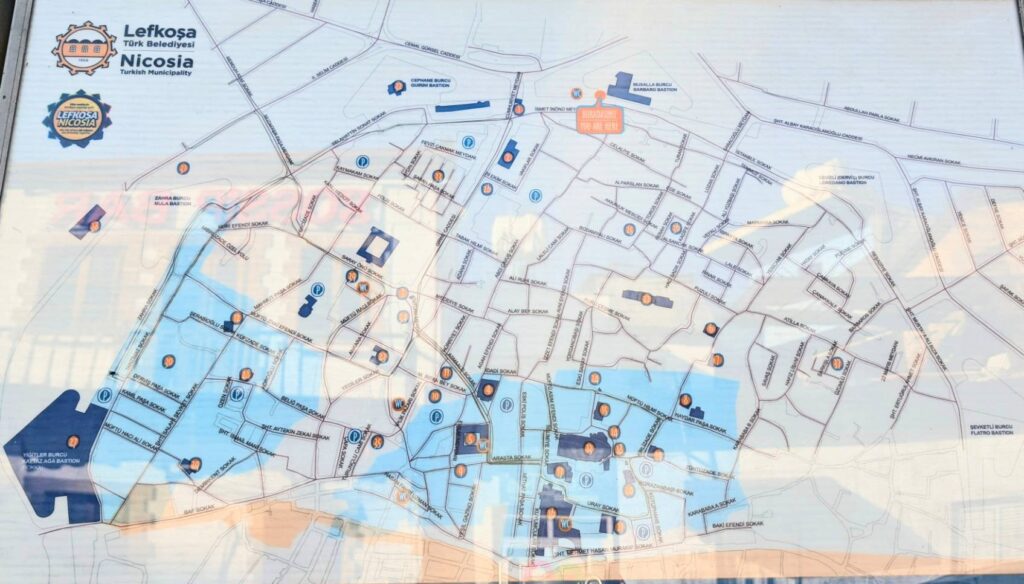
Photo 3: A map of Nicosia’s old city on a street information board on the northern side. In the maps in Photos 2 and 3, the circular old city is cut apart, and its whole cannot be captured.
References
Furuta, Motoo. “Zanryū Nihonjin no Nihon kikoku no haikei” [The Background of the Repatriation of Japanese Remainees to Japan]. In Ugokidashita tokei: Betonamu zanryū Nihonhei to sono kazoku [The Clock That Began to Move: Japanese Soldiers Who Remained in Vietnam and Their Families], by Miyuki Komatsu, 217–229. Tokyo: Mekong, 2020 (In Japanese).
Trouillot, Michel-Rolph. Silencing the Past: Power and the Production of History. 20th anniversary ed. Boston: Beacon Press, 2015. (Originally published in 1995).