

Introduction
On September 28 and 29, 2026, I participated in the International Reconciliation Project’s Summer School, titled “Political Imagination Beyond National Borders: Reconciliation in Postwar East Asia Conference,” at the Faculty of Asian and Middle Eastern Studies at Cambridge University. Although it was my first time attending the summer school, the conference was very insightful, and I had a wonderful time during this visit. In this report, I intend to provide a brief overview of my presentation and research networking at Cambridge.
Presentation and Q&A
On September 28, I gave a presentation titled “Returning to Asia: Shigemitsu Mamoru, the U.S.-Japan Security Treaty, and Asian Regionalism in the 1950s.” Drawing on my current research project on the relationship between postwar Japan’s security policy and the postwar rapprochement between Japan and Asian countries, I reexamined Shigemitsu Mamoru’s foreign policy conceptions. As Japan’s foreign minister under Tōjō Hideki, Koiso Kuniaki, Higashikuni Naruhiko, and Hatoyama Ichirō, Shigemitsu helped shape wartime and early postwar Japanese diplomacy. Historians have explored his foreign policy planning and demonstrated his consistent emphasis on building close relations with Asian countries, even beyond the Asia-Pacific War. They have also shown Shigemitsu’s postwar search for Japan’s rearmament and the withdrawal of U.S. military forces from Japan’s mainland. However, existing scholarship tends to examine Shigemitsu’s foreign policy planning toward Asia and his security planning separately. Therefore, in this presentation, I explored the connection between these two issues in postwar Shigemitsu diplomacy by focusing on the continuities in his diplomatic and security vision that transcend the Asia-Pacific War.
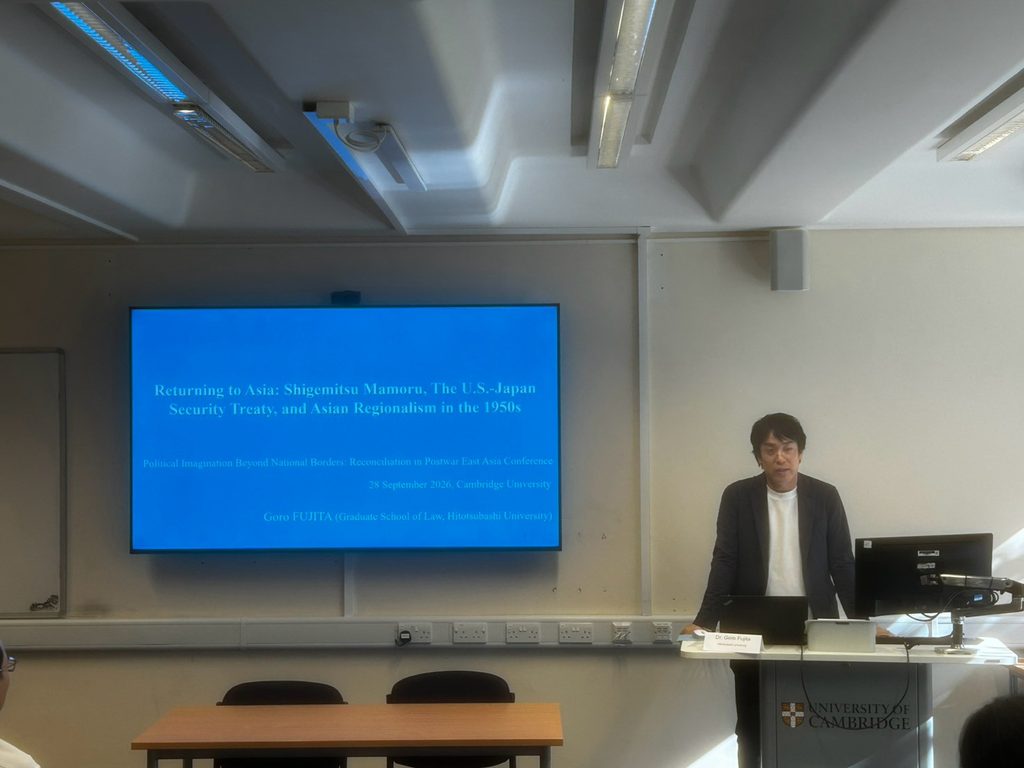
〈Photo:Faculty of Asian and Middle Eastern Studies, Cambridge University, September 28, 2026, Photo by Ikegami Keitoku, Photo of the author’s presentation〉
After the presentation, other participants asked me many insightful questions and offered comments. Some questions concerned Shigemitsu’s diplomatic and security planning. For example, I was asked about the relationship between Shigemitsu’s diplomacy toward the United States and Asian countries and his pursuit of Japan-Soviet normalization, as well as the distinction between Shigemitsu’s real intentions and the rhetoric in his statements and writings. Other questions addressed the characteristics of the Japanese vision for Asia and the United States beyond the Asia-Pacific War (in particular, how specific Shigemitsu’s vision was compared with that of other leading political elites). Through these (and other) questions and my replies, we engaged in intensive discussions about postwar Japan’s rapprochement with neighboring countries, U.S.-Japan relations, and continuities in Japanese diplomatic and security planning between the wartime and postwar periods.
Research Networking
Through participation in the 2026 summer school, I actively networked with other participants in addition to presenting, broadening my research scope. In particular, I exchanged views with Professor Barak Kushner, Japanese historians, and graduate students in the United Kingdom. These conversations provided valuable insights into current trends in modern Japanese history within British academia. Building on this new research network, I intend to help facilitate international research exchange.
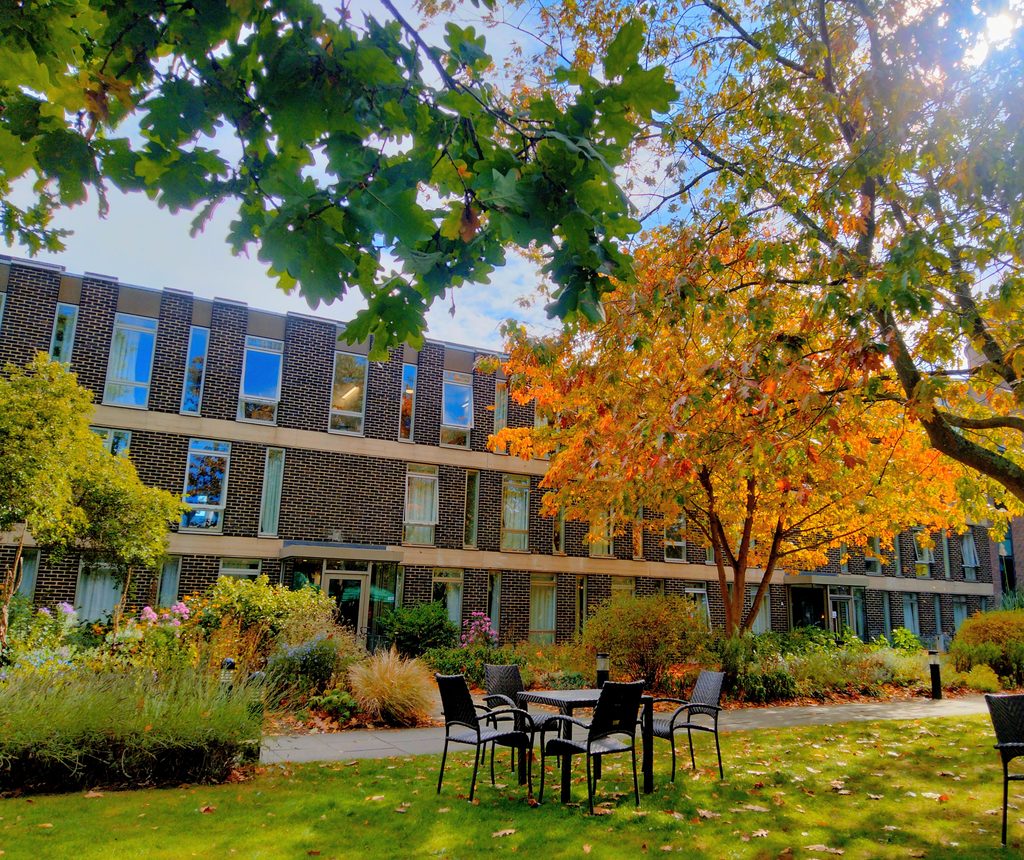
〈Photo:Fitzwilliam College, Cambridge University, September 30, 2026, Photo by Fujita Goro, Photo of the author’s accommodation (Fitzwilliam College, Cambridge University)〉
Conclusion
Participating in this summer school was highly insightful for my research and for networking. I am grateful to Professor Asano Toyomi, Professor Barak Kushner, the faculty and students at Cambridge University, my colleagues, and the staff of the International Reconciliation Project at Waseda University.
Acknowledgements
This research project is supported by JSPS KAKENHI (23K20033), Waseda University Grant for Special Research Projects (2025E-001), and Murata gakujutsu shinkō kyōiku zaidan kenkyū josei 2025.
Reference
Hatano, Sumio. Taiheiyō sensō to ajia gaikō, Tōkyō: Tōkyō daigaku shuppan kai, 1996
Iriye, Akira. Power and Culture: The Japanese-American War 1941-1945, Cambridge, MA: Harvard University
Press, 1981
Kushner, Barak and Sherzod Muminov, eds. The Dismantling of Japan’s Empire in East Asia:
Deimperialization, Postwar Legitimation and Imperial Afterlife, Routledge, 2017
Miyagi, Taizō. Bandon kaigi to Nihon no ajia fukki: Amerika to ajia no hazama de, Tōkyō: Sōshi sha, 2001
Pan, Liang. Nihon no kokuren gaikō: senzen kara gendai made, Nagoya: Nagoya daigaku shuppan kai, 2024
Sadō, Akihro. Sengo Nihon no bōei to seiji, Tōkyō: Yoshikawa kōbunkan, 2003
Sakamoto, Kazuya. Nichibei dōmei no Kizuna: anpo jōyaku to sōgosei no mosaku, Tōkyō: Yūhikaku, 2000
Swenson-Wright, John. Unequal Allies?: United States Security and Alliance Policy Toward Japan, 1945-1960,
Stanford, CA: Stanford University Press
Takeda, Tomoki. Shigemitsu Mamoru to sengo seiji, Tōkyō: Yoshikawa kōbunkan, 2002
Yellen, Jeremy A. The Greater East Asia Co-Prosperity Sphere: When Total Empire Met Total War, Ithaca:
Cornell University Press, 2019