

From September 26 to October 4, 2026, I had the privilege of participating in the 2026 Summer School of the International Association for Reconciliation Studies (IARS). During this period, we were invited by Professor Barak Kushner of the Faculty of Asian and Middle Eastern Studies at the University of Cambridge and Professor Martin Leiner of the Jena Center for Reconciliation Studies at Friedrich Schiller University Jena to participate in academic exchange activities at both universities under the leadership of Professor Toyomi Asano of Waseda University. I would like to express my sincere gratitude to the professors who invited us, Professor Asano, who led the overall project. This program not only gave me the opportunity to discuss international reconciliation with specialists from different academic fields and examine the political, cultural, and intellectual challenges facing reconciliation from new perspectives, but also deepened my understanding of the position of my own research subject—women-oriented popular culture—within the broader international landscape. I would like to elaborate on these insights below.
Since I came to Japan to study in 2022, I have been pursuing a research question concerning international reconciliation. In formal domains such as politics and economics, reconciliation between nations seems to face numerous obstacles, making progress difficult. By contrast, in the realm of popular cultural exchange among ordinary people, individuals appear to be more receptive to other cultures and more willing to engage with different cultural interpretations of the same subjec . This observation led me to focus on BL (Boys’ Love), a form of women-oriented popular culture shared between China and Japan, as a specific research subject. My research explores the potential for understanding and reconciliation between Chinese and Japanese fan communities as manifested through this cultural phenomenon.
In my presentation at the University of Cambridge, “The Reconciliation of Tradition and Non-Tradition: Clan-Based Culture in Chinese and Japanese Popular Works,” I selected two recent BL works from China and Japan that have attracted considerable public attention and examined how this seemingly unconventional form of contemporary popular culture interacts with traditional Asian social structures.
Through analysis, I reconsidered the concept of “reconciliation” in BL culture, popular culture, and the contemporary world more broadly. I argued that reconciliation between traditional societies and modern Western concepts does not require treating the two as entirely independent entities and then artificially establishing connections between them. Instead, it involves returning to their respective histories and discovering the affinities that already exist within these concepts themselves, thereby establishing a foundation for reconciliation and dialogue. Compared with domains such as politics and economics, where modern Western concepts often enjoy greater discursive authority, this historical continuity exists in more subtle and organic forms within popular culture, including BL. Consequently, audiences may find it easier to engage in communication and dialogue on the basis of this historical continuity.
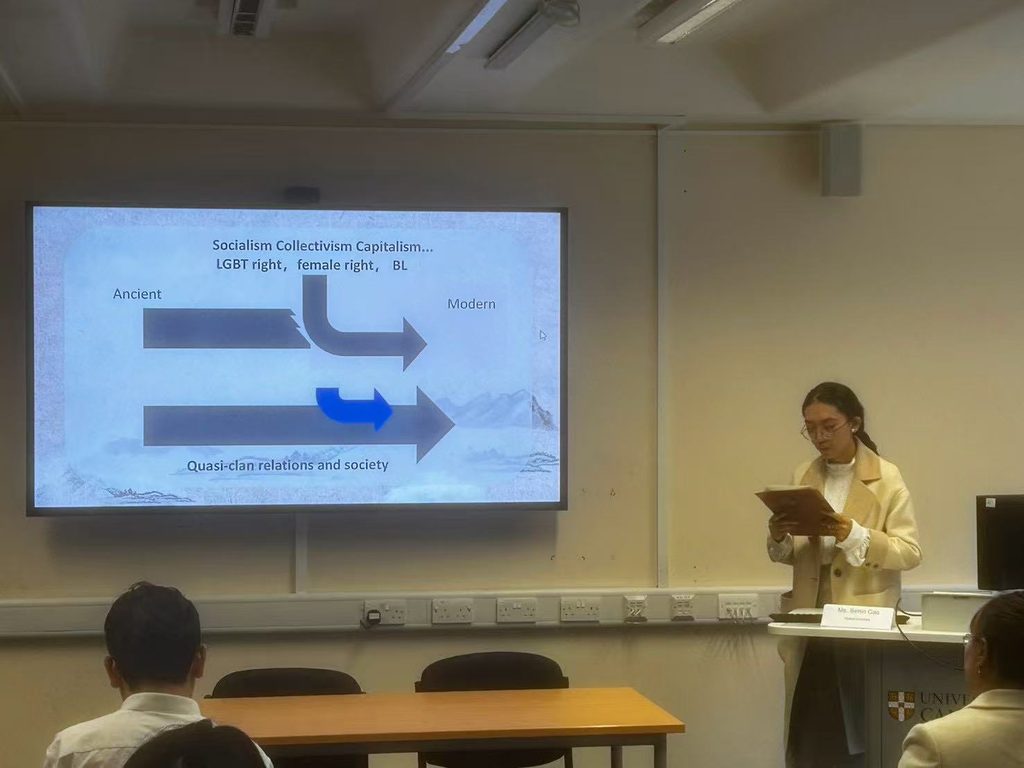
[Insert Photo 1: The Presenter and Historical Continuity in Asian Societies,Cambridge , photo taken by Mr. Ikegami Keitoku]
During the question-and-answer session, I received two types of questions and comments. The first came from younger researchers who were curious about BL as an emerging genre. Their questions included how the male characters depicted in BL differ from men in the real world, and what distinguishes BL from other forms of popular culture, such as manga, anime, and emerging forms of cosplay-related services. The second type of response came from researchers with more traditional backgrounds in history and international politics, who expressed skepticism about the role that popular culture and subculture could play in addressing serious international issues. They argued that popular culture is largely oriented toward entertainment and therefore may have difficulty exerting a tangible influence on concrete international problems. Indeed, an individual may be willing to maintain communication within Chinese and Japanese BL fan communities, yet find it much more difficult to continue a dialogue when confronted with acute political conflicts. Achieving reconciliation under such circumstances becomes even more challenging. Given its particular functions and purposes, popular culture undoubtedly has these limitations.
However, taking into account the discussions with the professors present at the program, as well as Professor Martin Leiner’s lectures on reconciliation studies during our subsequent visit to the University of Jena, I remain optimistic about the potential role of popular culture in international reconciliation.
Professor Leiner repeatedly emphasized the important role of negotiation in his lectures. The way popular culture integrates modernity, Western-derived concepts, and indigenous traditional values is itself a form of negotiation that begins with practice. In other words, rather than first examining historically how Western or modern concepts conflict with local traditions, or analyzing the two sides separately, popular culture begins by directly creating works that embody imaginative representations of their integration within a particular society. In this sense, popular culture can serve as a powerful medium for negotiation and reconciliation between nations.
Also, the enthusiasm of younger researchers for incorporating popular culture into academic discussions indicates its growing social significance.Their interest suggests that popular culture is beginning to transcend the boundaries of individual preference and emerge as a subject of broader social relevance, public discussion, and shared values.
At the same time, the presentations by other researchers on China-Japan, South Korea–Japan, and Japan–United States relations were well supported by historical evidence and offered rigorous, clear, and insightful analyses of the challenges currently facing regional politics. From the most practical perspective, reconciliation among countries in the Asia-Pacific region will remain an issue that demands our attention for the foreseeable future. Addressing regional problems through concrete policies and critical reflection on historical issues may continue to be essential to achieving regional reconciliation.
As someone without a specialized background in regional politics or history, I learned a great deal from the program, including information and research methods with which I had previously been less familiar. I hope to incorporate into my own research the meticulous collection and examination of historical materials demonstrated by scholars in these fields, together with their broader perspectives on the regional geopolitical landscape. Doing so, I believe, will enhance both the applicability and the analytical depth of my research.
I have long been troubled by the apparent disconnect between historical discussions and social practice. Put differently, there seems to be a persistent gap between analyses of the regional geopolitical landscape at the macro level and communication, interpersonal understanding, and mutual recognition at the individual level. People may find it relatively easy to achieve temporary reconciliation when interacting with specific individuals, setting aside their prejudices and historically conditioned positions. Yet when discussing macro-level political situations and abstract concepts of nationhood, they may readily revert to stereotypes or even extreme opinions.
During an academic exchange session at the University of Jena, Dr. Laura Vilenneva offered an answer to this question. She suggested that this gap could gradually be bridged through the involvement of a third party, such as the academic community, and the passage of time, provided that both sides remain committed to open dialogue and retain a willingness to change their views and understanding. For me, this idea of gradually transforming a polarized relationship by introducing a third dimension—the Other—and a fourth dimension—time—was one of the most valuable insights I gained from the program. It strengthened my confidence in the possibility of reconciliation.
Beyond providing invaluable opportunities for academic exchange, I would also like to express my special gratitude to the professors who organized historical tours of the University of Cambridge, Jena, and Leipzig. Through these visits, we were able to learn about the long history and distinctive institutional structure of the University of Cambridge. Since its origins as a development branching from the University of Oxford, Cambridge has cultivated a vibrant and inclusive academic culture while achieving excellence across a wide range of disciplines. The University of Jena, meanwhile, has a rich intellectual tradition and has educated outstanding scholars, including Marx, Hegel, and Leibniz. Leipzig, as a birthplace of the democratic movement in East Germany, also retains a particularly strong humanistic spirit. As I walked through these historically rich cities, seeing with my own eyes the world once seen by great thinkers, walking along the paths they once traveled, and listening to the voices they left behind, I became even more convinced that horizontal reconciliation between groups and societies is inseparable from a vertical understanding of the historical trajectories of particular regions and cultures.
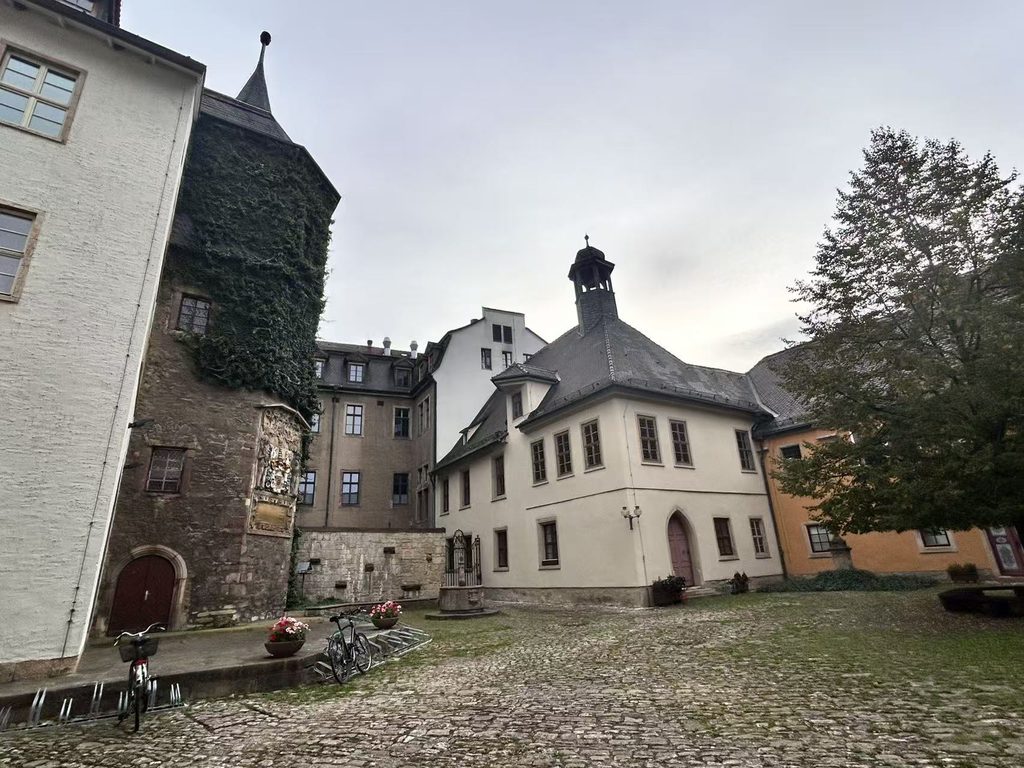
[Insert Photo 2: The Founding Site of the University of Jena, Jena, photo taken by author]
Looking ahead to my future research, I hope to articulate more clearly the insights I gained from this summer school concerning the continuity between historical traditions and modern life, as well as the role of popular culture in international reconciliation. I intend to develop these ideas into academic papers that can contribute to broader discussions in academia and society, opening up perspectives that engage with different disciplines and different ways of understanding the world.