

1. Overview
From September 27 to October 3, 2026, I participated in international conferences and a summer school held at the University of Cambridge in the United Kingdom and Friedrich Schiller University Jena in Germany as part of Waseda University’s Reconciliation Studies research project.
On September 28 and 29, the University of Cambridge hosted the conference “Political Imagination Beyond National Borders: Reconciliation in Postwar East Asia.” The conference featured research presentations and discussions on historical perceptions, diplomacy and security, culture, and memory in relation to reconciliation in postwar East Asia.
On October 1, I attended “Asian Perspective on Reconciliation Studies” at Friedrich Schiller University Jena, where participants discussed theoretical frameworks for reconciliation studies and specific cases from various parts of Asia. On October 2, I visited Leipzig and participated in a field excursion focusing on the end of the Cold War and German reunification.
The summer school provided a valuable opportunity to examine the concept of reconciliation from historical and theoretical perspectives through exchanges with scholars from different regions and academic disciplines. It also encouraged me to reconsider issues in Asia beyond the conventional framework of nation-states.
2. Research Presentations and Discussions at the University of Cambridge
The conference on September 28 began with opening remarks by Professor Barak Kushner of the University of Cambridge, followed by a keynote lecture by Professor Toyomi Asano of Waseda University.
In his keynote lecture, Professor Asano emphasized the importance of shared historical understandings and political discourse in considering reconciliation between states. I was particularly struck by his observation that Japan and South Korea have yet to develop a sufficient “common currency” for discussing historical issues. He also raised a fundamental question about democracy: although democratic decision-making presupposes a sense of collective identity or “we,” the boundaries of that political community cannot themselves be determined solely through democratic procedures. This argument prompted me to reflect on how domestic politics and international relations interact and mutually shape one another.
During the morning sessions, Qu Yang presented research on wartime propaganda and the formation of postwar memory, while Simin Cao examined representations of traditional and non-traditional elements in Chinese and Japanese boys’ love (BL) works. These presentations offered perspectives on reconciliation that differed from conventional political and diplomatic history. I found the discussions of changing narratives of war responsibility in Chinese society and gender representations in cultural works especially thought-provoking.
The afternoon sessions featured presentations by Goro Fujita on Mamoru Shigemitsu’s Asian regionalism and postwar security vision, Fumi Inoue on the formation of the postwar Japan–U.S. security system, and Takahiro Hamasuna on Japan’s Constitution and Okinawa in the 1950s. Fujita’s presentation examined how Shigemitsu envisioned a postwar regional order grounded in the principles of international cooperation and the United Nations Charter, while taking into account both Asian nationalism and U.S. military involvement in the region.
As the final presenter of the day, I delivered a paper entitled “Reinterpreting the 1969 Sato-Nixon Agreement: U.S. Nuclear Strategy and the Okinawa Reversion.” In my presentation, I reexamined the 1969 Sato-Nixon Agreement not only in the context of diplomatic negotiations between the Japanese and U.S. governments but also in relation to U.S. nuclear strategy and military operational planning. In particular, I focused on the relationship between the removal of nuclear weapons from Okinawa and U.S. military requirements, including the Single Integrated Operational Plan (SIOP), which envisioned a large-scale nuclear war against the Soviet Union and the communist bloc, as well as contingency planning for the Korean Peninsula. Through this analysis, I sought to situate the negotiations over Okinawa’s reversion within the transformation of the security order in the Asia-Pacific region during the Cold War.
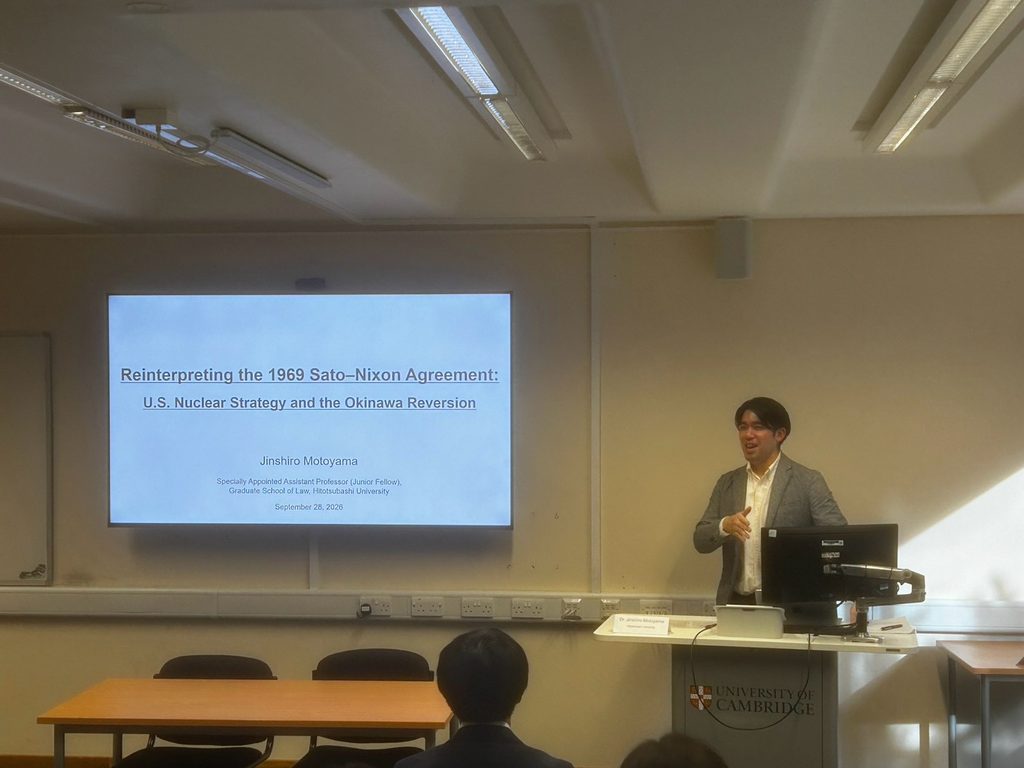
During the general discussion, participants emphasized the need to examine reconciliation involving postwar Japan from a multilateral perspective encompassing China, the Korean Peninsula, and Southeast Asia, rather than limiting the analysis to bilateral Japan–U.S. relations. Professor Kushner also raised an important question about how scholars can communicate their research findings to audiences outside their own areas of specialization. These discussions reinforced my awareness of the importance of situating Okinawa’s reversion within the broader international order of East Asia and connecting my research to questions of postwar reconciliation.
On September 29, the presentations focused on the restitution of cultural heritage, memories of historical violence, and representations of heroism and terrorism. Keitoku Ikegami examined disputes over the return of cultural property between Japan and South Korea. His presentation demonstrated how the differing terms used by the two countries—”donation” on the Japanese side and “restitution” on the South Korean side—were connected to the framework established by the normalization of diplomatic relations in 1965. Tatsuya Maisawa discussed the establishment of a memorial commemorating the Donghak Peasant Revolution in Korea. His presentation highlighted efforts to inscribe the names of victims regardless of their positions during the conflict and introduced the influence of Okinawa’s Cornerstone of Peace on this commemorative initiative. Björn Wickman’s presentation compared South Korea and Finland, focusing on differences in the historical evaluation of figures regarded as heroes or terrorists. He examined the role of collective memory in domestic politics and international relations.
Together, these presentations demonstrated that cultural heritage and memorials are not merely means of preserving the past but also play important roles in shaping political legitimacy and collective memory in contemporary societies.
3. Summer School at Friedrich Schiller University Jena
On September 30, I traveled from the United Kingdom to Germany. The following day, I participated in “Asian Perspective on Reconciliation Studies” at Friedrich Schiller University Jena.
The morning session featured a lecture entitled “Negotiation and Reconciliation” by Professor Martin Leiner. Using a parable about dividing 17 camels among heirs, the parable suggested to me that how new solutions can emerge when parties reconsider the framework of a problem rather than treating their competing demands as fixed. This discussion provided a valuable perspective on reconciliation as a process that involves transforming the perceptions and relationships of the parties concerned, rather than merely reaching compromises or adjusting competing interests.
The afternoon sessions featured presentations by Cao Thi Minh Chau on reconciliation within the Vietnamese diaspora in Germany, Huijia Teh on the Sustainable Development Goals (SDGs) and global governance in Malaysian universities, and Arauf Aji Harindra Sakti on religious moderation in Indonesian secondary education. These presentations helped me understand that reconciliation is not limited to diplomatic relations between states but also concerns diverse social contexts, including migrant communities, educational institutions, and religious communities.
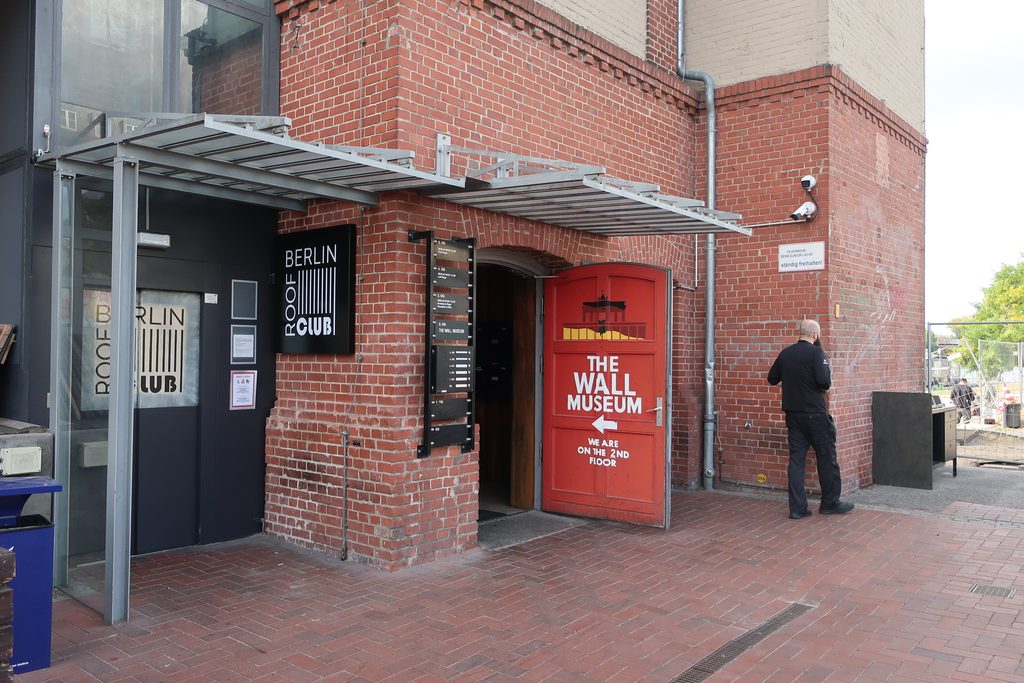
On October 2, I visited Leipzig and participated in a field excursion on the end of the Cold War and German reunification, guided by Professor Leiner. On the final day, I independently visited the Wall Museum in Berlin.
These visits provided an opportunity to consider the end of the Cold War not merely as an event in international politics but also in relation to the historical experiences of local communities and ordinary citizens.
4. Outcomes and Implications for Future Research
Through this summer school, I was reminded that reconciliation studies is an interdisciplinary field encompassing diplomatic history, political science, cultural studies, memory studies, education, and other disciplines. One of the most important insights I gained was that reconciliation does not necessarily end with agreements between states. Rather, it is sustained through the development of shared historical understandings, the formation of collective memory, and continued dialogue among the parties concerned.
The discussions also encouraged me to reconsider my own research on Okinawa’s reversion and U.S. nuclear strategy. Rather than treating Okinawa’s reversion solely as the outcome of a diplomatic agreement between the Japanese and U.S. governments, I recognized the need to examine it in relation to the historical experiences of Okinawan society and the broader security order in East Asia.
Furthermore, situating Japan–U.S. relations within a wider regional history encompassing the Korean Peninsula, China, and the Pacific Islands will be essential for developing my future research. The opportunity to engage in discussions in English with scholars from different countries was also invaluable in helping me articulate the central questions and broader significance of my research to an international audience.
Building on the insights and academic connections gained through this summer school, I intend to further develop my research on U.S. nuclear strategy and Okinawa’s reversion by incorporating perspectives from reconciliation studies and examining the broader relationship between Cold War security policies and postwar reconciliation in East Asia.
Note: This research project is supported by JSPS KAKENHI (23K20033 and 26K24181), Mishima Kaiun Memorial Foundation kenkyu joesei (2025) and Murata gakujutsu shinkö kyöiku zaidan kenkyu josei (2025).