

From late September to early October 2026, I participated in the International Reconciliation Studies Project’s summer school, held in the United Kingdom and Germany. As part of this programme, I had the opportunity to present my research, entitled “Cultural Heritage at the Crossroads of Nation-Building: Japan–South Korea Restitution Disputes,” at the “Political Imagination Beyond National Borders: Reconciliation in Postwar East Asia Conference,” held on 28–29 September at the Faculty of Asian and Middle Eastern Studies, University of Cambridge. I would first like to express my sincere gratitude to the International Reconciliation Studies Project, led by Professor Toyomi Asano, for providing this valuable opportunity; to Professor Barak Kushner, who warmly welcomed us during our visit; to everyone involved in organising and hosting the conference; and to the participants who offered questions and comments. My participation prompted me to reconsider both the effectiveness of the analytical framework I have developed for studying cultural property issues between Japan and South Korea and the challenges concerning its scope. In what follows, I outline my presentation before reflecting on the research questions that emerged from one exchange during the discussion.
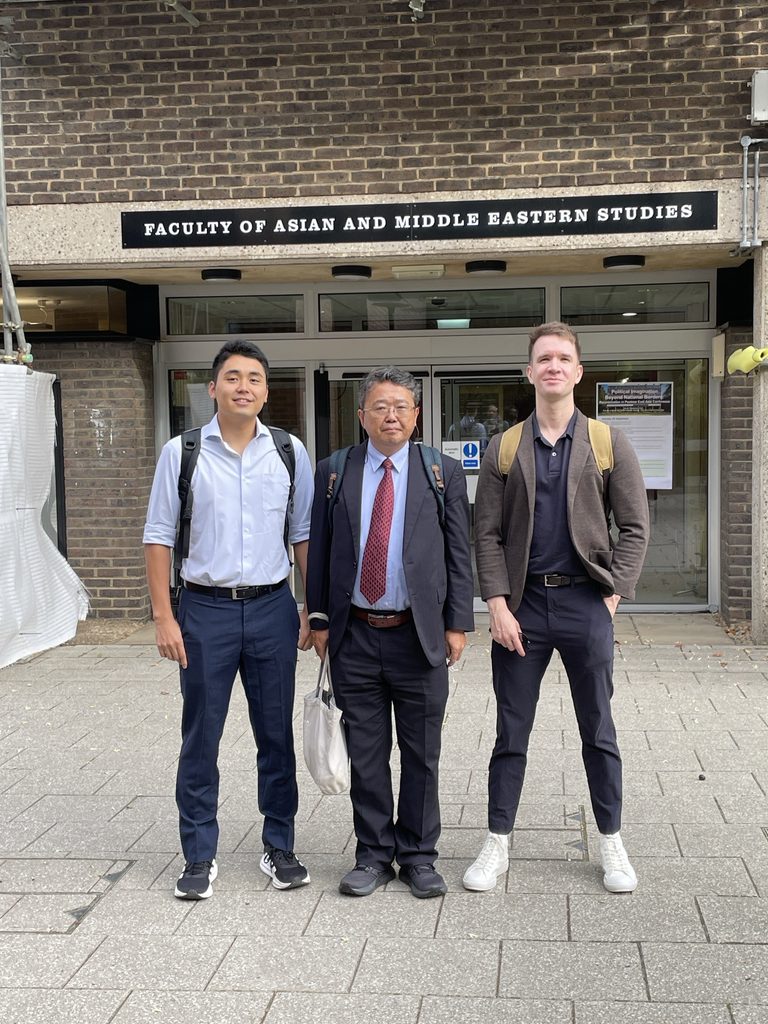
(Photo 1: Outside the conference venue.
From left: the author, Professor Toyomi Asano, and Dr Bjorn Wickman.)
In recent years, the restitution of cultural property removed from its countries of origin during colonial rule has advanced across the world. Even in relations between Japan and South Korea, where deep divisions persist over understandings of the colonial past, cultural property restitution—including the transfer of Kangetsudō to South Korea in 2025—has been welcomed as a practice symbolising future-oriented friendship and reconciliation. Meanwhile, demands for the return of the Ogura Collection and the Icheon Five-Storey Stone Pagoda continue, bringing conflicting historical understandings to the fore over where cultural property should be held. Why have some cultural properties been transferred to South Korea while others remain in Japan? My presentation examined the discursive and institutional structures that have produced these divergent outcomes.
To address this question, I first analysed the “1965 system,” which continues to shape contemporary Japan–South Korea relations, and the bilateral normalisation talks through which it emerged, focusing on cultural property issues. I then compared the intergovernmental “handovers” of 1958, 1965, and 2011; the physical transfers of the Bukgwan Victory Monument, the Odaesan archive copies of the Annals of the Joseon Dynasty, and Kangetsudō; and the continued retention in Japan of the Ogura Collection and the Icheon Five-Storey Stone Pagoda despite demands for their return.
As previous scholarship has demonstrated, the 1965 system institutionalised “handover” as the form of intergovernmental transfer, leaving both the historical and legal significance of such transfers undetermined and the two countries’ differing understandings of colonial rule unresolved. It also established a framework under which decisions concerning non-state-owned cultural property were left to the voluntary initiative of owners, subject to the constraints of Japanese domestic law. My presentation showed how, within this overarching framework, political circumstances shaped intergovernmental transfers, while owners’ understandings, legal status, and organisational logics shaped the actions of non-governmental actors, selectively producing either transfer or continued retention. The movement and non-movement of cultural property can therefore be understood not as contradictory phenomena, but as outcomes of different variables operating within the same structure.
To conceptualise this structure, I employed “Authorized Heritage Discourse” (AHD), a concept that has been central to my research. In South Korea, cultural property removed during the colonial period is positioned as “cultural heritage located overseas” that ought to be returned. In Japan, by contrast, it is positioned as “Japanese cultural property” preserved and used under lawful ownership. These understandings of heritage are supported by each country’s domestic institutions and, through those institutions, reproduced at the level of public understanding. Cultural property issues between Japan and South Korea can thus be understood as arising where differing conceptions of heritage, embedded in each country’s nation-building, collide over the meaning and treatment of the same cultural property.
I further considered these findings by distinguishing among intergovernmental reconciliation, reconciliation between citizens, and reconciliation between nations. Intergovernmental “handovers” can be understood as a form of intergovernmental reconciliation through political compromise, seeking to improve relations while leaving divergent historical understandings unresolved. Individual transfers by non-governmental actors can, in turn, be regarded as reconciliation between citizens that helps address gaps left by the 1965 system. Yet these transfers also take place within the limits permitted by that system and Japanese domestic law. They therefore appear as a form of “reconciliation between citizens conditioned by intergovernmental reconciliation.”
The realisation of these transfers must, however, be distinguished from a transformation of the conflictual relationship between the two countries’ AHDs. The cases examined did not establish evidence of change amounting to reconciliation between nations. In this sense, although the physical transfer of cultural property may constitute a limited form of reconciliation, its occurrence cannot itself be equated with reconciliation between nations. Moreover, each form of reconciliation has the potential to marginalise particular memories and actors. Accordingly, when interpreting cultural property transfers as reconciliation, it is necessary not only to evaluate their realisation positively, but also to bring the violence inherent in the process within the scope of analysis. I presented this as a question for future research.
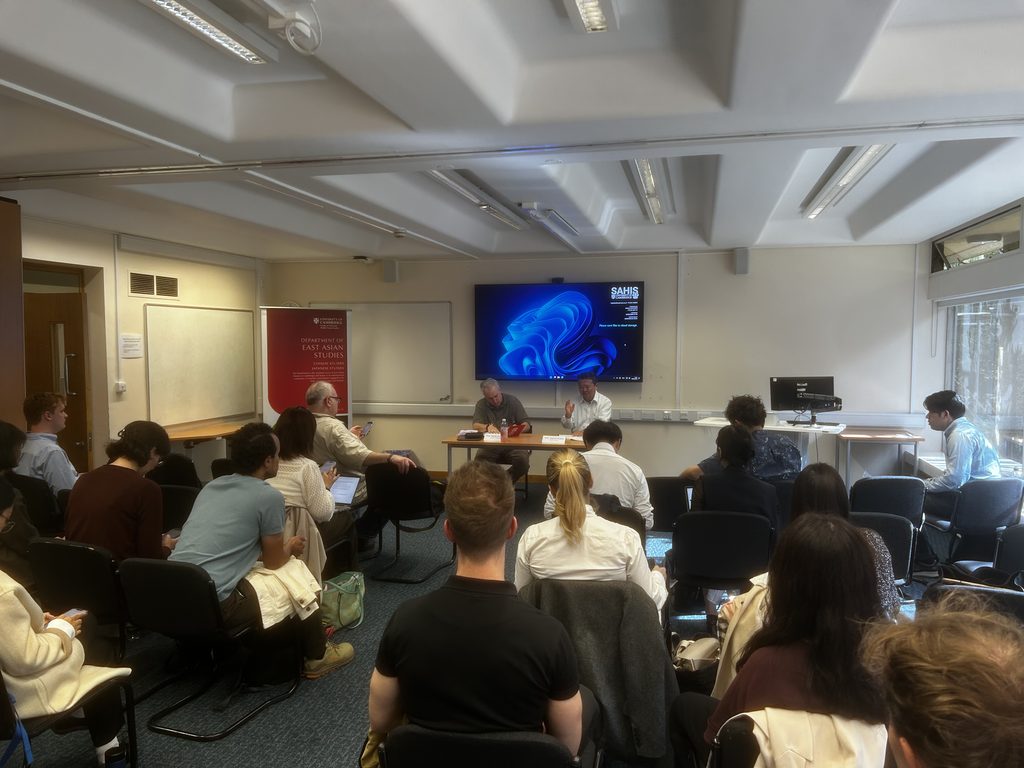
(Photo 2: The conference in session, with approximately 30 participants.)
The presentation elicited highly thought-provoking questions and comments from the audience. One question, for example, concerned how cultural property was treated under the particular conditions of the Cold War, and how this differed from its treatment during colonial rule or after the Cold War, periods characterised by dramatically different political environments. This was an important question about both the explanatory power of my framework and its theoretical capacity to capture historical realities in sufficient detail. When combined with theories of nationalism at the domestic level and insights from cultural policy studies, including “object diplomacy,” at the international level, AHD offers a useful perspective for explaining the political dynamics surrounding cultural property between Japan and South Korea. What is cultural property understood to symbolise? What institutions and understandings sustain those meanings, and how do they shape diplomatic practices and practices of ownership? Starting from these questions, it is possible to examine the colonial, Cold War, and post-Cold War periods within a shared analytical framework.
Yet the question prompted me to reconsider how the very capacity to provide a comprehensive explanation can also become an analytical limitation. Explaining cultural property issues across different periods through the same framework has value as a form of social-scientific generalisation. At the same time, unless the political environments and power relations specific to each period are adequately captured, such an explanation risks abstracting away important differences. Identifying a shared structure is not necessarily the same as explaining why a particular event occurred at a particular moment and in a particular form.
My approach to international cultural property disputes through AHD draws on constructivism in International Relations: rather than treating state interests as given, it attends to the processes through which they are socially and historically constituted. From this standpoint, it is important not merely to identify common structures, but also to explain how meanings and understandings were formed in particular cases and how they guided concrete actions. I understood the question not as a rejection of my existing comprehensive account, but as an indication of the need to develop it into a more precise explanation grounded in historical context. This challenge is equally important when considering cultural property issues through the lens of “reconciliation.” Even when described by the same terms—“handover” or “restitution”—the meaning of an action differs according to the period and the actors involved. What became possible, what remained unresolved, and whose memories or demands were left out? Without examining these questions in concrete terms, we cannot discuss cultural property transfers collectively as “reconciliation.”
Participating in this summer school was both an opportunity to share my research findings and an occasion to reconsider what my research can explain and what it has yet to explain adequately. Building on the analytical framework I have developed, I intend to examine more closely the political environments, institutions, and actors’ understandings specific to each period. I hope to carry the questions raised at the University of Cambridge forward into my future research on cultural property issues between Japan and South Korea and on international reconciliation.

(Photo 3: Fish and chips shaped like a shachihoko.)