I had the opportunity to participate in the summer school from the 16th to the 23rd of September 2025 in Arlington, Virginia, and Washington, D.C., in the USA. I was excited to go because, while I had been to the US when I was a child, that was so long ago that, for all intents and purposes, I consider this my first visit. The summer school itself consisted of lectures by professors at George Mason University (henceforth GMU), a presentation by Dr Pau Sian Lian at the German Marshall Fund about the current situation in Myanmar and the potential examples of reconciliation taking place during the civil war, visits to museums and monuments, our, the participants’, own presentations and pasticipation in the Peace Week serious of lectures at GMU.
Out of the presentations, I found the lectures given by GMU’s four professors particularly memorable, each offering an important empirical or theoretical insight. Prof. Karina Korostelina’s emphasis on the need to break out of one-sided narratives of heroes and villains in historical memory formation — that is, recognizing that both one’s own heroes and those of one’s supposed ‘enemies’ can also be villains — Prof. Marc Gopin’s argument that reconciliation should begin with actions rather than words — through kindness and unneighborly mutual aid rather than mere verbal confessions and deliberations — and Prof. Jeffrey Helsing’s point that learning is not simply about memorising data but about being affected and transformed by what one learns have all deepened my understanding of reconciliation.
However, I want to give special attention to Prof Daniel Rothbart’s lecture, since, like myself, he also specialises in philosophy. He quoted a report by South Africa’s Truth and Reconciliation Committee (henceforth SATRC), and two points stood out to me in particular: one should share‘ in the shame at the capacity of human beings of any race or language group to be inhumane to other human beings’ and that by denying black South Africans human dignity ‘thereby the dignity of all South Africans was diminished’. I applaud these statements because, even though they are referring, they emphasise the universality that transcends the particular embeddedness of the historical context (apartheid) of this process. Being aware of one’s capacity to do inhumane things is particularly important when the sides of the victim and perpetrator are one- sided: Prof. Korostelina’s point about seeing both sides of factions and holding both their perspectives together in a contradictory way definitely applies well in relatively symmetrical conflicts, but in clearly asymmetrical grievances, like the holocaust, such an argument can come across as a bit tone-deaf. Which is why it is important to emphasise the capacity to do an inhumane act, since that is something we all universally share, even when the grievances are clearly one-sided. The second quote is also based on a universalist position with its emphasis on how the exclusion of one implies the exclusion of all. One’s place — that is, one’s identity and sense of belonging — within society is not as secure as one would like to believe, but is always in danger of slipping away, and the case of excluded black South Africans in apartheid reveals the truth of this insecurity. That is why combating apartheid was an endeavor with universal impacts that would transform South African society as a whole and reverberate far beyond.
This brings me to our visit to the United States Holocaust Memorial Museum (henceforth USHMM). I have already visited Auschwitz in Poland twice, and seeing the concentration camp itself is far more impactful than any museum, so I cannot say I saw or learned anything particularly new except the solemnity of the Hall of Remembrance. However, there was an extra exhibition about the genocide in Myanmar, which gave me pause. If USHMM also holds an exhibition about other atrocities in line with its slogan of ‘never again’, will it ever hold one about the current war between Israel and Hamas, in which many accuse Israel of genocide? I find it very discouraging that the Holocaust has been weaponised to deflect any criticisms of Israel’s actions. It seems that Israel, a nation allegedly founded as a haven for a people to escape prosecution and genocide, did not take SATRC’s lesson about recognising one’s capacity for inhumane acts.
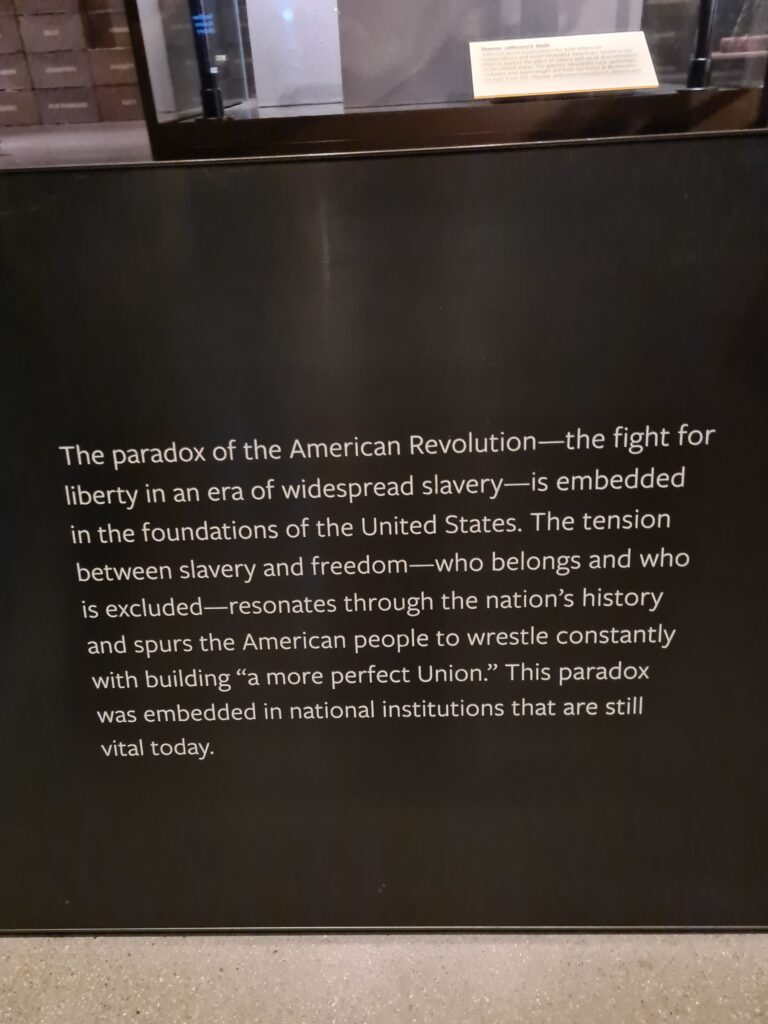
We also visited the National Museum of African American History and Culture (henceforth NMAAHC). I found the NMAAHC more interesting, although it also suffers from what I call a ‘textbook format’ of presentation. In other words, too much information is given through text, all of which one could maybe read if one stayed the whole day in the museum, but I doubt many people do that. Thus, one’s visit always feels rushed and incomplete, since there is so much one has to skip to not stay in too long, especially if there’s a timetable one should adhere to. Nonetheless, I found the visit illuminating, especially how the African American struggle compelled the US to change, which echoed the point made by the SATRC about the indignity of one equaling the indignity of all.
While the above quote can be interpreted in various ways, I see it as an embrace of the contradictory nature of the US as a country whose liberties are made possible by the tension, the antagonism that runs threw it — the contradiction between freedom and slavery being the most obvious example.
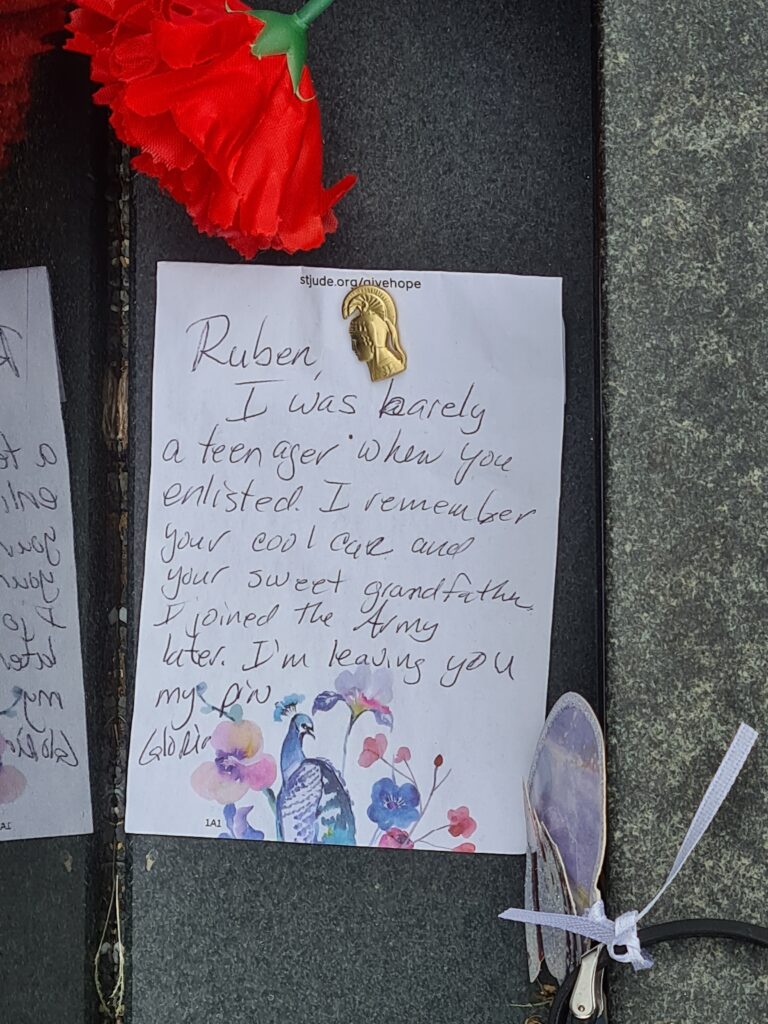
Another memorable experience was visiting the World War II, Korean War, and Vietnam War memorials in Washington, D.C. While said memorials can clearly be described as instances of propaganda, I was surprised to find personal dedications being left there by family and friends to specific individuals, even though these wars happened at least 50 years ago.
For some people, these monuments are not just abstract propaganda from a long distant war, but a dedication to family members and close friends. When seeing these very personal letters, I could not help but think back to Prof. Korostelina’s point about the dialectical coincidence of heroes and villains. Hypothetically, if it came to light that the individuals to whom these letters are dedicated were involved in war crimes, what does this imply for the future of the monuments? Would they have to be dismantled? While I understand why Confederate statues are considered undesirable nowadays, I do not think one can look at these monuments through the same lens. If people who were close to these fallen soldiers and to whom such dedications bring a feeling of solace and closure, taking this away from them would likely breed much resentment, which would get in the way of any potential for reconciliation. People must be allowed to grieve for their loved ones even when said loved ones might be the most hated ones in the eyes of another. If this right is denied, there will be little readiness to listen to the other side, which will only engender the further entrenchment of a Schmittian friend/enemy worldview.
Concerning our accommodation, we stayed at a motel, a uniquely American form of accommodation, that was showing its years. While rats and cockroaches are an undoubtedly unpleasant sight, I do not consider them ‘deal breakers’, but the rumours of bedbug infestation kept me quite paranoid. Otherwise, I was pleasantly surprised by the local habit of thanking bus drivers when getting off public transportation. After seeing that, I made sure to follow suit. For a country that is usually perceived as a bulwark of individualism, it was heartwarming to see such a collectivist practice of solidarity.