Abstract of the presentation
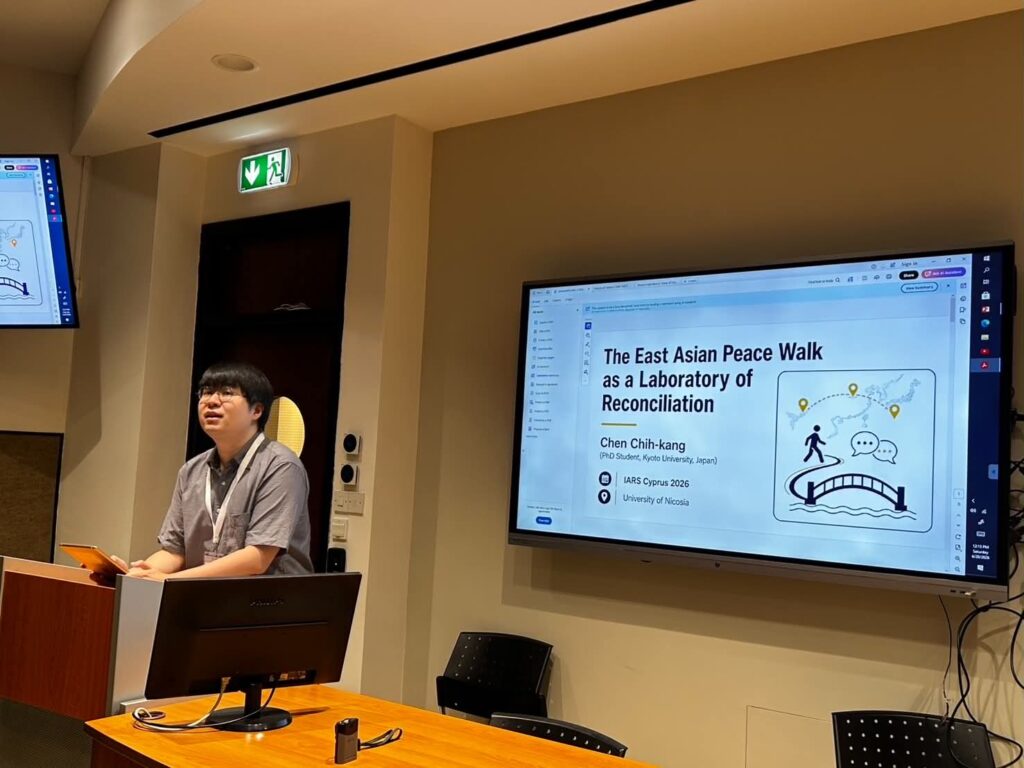
The following is the abstract of the paper presented at IARS 2026 in Cyprus under the title “The East Asian Peace Walk as a Laboratory of Reconciliation.”
This paper examines the East Asian Peace Walk as a practical laboratory of reconciliation in the context of rising security tensions surrounding a possible Taiwan contingency. Rather than understanding reconciliation as the elimination of political differences or the achievement of consensus, the paper argues that reconciliation should be understood as the creation of conditions for dialogue through shared bodily experience, face-to-face encounters, and mutual understanding.
The discussion begins by outlining two contrasting perspectives. In Okinawa, fears of a Taiwan Strait conflict are shaped by both the concentration of U.S. military bases and the collective memory of the Battle of Okinawa, which foster a deep skepticism toward militarization. In contrast, many Taiwanese regard military preparedness as essential to defending their democracy and autonomy against the growing threat posed by China. These differing historical experiences often produce misunderstanding between Taiwanese and Okinawan peace advocates.
Drawing on the my participation in the 2025 East Asian Peace Walk on Ishigaki and Yonaguni Islands, the paper analyzes the walk as a “laboratory of reconciliation.” It identifies three dimensions of this experience. First, it is an experiment of the body, as participants walk long distances and experience the islands’ geography, climate, and environment directly rather than discussing peace only in abstract terms. Second, it is an experiment of relationships, bringing together Taiwanese, Okinawans, Japanese participants, religious practitioners, activists, and residents who live, eat, and travel together. Third, it is an experiment of understanding, in which participants do not necessarily change their political positions but come to understand the origins of one another’s fears and concerns.
My conversations with residents of Ishigaki and Yonaguni revealed widespread anxieties about wartime evacuation and the possible loss of their hometowns and communities. As a Taiwanese participant, I recognized that these fears closely resemble Taiwanese concerns about losing their homeland through military aggression. While the political judgments of the two societies remain different, both share a profound attachment to place and a fear of displacement. Walking through the islands also transformed Okinawa from an abstract strategic space into a lived landscape filled with communities, memories, and everyday life.
The paper concludes that the significance of the East Asian Peace Walk lies not in producing political agreement but in cultivating empathy across disagreement. By enabling participants to experience one another’s lands and lives directly, the walk encourages a shift from viewing East Asia solely through the language of geopolitics and military strategy toward understanding it as a region of shared human vulnerability. Such embodied dialogue does not resolve political conflicts, but it provides an essential foundation for reconciliation and contributes to imagining more humane approaches to peace and security in East Asia.
Discussion
Regarding this paper, Professor Hirai commented that it presented a moving account of the 2025 East Asian Peace Walk as a “laboratory of reconciliation.” He particularly appreciated my effort to maintain my own position on Taiwan’s right to self-defense while also gaining a deeper understanding of why Okinawans fear war.
Professor Hirai also raised two questions. First, he asked whether reconciliation had been mutual, questioning whether the Okinawan and mainland Japanese participants had also changed their understanding of Taiwan. Second, he asked about the limits of the peace-walk model, wondering whether it could also be applied to conflicts where democratic values are not shared, such as between Taiwan and China or Ukraine and Russia.
In response, I explained that an Okinawan participant had once asked me why Taiwan was unwilling to accept Chinese rule if doing so could avoid war. I replied that, from a Taiwanese perspective, the current situation in Hong Kong demonstrates that the absence of war does not necessarily mean genuine peace. After our discussion, the participant commented that, while Okinawa’s anti-war position remained unchanged, Okinawans should also make greater efforts to understand the situations in Taiwan, Hong Kong, and mainland China. He later visited Taiwan and spoke directly with Taiwanese people, which I regard as a meaningful example of mutual understanding.
Regarding the second question, I agreed that this kind of dialogue largely depends on the existence of freedom and democracy. Although participants from mainland China also joined the Peace Walk, some did so anonymously out of concern for their safety. While meaningful conversations were possible at the individual level, it remains difficult to assess whether such exchanges can have any broader influence under China’s current political system.
Other learnings in the conference
During the conference, I also attended a session featuring two former negotiators involved in the Cyprus peace process. According to their presentations, the severity of the conflicts in the last century has led both the Greek Cypriot and Turkish Cypriot sides to remain committed to addressing current issues through peaceful means. Seeing negotiators from both sides sit together to discuss and share their experiences left a strong impression on me as a participant from Taiwan, especially given that there are currently no official channels of dialogue between the two sides of the Taiwan Strait.
I also attended a session on the Committee on Missing Persons in Cyprus (CMP), where Greek Cypriot and Turkish Cypriot archaeologists shared their experiences of excavating the remains of victims from the conflicts of the last century, identifying them through scientific methods, and returning them to their families. One remark particularly impressed me: “Behind every victim there is a family and a circle of friends, which means that the impact on society extends far beyond the number of those who lost their lives.” This perspective left a deep impression on me.