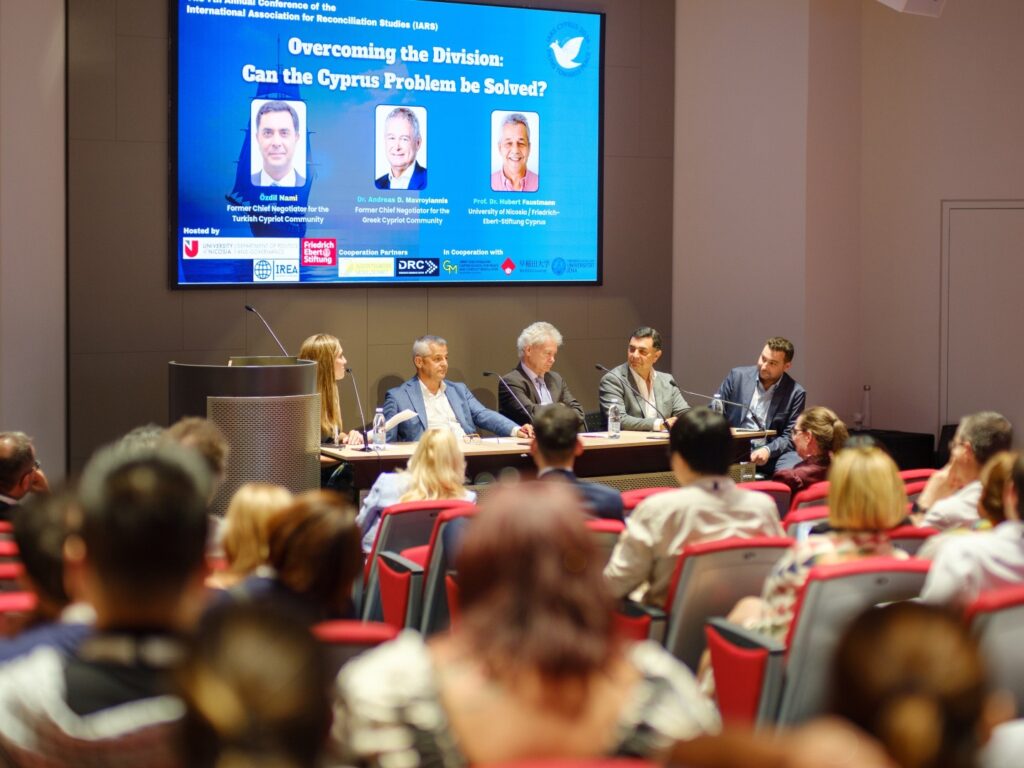
Attending the IARS conference in Cyprus, I presented my paper on identity expansion and the development of orientations toward peace among ASEAN students in Japan. Not only did I have an insightful discussion with the audience about the paper; I also learned a great deal about reconciliation through a deeper understanding of the Cyprus problem.
Summary of the Presentation
My paper begins from an assumption that has quietly justified decades of student mobility: international education promotes peace. The long-standing belief underpinning exchange and scholarship programs worldwide holds that cross-cultural contact broadens perspectives and softens the lines between nations. It is a promising idea; it is also, I argue, an under-tested one. Most research on study abroad measures academic gains, career outcomes, or intercultural competence rather than peace-related outcomes directly.
To address this gap, I proposed a mechanism: identity expansion — the extension of one’s sense of “we” beyond the nation, toward broader communities, regional and global. Drawing on a mixed-methods design (a survey of 301 students and 69 interviews, spanning all ten ASEAN nations), I examined how identity develops during international education in Japan, and what orientations toward peace emerge as it does. Kelman’s three perception changes in reconciliation (of the other, the self, and the relationship) served as my analytical entry point.
The findings complicate this assumption rather than confirming it. Students did expand their sense of belonging without sacrificing national attachment; indeed, the two could reinforce one another. But expansion alone accounted for little of how peace-oriented outcomes developed. What mattered was its quality. Students who genuinely, emotionally incorporated broader communities developed peace-relevant orientations; those who adopted the language of global belonging as a career asset, or grasped it intellectually without feeling it, did not. The orientations themselves developed unevenly. Understanding emerged readily. For instance, students could interrogate their own national narratives with striking honesty. Belonging, on the other hand, developed conditionally, often through deep and meaningful encounters rather than mere exposure. Finally, commitment to act arose rarely, if at all. This agentic bottleneck seemed to be the most stubborn, persisting even among students with years of immersion under otherwise favorable conditions. International education, I concluded, can begin to cultivate readiness for peace among individual students. However, transforming this readiness to society-wide effect would require supporting structures beyond the classroom.
Questions and Discussion
The most valuable response came from Prof. Karina Korostelina, whose two comments each pressed on a soft point in my argument. Her first comment concerned my finding on the agentic bottleneck. I had attributed this barrier to a lack of structural support — networks, platforms, or the circuitry needed to carry personal change outward. She pushed back, suggesting that the capacity to act collectively might transfer through other means even in the absence of such structures. Her point was that the bridge from individual to collective is not only structural but psychological, and that self-efficacy — the belief that one’s action can matter — is central to it. This observation resonates strongly with the work of van Zomeren and colleagues (2008), which I had reviewed in my article but not discussed in detail. My own data records the same dynamic directly; in one student’s words, “even as a scholarship student, I feel powerless.” This insightful comment will enrich the discussion section as I revise it.
The second question concerned how identity actually changes, and it introduced a term that could enrich my discussion: reflected, or reflective, identity. Korostelina’s (2007) framework is useful for explaining two findings in my study. The first is the critical reflection my students displayed — their ability to hold their national identity up to examination (“we cannot always be the victim”). This is what I had called cognitive-reflexive orientation, and it corresponds closely to what Korostelina terms the reflected form of identity: identity turned back on itself, examined rather than, in her terms, mobilized around an oppositional “We–They” charge. The second is identity expansion itself. Here the reflected form offers a possible mechanism: a national identity held in a mobilized, oppositional form has little room to expand, whereas one held reflectively, becomes available for expansion toward broader, postnational communities. This speaks directly to my Ph.D research, which asks whether there is such a thing as a global citizen from an identity perspective. Reflection, in other words, may be a pathway that allows national identity to expand toward a global one.
Learning from Cyprus
IARS 2026 in Cyprus has been a unique intellectual, cultural, and personal experience. For the duration of the conference, I lived inside a divided city where I was able to look, quite literally, at people on “the other side.” Nicosia is the very physical fact of a divided society. And it landed on me personally. As Vietnamese, we too were once divided — by territory, by ideology — and the divide, though the map no longer shows it, can still be felt. Standing at the buffer zone, I was not only an observer of someone else’s conflict.
I learnt most from Cyprus from two sessions. The first, a roundtable on rethinking peace-process design, left me with a sense of how complicated reconciliation really is, suggesting a necessity of new approaches and methods to conflict resolution, reconciliation, and research. The second, a high-level panel bringing together the former chief negotiators for both communities — Özdil Nami and Andreas Mavroyiannis — taught me that reconciliation demands both top-down and bottom-up effort at once, that leaders and people must somehow come to see the same thing before any settlement can hold. Despite the Cyprus problem has not been solved, and its permissive outlook to be solved in near future, it was intriguing listening to their stories as living evidence of how frequent contact and dialog are essential in reconciliation process.
Reflecting on days of presentations and discussions about reconciliation studies in general and the Cyprus context in particular, one thing came into my mind: reconciliation and peacebuilding do not follow a fixed sequence. In Nadler’s framework, socio-emotional reconciliation follows the instrumental phase; reconciliation comes after settlement. Cyprus does not seem to follow this order. Here, reconciliation may need to come first — or at least to begin alongside a conflict still unresolved. The Cyprus problem, after all, may only be solved once Greek and Turkish Cypriots begin to reconcile with one another. This is precisely the intuition behind Leiner’s Hölderlin perspective, which locates reconciliation in the middle of conflict rather than only after it.