

I was fortunate to have participated in the 7th Annual Conference of the International Association for Reconciliation Studies (IARS) in June 2026 at the University of Nicosia in Cyprus. Before I reflect on this experience, I would like to express my gratitude to Asano-sensei, members of the International Reconciliation Team, and the conference organizers for co-creating such a deep and meaningful learning opportunity. Also, I appreciate Uesugi-sensei for explaining and characterizing the Cyprus conflict during our pre-conference study session, which grounded our understanding of the North-South divide between the Greek and Turkish Cypriots and helped us reconsider what reconciliation looks like from the perspective of a non-violent ‘frozen conflict’.
Presenting as a member of the International Education team, my presentation at IARS 2026 was titled “Universities as Potential Sites for Epistemic Reconciliation: Mediating Global Sustainability Norms and Local Epistemologies”. Through this study, I proposed the concept of ‘epistemic reconciliation’, and wished to examine the extent to which universities, with their identities as locally-rooted institutions situated in the regional and global international higher education field, are able to mediate global norms and local epistemologies as a form of epistemic reconciliation.
The case I focused on was global sustainability norms, which went through multiple iterations, but the most current and notable one is the 2030 Common Agenda in the form of the Sustainable Development Goals (SDGs). The Agenda contains redistributive, inclusive rhetoric such as being “a plan of action for people, planet and prosperity”, which “seeks to strengthen universal peace in larger freedom”, and recognises that “eradicating poverty in all its forms and dimensions, including extreme poverty, is the greatest global challenge and an indispensable requirement for sustainable development”, while aiming to “empower the vulnerable” for “peaceful, just, and inclusive societies” (UN, 2015). In the international higher education field, the SDGs have also gained traction as an agenda for higher education to contribute to the public good, leading universities to align their education, research, and community engagement functions to the SDGs.
Through qualitative document analysis, the findings reveal contradictory dynamics among different stakeholders, where institutional and structural adoption of the SDGs is perceived as symbolic and overly focused on visibility, rankings, and reporting, which limits the potential of epistemic reconciliation. However, community partnerships, as well as faculty and staff agency create emergent forms of epistemic reconciliation as these actors actively translate and localise sustainability norms, with attempts to bridge global norms with local and indigenous knowledge. My presentation concludes that although institutions have significant potential to be arenas of epistemic reconciliation, their potential remains constrained without deep structural transformation to harmonise and localise sustainability leadership instead of reinforcing existing epistemic inequalities.
During our panel presentation that started slightly late after lunch, there was very little time left for Q&A, so only one question was addressed to my presentation on who the parties of reconciliation were. As my study was focused on the abstract notion of epistemic reconciliation, I tried to frame it as how and whether universities, as knowledge producers and stewards, reconcile the global and local epistemic notions of sustainability. Perhaps I did not manage to explain it clearly in the slide, so this question and the subsequent post-presentation discussion with my team opened a productive conversation about what “parties” to reconciliation look like in epistemic rather than interpersonal terms, and pointed toward future theoretical development connecting your framework more explicitly to epistemicide and epistemic justice scholarship.
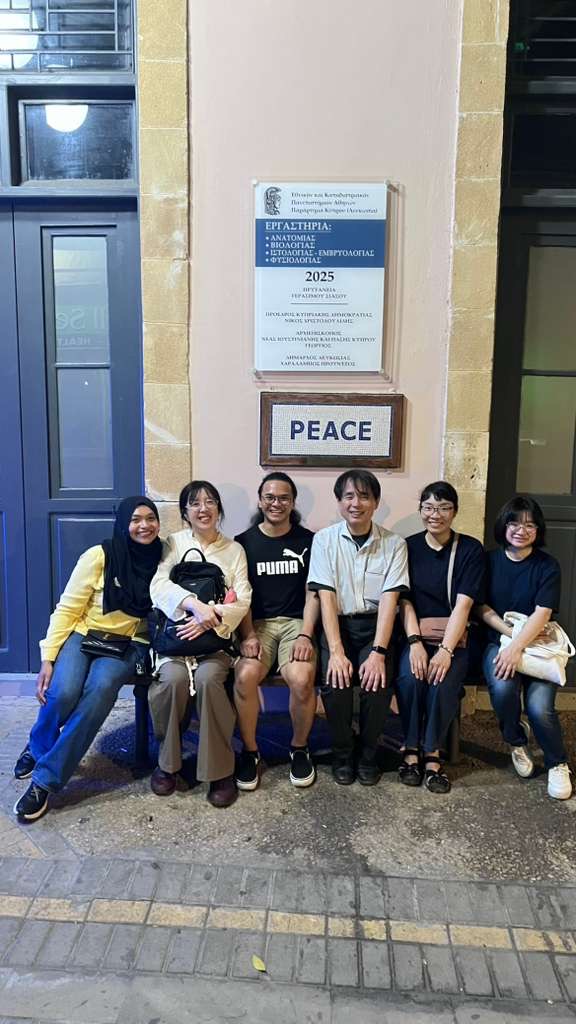
Photo 1: The International Education team group photo in front of a Peace sign
Reflexivity and the Kind of Researcher I Want to Be
I remember upon joining the International Reconciliation Studies project, we were asked to write about our research interests and also what kind of researcher we would like to be. Attending IARS 2026 reminded me of what I wrote, which included to ‘embody different ways of knowing and being’, and to ‘learn from diverse knowledge actors, practitioners, and elders’. Meeting the team from Doctors Against Genocide was one of my most memorable moments in this conference, as they shared over a lunch chat and also their presentation how they are directly involved in efforts to stop genocide as medical workers. From continuous advocating to their own governments to stop funding wars, to providing healthcare and medical assistance in conflict-affected areas and experiencing deaths of colleagues and patients, to having family and friends subject to ongoing violence and conflict, these doctors embody the kind of researcher I aspire towards: one who aligns their way of life with the knowledge they advocate for.
Attending their roundtable on “Preventing Genocide: A Proactive Medical Approach to Early Recognition and Prevention”, it was illuminating how they characterised genocide prevention as preventative healthcare. Furthermore, their roundtable also included the variety of strategies they use to advocate their cause, from boycotting certain companies and products, to speaking out against the use of their pension funds to invest in corporations associated with weapons and funding wars. This reminds me of the stark reality that there is no neutrality in the face of oppression, and as a researcher I need to be mindful of the fine line between relativism and anything goes, and sit with the discomfort of not always knowing in the pursuit of knowledge.
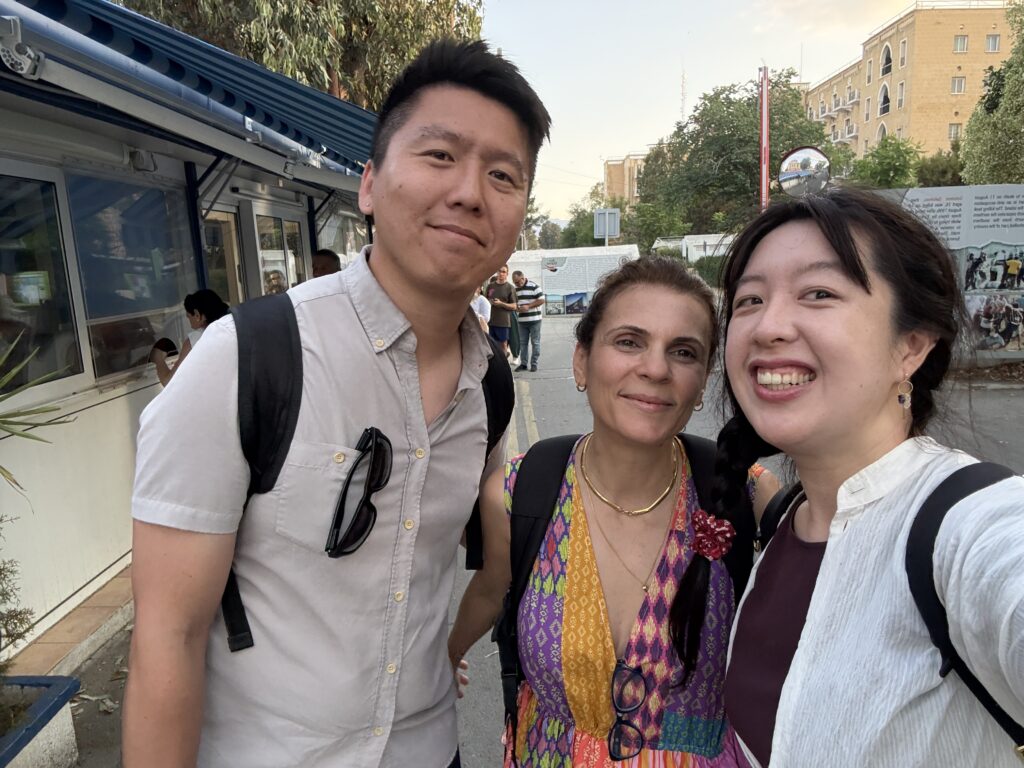
Photo 2: Taken with two members from the Doctors Against Genocide team after crossing the border
Attending IARS 2026 has been a formative experience that has pushed me to reflect not only on the theoretical boundaries of my research, but also on what it means to produce knowledge in the service of something larger than academic contribution. Meeting the Doctors Against Genocide team reminded me that the distance between research and practice, between knowledge and action, is not inevitable, but a choice. As I continue to develop my research on how Malaysian universities navigate global norms and local epistemologies, I carry with me a renewed commitment to the kind of researcher I set out to be: one who does not treat epistemic questions as purely theoretical, but as deeply connected to whose knowledge survives, whose is erased, and what structures make that erasure possible. Cyprus itself, a city where a physical border still divides communities across unresolved histories, was perhaps the most fitting reminder that reconciliation is rarely complete, and that sitting with that incompleteness is a form of practice in scholarly integrity.