

Trip Overview
This research trip had two parts. It began with a two-day field trip to Munich, where I spoke with members of the Vietnamese diaspora about how they remember the war and what has moved them, over decades, to remember it the way they do. It ended in Nicosia, at the 7th Annual Conference of the International Association for Reconciliation Studies, “Paths Toward Peace: Reconciliation in Theory and Practice,” held at the University of Nicosia on June 19–22, 2026. There I presented a revised version of the paper I first gave at IARS Seoul in 2025, now titled “From Inherited Selves to Constructed Selves: The Role of Identity Transformation in Post-Conflict Reconciliation.”
Placing the two halves side by side was not planned as a method, but it worked as one. In Munich I listened to people for whom the Vietnamese war is memory rather than inheritance. In Nicosia I stood at a border that has not closed and watched people cross it on foot, chatting, unremarkable. The distance between those two scenes is where most of my thinking on this trip happened.
Munich: Listening to Those Who Lived It
I traveled to Munich to speak with Vietnamese residents there, most of whom left Vietnam after 1975 or in the decade that followed. My interest was narrow and specific: how they position the past now, what prompted any shift in that position, and whether reconciliation, as a word, means anything to them at all.
For reasons of anonymity I include no photographs and no names here, and I keep the details thin. What I can say is that the conversations complicated the diaspora as a category. The people I met did not hold one memory in common. Some described a reconciliation already completed, quietly, in private, without ever using the term. Others described a wound that annual commemoration in Vietnam reopens each spring. Several drew a firm line between the government and the country, and located their anger precisely on one side of it.
It is always different to hear this firsthand. In my own data, the diaspora appears secondhand, through what my participants report of their encounters with elders abroad. In Munich the elder was in front of me, pouring tea. The methodological lesson is uncomfortable and useful: my participants’ accounts of the diaspora are themselves a construction, and I have been treating them, at times, as a window.
Nicosia: A Border That Is Crossed
Cyprus entered my research imagination at the Kavala summer school in 2024. Two lessons from that week have stayed with me. The first was Professor Umemori’s deceptively simple question, “reconcile what, and with whom,” which reframed reconciliation as a problem of definition before it is a problem of policy. The second was a session with Dr. Charalampos Karpouchtsis, who challenged familiar Greek narratives on Cyprus from within, and a closing exercise in which participants named what reconciliation there would require: education, transparency, dialogue. I wrote about Cyprus then without having seen it.
This time I saw it. Nicosia is the last divided capital in the world, and the division runs through the middle of an ordinary shopping street. What surprised me was not the buffer zone but the traffic across it. People queue at the checkpoint, show a document, walk through, and buy coffee on the other side. They are friendly. The border is both absolute and porous, and I had not understood how those two facts could hold at once until I watched it for an afternoon.
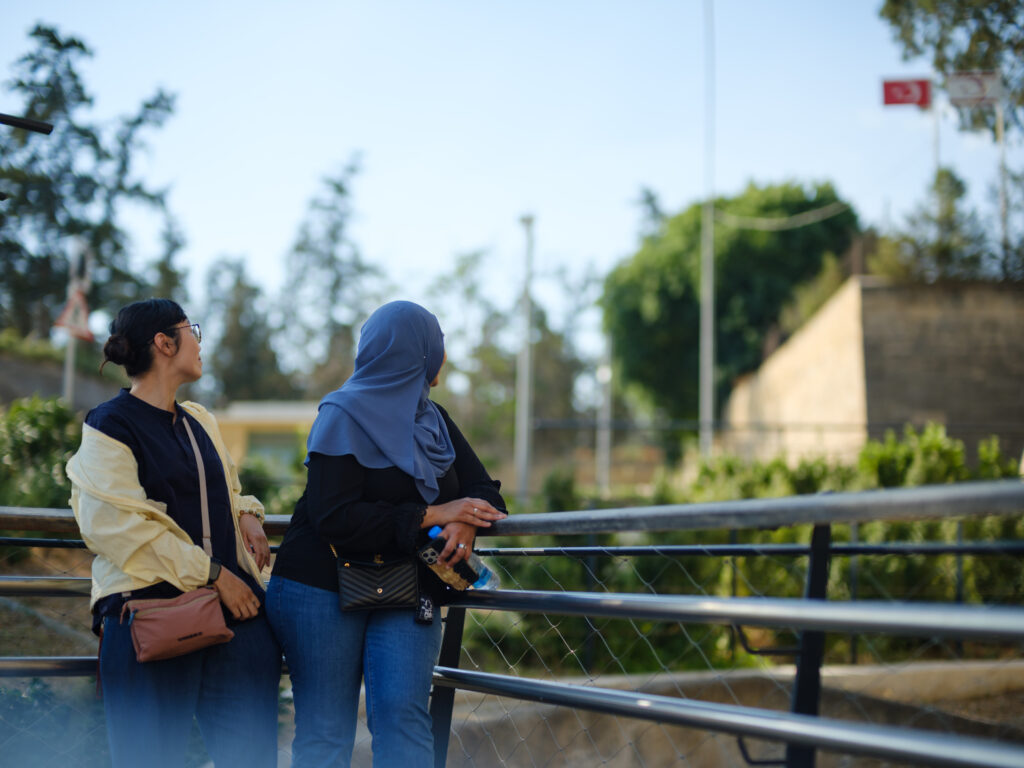
Dr. Rita Ikeda and I were talking about the division while looking at the Turkish Cypriot flag from the Greek Cypiot side
The keynote discussion on the conference’s opening evening, “Overcoming the Division: Can the Cyprus Problem be Solved?,” left the strongest impression. It brought together Özdil Nami, former Chief Negotiator for the Turkish Cypriot community, and Dr. Andreas D. Mavroyiannis, former Chief Negotiator for the Greek Cypriot community, in conversation with Professor Hubert Faustmann of the University of Nicosia and the Friedrich-Ebert-Stiftung. To hear the two men who sat in those rooms describe what was possible, what was nearly possible, and what the domestic politics on each side made impossible, was a corrective to any model that treats reconciliation as an attitudinal variable. They spoke about trust as a resource with a shelf life. They also spoke, both of them, about the cost of being seen as too willing to understand the other side. That cost is not in my data, but it should be.
Presenting “From Inherited Selves to Constructed Selves”
I presented in the panel “Education as a Site of Memory, Tolerance and Identity Construction in Asia: Individual and Institutional Perspectives,” a fitting frame, since my paper treats the university abroad less as a setting than as an instrument.
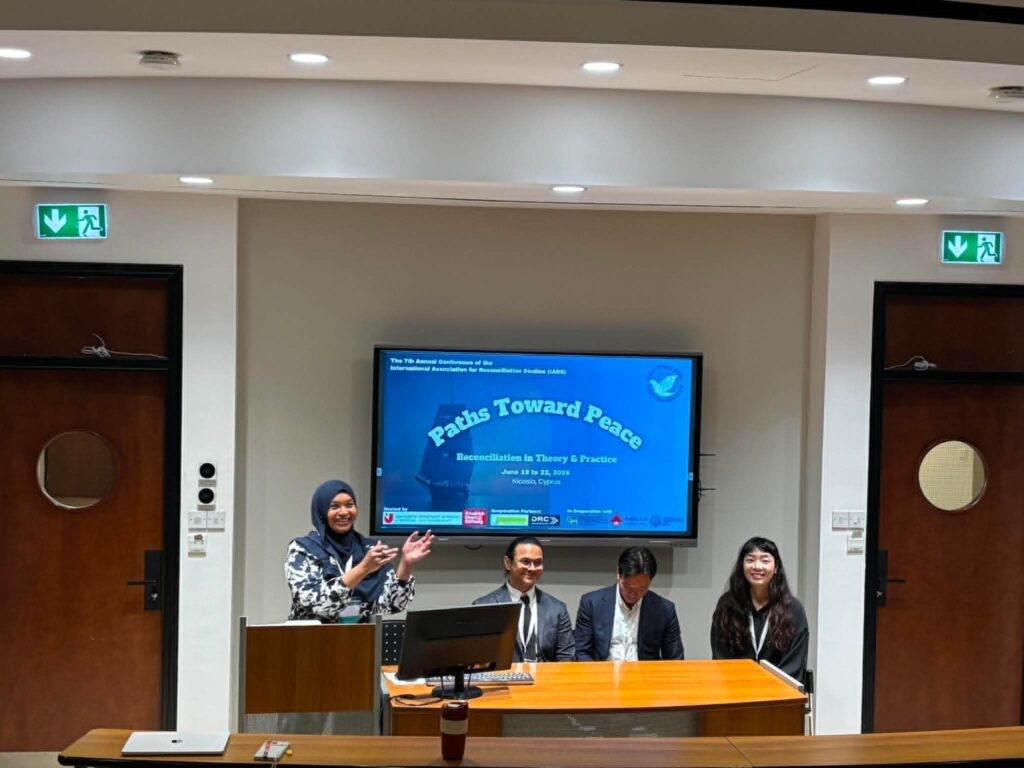
Me and my panel
This is the research I plan to submit to journals such as Memory Studies. My paper asks how study abroad in former adversary nations transforms the way young Vietnamese nationals understand their history, their national identity, and their role in reconciliation. It draws on a 14-month longitudinal design with five graduate students, three in Japan and two in the United States, combining four waves of focus group discussion with reflective writing, analyzed through reflexive thematic analysis and read against postcolonial, social identity, and critical peace theory.
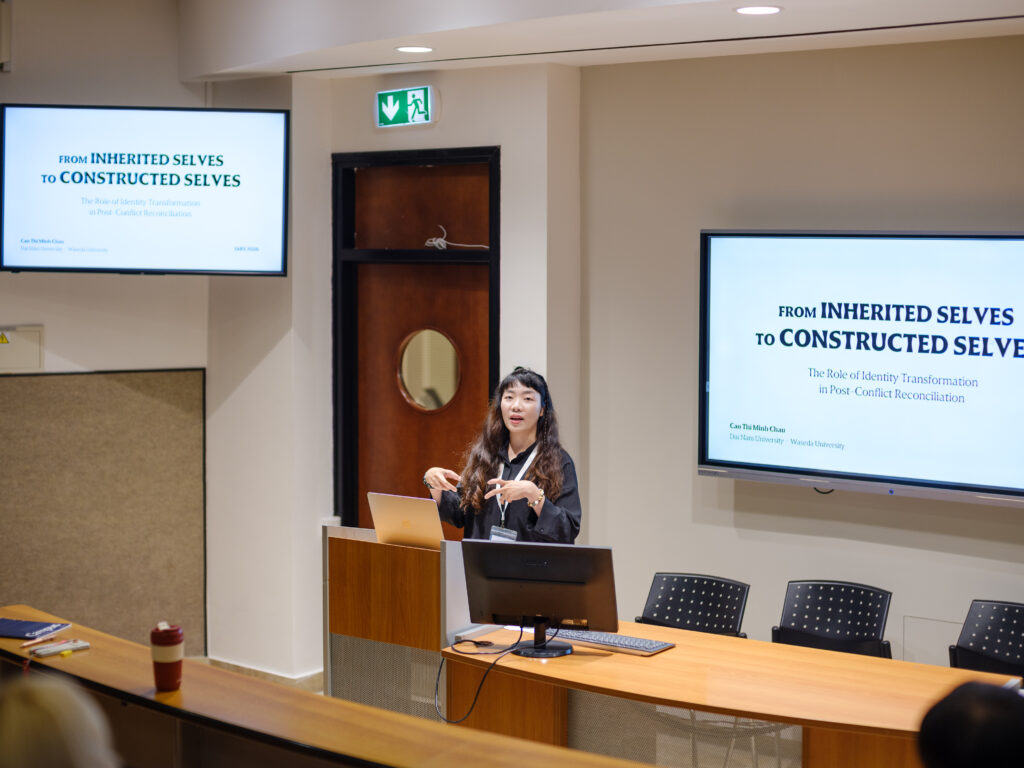
Me presenting
The argument is that reconciliation begins with the self that does the reconciling. Participants arrive holding an inherited self: a single state narrative, passively held, in which reconciliation is something other countries owe Vietnam. Abroad, that self meets two shocks, historical invisibility and hypervisibility, and a third and sharper disruption from within Vietnameseness, in encounters with diaspora elders whose memory of the same events is loss rather than liberation. Participants then take up the exhausting role of cultural translator before arriving at a constructed self marked by critical patriotism: heightened identification combined with widened acknowledgment. By the final wave, the locus of reconciliation has migrated from the interstate register to the intrapersonal.
I model this movement as a reconciliation spiral: recursive rather than linear, returning at each turn to the same axes of identity, history, and power, but at greater depth. Its most distinctive and most falsifiable claim is that better-informed anger is itself a marker of progress.
Two responses have stayed with me.
The first, from several colleagues, was that the spiral needs to be placed against existing frameworks rather than presented alongside them. Kelman’s identity change and Lederach’s nested levels are cited in the paper, but citation is not comparison. I need to specify what the spiral predicts that a stage model does not, and where it could be shown to be wrong.
The second was a question from Professor Kumagai. If informed anger is better than uninformed anger, she asked, then how do you get angry people to become informed? I did not have an answer in the room and I do not have one now. The model describes a transformation that happened to people who were, by circumstance, already placed inside a reflexive infrastructure: a graduate program, a research project, a foreign country, four sessions with a researcher asking them to explain themselves. Those conditions are not available to most people who are angry about the past, and they may be least available to those angriest. Whether the spiral describes a general process or only a privileged one is now, for me, the central open question. I suspect the honest answer implicates the design itself.
Concluding Thoughts
In Nicosia I watched people cross a border to buy coffee from someone their governments cannot agree to recognize. The keynote had asked whether the Cyprus problem can be solved, as though reconciliation were a problem with a terminal state. The street outside answered differently. Nothing there had been solved, and yet something was being practiced, daily, by people who had made no agreement and signed nothing.
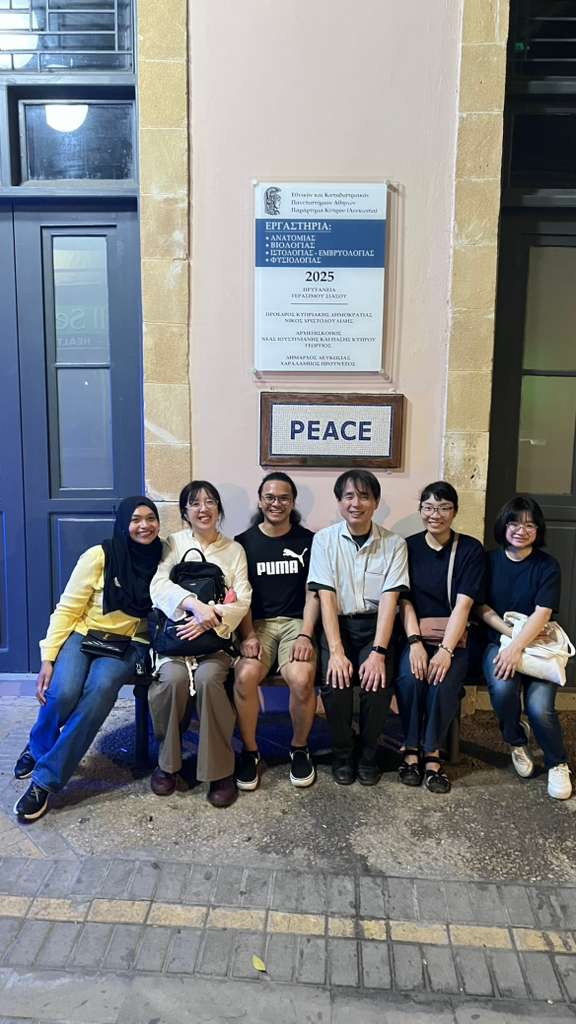
Professor Kuroda and his students (including me) at the border in Nicosia
That gap between the settlement and the street is where my own argument now sits, and it is less comfortable than it was. I traveled to Cyprus with a model that relocates reconciliation from the interstate register to the intrapersonal, and I met two former negotiators who could describe, in detail, the price paid by anyone visibly willing to understand the other side. Interior work does not exempt a person from structural cost. My participants know this. Linh said as much when she observed that personal pride cannot alter economic dependence.
So I return to Tokyo with the paper’s revisions clear and its foundations less settled, which is, I think, the correct outcome of a conference. The revisions are specifiable: compare the spiral against stage models, state what it forbids, name the conditions it presupposes. The foundations are not. Professor Kumagai’s question stays open, and I have begun to suspect it is not a gap in the model but the model’s proper subject. If informed anger is the achievement, then the reflexive infrastructure that produces it, the seminar room, the foreign country, the interlocutor who asks you to explain yourself, is not context for reconciliation. It may be the thing itself. That would make reconciliation, in the end, a question of distribution: who is given the conditions in which to become informed, and who is left simply angry.