

From 26th September to 4th October 2026, I was granted the opportunity to participate in the International Reconciliation Studies Summer School. This was a particularly unique event given that the participants were able to visit both the University of Cambridge in England, and the Friedrich Schiller University Jena (hereafter: Jena University) in Germany on the same trip. Sincere appreciation goes to Professor Toyomi Asano and the International Reconciliation Studies Project team who planned and organised this learning event, Professor Barak Kushner from Cambridge University, as well as Professor Martin Leiner and Dr Laura Villanueva from Jena University for kindly hosting us at their respective institutions.
Presenting as a member of the International Education team, I shared my research, “The SDGs as a Global Governance Mechanism: Reconciling Global Performativity and Local Justice in Malaysian Universities,” at Jena University, drawing on my PhD work to connect SDG governance in higher education to international reconciliation studies. The SDGs are non-binding global targets that emerged from decades of UN-led environmental and development summits; the 17 goals and 169 targets, spanning people, planet, prosperity, peace and partnership, were adopted by all UN member states in 2015. In higher education they now shape, guide and benchmark university strategy worldwide, and Malaysian universities have aligned teaching, research, community engagement, governance and campus operations with them. Yet although the SDGs are framed as a universal aspiration addressed equally to the Global North and South, they are not neutral: they carry particular assumptions about what sustainability and development mean. Entering a higher education field already unequal and shaped by market logics, these norms pressure universities in the semi-periphery and periphery to engage in ways that do not always reflect local understandings of justice.
Comparing three sets of data from Malaysia’s SDGs Voluntary National Review (VNR) 2025 that measures Malaysia’s progress in the SDGs, Scopus-indexed research publications on the SDGs by the five research universities in Malaysia, and the SDGs rankings achievement of Malaysian universities, a significant gap emerged between the national needs, university research, and the achievements of universities in the SDGs ranking. For example, in the VNR, SDG 16: Peace, Justice, and Strong Institutions was the goal where Malaysia is most behind progress, but research publications related to peace and justice in Scopus were among the lowest, while two of the research universities in Malaysia managed to achieve No.2 and No.9 globally for SDG 16 in the 2026 Times Higher Education (THE) sustainability rankings. Content analysis of domestic annual reports and international sustainability reports also frame sustainability engagement differently, with the same universities framing their energy initiative or rationale for pursuing sustainability as a normative, natural responsibility of universities in the international report, while highlighting the pragmatic benefits such as how solar panels help universities to save electricity costs in the domestic report. Interviews with university management, faculty and sustainability officers also reveal how certain norms assumed in the SDGs are not compatible with local conditions, such as the requirements of LGBTQ policies, which are perceived as a liberal Western value system opposed to Malaysian local culture and values. The imbalance within the one-size-fits-all approach in the THE sustainability rankings was also mentioned, with challenges towards financial assistance for refugees particularly since Malaysia is not a signatory of the 1951 Refugee Convention. Collectively, these examples show the different ways in which mechanisms pushing global or universal values could conflict with local needs and values, thus gesturing towards the need for reconciling national and local justice with universal assertions of what is just and fair, instead of imposing fixed ideas of sustainable development.
I received a few valuable questions about my presentation. A question from Tsukuru-san was about my word choice to contrast global values and local justice, as though they are at opposition with one another. Initially, I wanted to present the complexities when thinking about the global-local dialectic, while seeing how universal values asserted by the SDG framework interact with local understandings of sustainability and national needs. My response then was how I wanted to highlight that there is not necessarily a dichotomy between global values and local justice, but instead sometimes they reinforce each other, such as in values related to environmental protection and conservation, or enrich each other, such as the upward norm diffusion and advocacy of spirituality as SDG 18 as an addition to the 17 SDGs, or even conflict with each other, such as the requirements for LGBTQ policies or refugee financial provision within the THE rankings reporting. Another comment from Villanueva-sensei then compared her experience working with local Colombian coffee farmers to rebuild lives post-conflict, where they needed their reports to align to the SDGs despite already doing on-the-ground work for sustainable livelihoods, and eventually they needed help from a university to frame their work within the SDG framework in order to obtain funding. Onozaka-san also suggested extra reading on Catherine Walsh’s concept of decolonial pedagogies. Synthesising the questions and comments, I realised that defining keywords and stating our positionality at the beginning of the presentation would be helpful to guide the audience as to where my starting point and concept for my research is, especially considering how interdisciplinary the field of international reconciliation studies is. Furthermore, the Colombian coffee farmers example also shows how global frameworks do not only affect institutions, but also grassroots peace work.
When considering international reconciliation, there might be desired universal norms or values purported by international organisations and other actors. However, within the process of striving to align with universal norms or values, the rewards or perceived benefits might influence institutions to pursue global value frameworks rather than mediate between the local, national, and global. This is especially true for universities in an international higher education field that rewards such alignment and driven by the need to secure legitimacy through reputation-building practices such as high ranking positions. However, actions such as the aforementioned advocacy for SDG 18: Spirituality and the contestations towards norms related to refugee financial provision and LGBTQ policies suggest potential avenues for mutual learning for the reconciliation of global and local values.
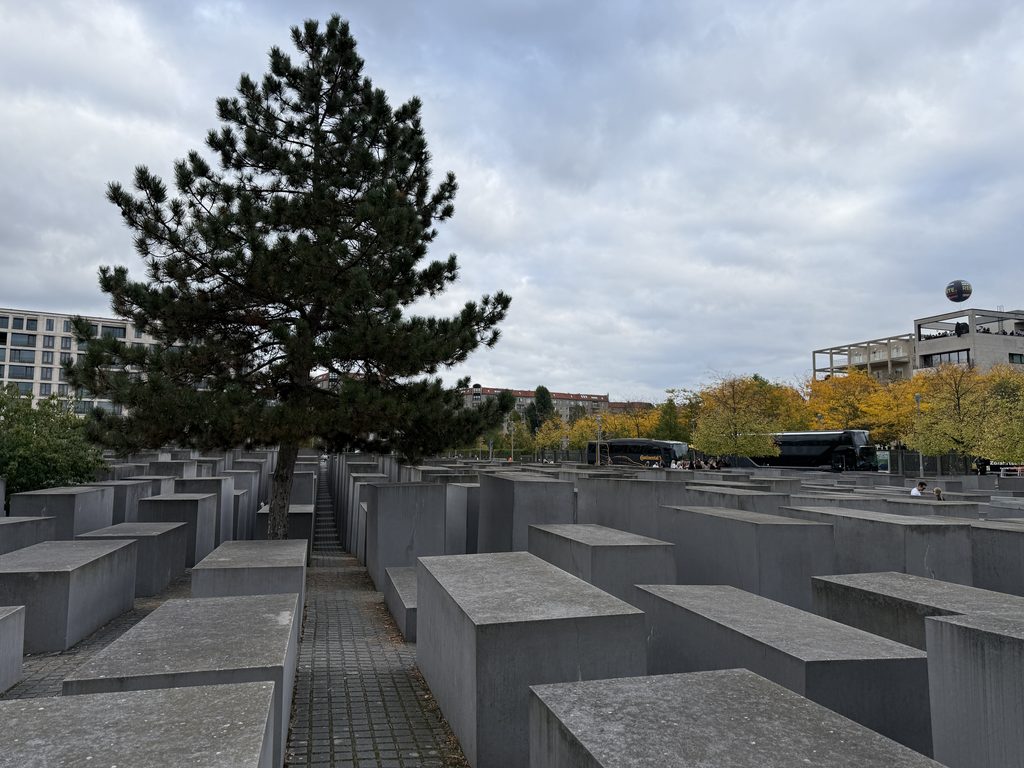
Monument Memorial to the Murdered Jews of Europe – Germany’s central Holocaust memorial, Berlin, photo taken by author
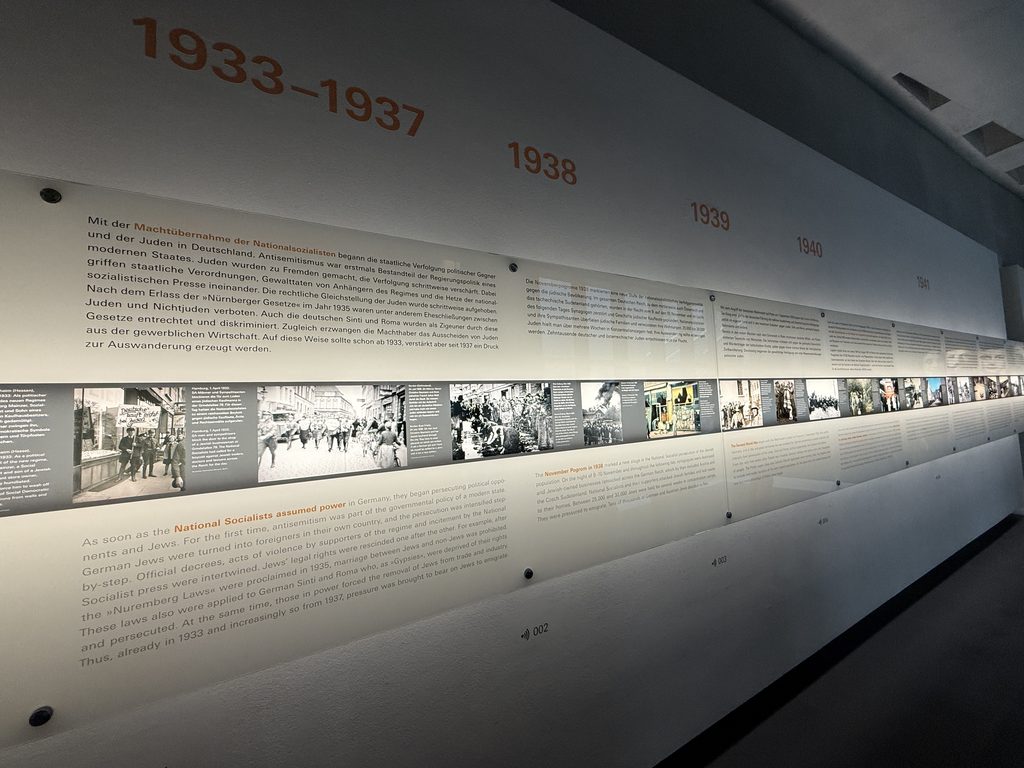
Information Centre displaying the events leading up to the Holocaust, the Memorial to the Murdered Jews of Europe, Berlin, photo taken by author
Reflecting on international reconciliation as a field, my trip, especially to Germany made me reconsider the global-local dialectic and the diversity of the world. In Berlin, I managed to visit the Memorial to the Murdered Jews of Europe, a monument of remembrance and commemoration for the Jewish victims of the Holocaust. There was an underground information centre located at the site, though the labyrinth of tomb-like concrete installations of the monument made it difficult to find the entrance. Wandering through the eerie concrete blocks of varying heights, I felt like I was in the midst of unnamed tombs. Quoting from the architect, Peter Eisenman (translation: Dr. Günter Schlusche), “In our monument there is no goal, no end, no way in or out…there is no nostalgia, no memory of the past, only the vivid memory of individual experience. Today we can only understand the past through its manifestation in the present.” From the vantage point of someone growing up in Malaysia and ethnically Chinese, I have always heard my elders talking about how Germany is described as a nation that takes responsibility and acknowledges its accountability for the atrocities of World War II and the Holocaust through collective historical guilt and reparations, compared to the East Asian paradox of reconciliation where Japan’s overall recognition of its wartime actions, especially in South Korea, China and Southeast Asia, still remains incomplete and contentious, though the contrast itself is debated among scholars of memory politics, and the two cases differ in ways that complicate direct comparison, including their postwar occupation regimes, Cold War alignments, and the regional positions of each successor state. I record this as a comparison I grew up with rather than one I have examined closely, and the summer school made me want to examine it further when the opportunity arises. From the perspective of global values and local justice in international reconciliation studies, how we approach memory of atrocities in the present, and how we subsequently manifest it in the present with appropriate recognition and respect for the past in justice-driven ways that are acceptable to the victims but also viable for the perpetrators or successor societies, still remain a conundrum to be explored.