

1. Summary of the presentation
My presentation, “Divided by Vietnam, United by Germany? Intra-Community Reconciliation in the Vietnamese Diaspora,” reported a pilot study and the redesign it forced. Germany received Vietnamese migrants from opposite sides of the same conflict: refugees from the South in West Germany from 1979, and contract workers from the North in East Germany from 1980. Reunification in 1990 placed both groups in one state. The study asks how these migrants relate to the divisions they inherited and what work the shared host society does on those relations.
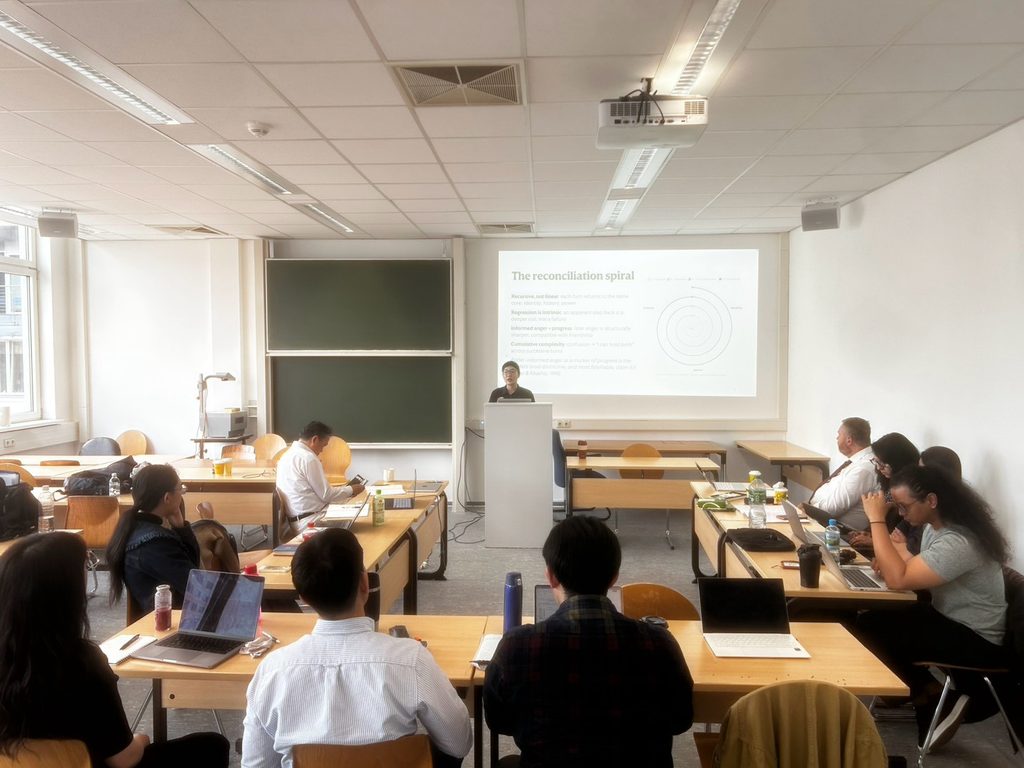
I first introduced the reconciliation spiral from my earlier longitudinal study of Vietnamese students in Japan and the United States. The model treats reconciliation as recursive, with regression built in and better-informed anger read as progress. I then positioned the new study against Su (2022), whose Berlin ethnography addresses nationhood and nationalism. My study adds the 1954 displacement and inherited rupture, focuses on reconciliation and closure, and begins in Munich.
The pilot consisted of seven participant-led conversations in Vietnamese in Munich in June 2026. Four preliminary findings followed.
- Participants combined several positions on the past within one conversation, so the positions are repertoires and cannot be assigned to types of person.
- Hardship in Germany is shared across the divide, while the loss of a country is held by one side only. Solidarity therefore goes around the division.
- Former socialist-stream participants ranked themselves above the 1954 and 1975 arrivals on the ground that they can return to Vietnam without shame.
- Participants rejected the term hòa giải and described wanting something closer to closure, which is individual and does not require the other party.
The last finding challenges the spiral model, which assumes continued return to unresolved material. I closed with the Phase 2 design: Munich and Berlin as sites, sampling across routes of departure, and one fieldwork round timed around late April.
Most of the discussion turned on one problem: what counts as evidence of reconciliation when participants refuse the word.
The first comments addressed what the study should observe. One suggestion was that naturalization, and especially the renunciation of Vietnamese citizenship, could serve as an indicator of a person’s relation to the Vietnamese state. A second comment was that reconciliation concerns specific incidents as well as the term. The relations involved need to be separated: with the country, among the refugees themselves, and across generations. Family memory is inherited, and it links people to the present government or to refugees who arrived by other routes. Grave incidents deserve direct attention.
The discussion then moved to closure and to the spiral model. Closure was read as reconciling with oneself, a peace within the person that ends the matter for them. On the spiral, a commenter observed that the model presupposes reflection on history and identity, while people occupied with daily work may have neither the time nor the wish for it. The advice was to ask how family memory shapes their reactions and their feelings toward the two governments, and to expect limited explicit reflection on identity.
Several comments were technical. Different countries and groups define reconciliation differently, so the study needs a working definition that fits this case. The English rendering of hòa giải requires care, because participants who reject the word may be rejecting one particular version of it. Discourse analysis could show how usage differs across groups. On my open question about claiming reconciliation that participants never name, the advice was to test the claim against the literature, see whether it fits, and stay close to the meanings participants give. The data do not need to be adjusted to the concept.
The last part of the discussion took up my question about comparison with other divided diasporas. North Korean defectors were raised as a comparison case, including the view of North Koreans as actors in peacebuilding. Defectors who resettle in a third country often feel that they do not fit in, and some join Christian communities or convert in order to belong. They speak openly about their upbringing and their feelings, which my Vietnamese participants rarely did. The North Korean and South Korean relation is therefore only a partial parallel. The Cuban case was also mentioned, including the tendency toward reconciliation during the Obama era and the role of the military.
2. What I learned from the comments
The comments were especially useful because this study is a new direction for me. My earlier research was in education, and this project concerns personal experience and identity, so I needed guidance on both concept and method.
Concept and evidence. I will define reconciliation and closure operationally before Phase 2, keep the Vietnamese terms in analysis, and document how participants use or refuse hòa giải. Where they do not name reconciliation, I will report the meanings they give and test my reading against the literature. I will also give more weight to emotion. The comments on closure as peace within oneself, together with Professor Leiner’s point about a psychological need for reconciliation, suggest that the shame, anger, and grief in my pilot material deserve analysis in their own right.
Next steps. I will revise the interview guide to cover citizenship decisions, family memory, specific incidents, and feelings toward both governments. I will ask about daily life first and treat reflection on identity as something that may or may not appear. I will also read the North Korean and Cuban literature as comparison cases, with attention to reconciliation with oneself or one’s own group and to the influence of a diaspora on the home society. Two themes remain to be developed: what can and cannot be said within each community, and how a diaspora contributes to nation-building.
3. Other lessons learned
Cambridge. The exchange between Professor Kushner and Professor Asano identified what the project’s framing leaves out. Three points stood out: the place of state-building, the role of theory in the keynote, and the meaning of “the West,” which in practice often refers to the United States and the United Kingdom alone. The last point reflects how working languages limit research perspectives. The discussion also proposed that a new understanding of Japan and of its role in Asia and the world amounts to a rereading of world history. Presenting research in another language was treated as part of this work, and all of these points lead to the role of education. This is directly relevant to my teaching and to my research on international education.
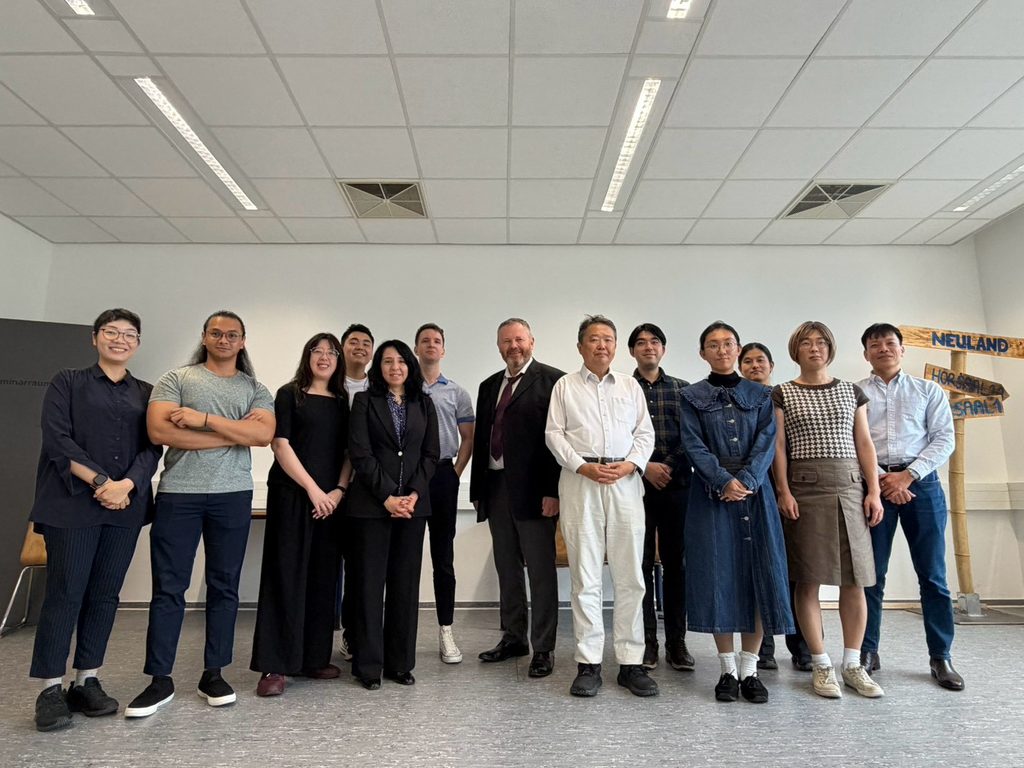
Jena. Professor Leiner’s lecture, “Negotiation and Reconciliation,” argued that negotiation is a component of reconciliation and that people have a psychological need for reconciliation. The second claim changed how I read my own material. It places reconciliation in the emotional life of individuals as well as in relations between groups, which is where my participants located closure.
Munich. I did not join the Leipzig excursion and traveled to Munich after the workshop, where I stayed for almost two days, from October 2 to 3. Munich is where I held the pilot conversations in June 2026, so the visit let me return to the same community with the Jena comments fresh in mind.
The visit had three purposes. The first was to reflect on the comments close to the field and to work out how each one changes the questions I should ask. The second was to talk casually with members of the Vietnamese community. I spoke with around 12 people at restaurants, salons, churches, and temples, including three of the June participants. In line with the lesson of the pilot and the advice I received in Jena, I kept these conversations informal, let people speak about their daily lives, and did not introduce the term hòa giải myself. The third was to identify potential informants for Phase 2. The pilot sample was uneven across routes of departure, so I looked in particular for people whose routes were underrepresented in June.
I did not conduct formal interviews or collect data during this visit. Its value was preparatory: I renewed contact with the community, tested a more indirect way of approaching the topic, and began building the list of informants that Phase 2 requires.
4. Personal reflection
I felt lost during much of the Cambridge conference. Most of the sessions were conducted in Japanese, and the papers dealt with diplomatic and political history, which is outside my training. I could follow the outline of the arguments, but I often lacked the background to judge them or to contribute to the discussion.
Professor Kushner’s remarks encouraged me. The discussion he led acknowledged that working languages limit what researchers can see, and it treated presenting in another language as part of the work of reconciliation studies. Hearing this helped me see my difficulty as a common condition of international research that can be addressed through effort and education.
The experience also prompted me to study history more seriously. History is the foundation of what we have today. The security arrangements, constitutions, and territorial settlements discussed in Cambridge still shape relations in East Asia. The same is true of my own topic: the divisions among Vietnamese people in Germany began in 1954, 1975, and 1989 to 1991, and my participants’ feelings today cannot be understood without those events. I had approached the diaspora study through present-day experience and identity. I now see that I need a firmer command of the historical record in order to interpret what participants tell me, and to recognize what they leave unsaid.
The two events therefore complemented each other. Cambridge showed me the gap in my historical knowledge, and Jena gave me concrete guidance on a study that is new territory for me. I went to Munich afterward with clearer questions and more confidence in the direction of the project.