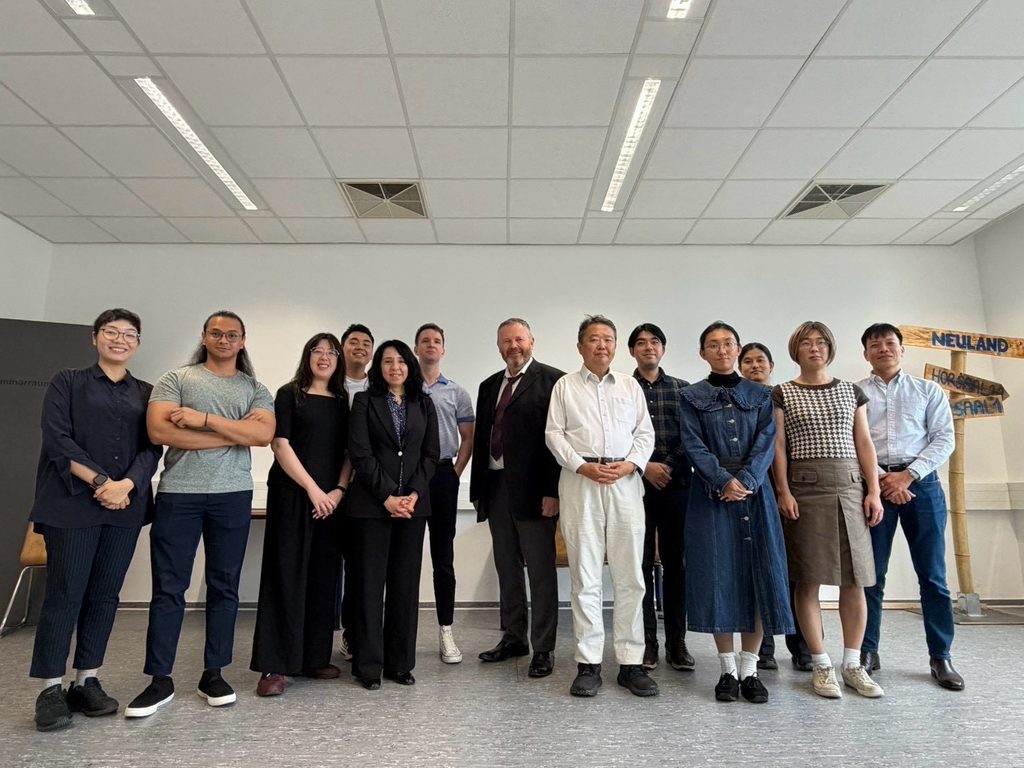
I presented my research project at Friedrich Schiller University Jena, Germany. The research began with a question rooted in Indonesia’s experience of terrorism, particularly the 1stBali Bombing in 2002,
which claimed more than 200 lives, and the bombing of the JW Marriott Hotel in Jakarta. These events became important reference points for understanding how Indonesia has responded to religiously motivated violence and its consequences for society. My project focuses on Indonesia’s religious moderation education policy between 2020 and 2024, particularly how the policy seeks to address and counter the image of Islam that terrorist groups attempted to impose on Indonesian society.
From the perspective of cultural memory studies, mass casualties resulting from ideological violence can be understood as a form of cultural trauma. Mullis argues that such violence affects more than the individuals directly involved because it can challenge the collective identity and memory of a community. Those who experience or inherit such trauma are then required to engage in what can be described as “discursive meaning-making,” including through cultural expression and creative literature, in order to process collective anguish and continuing grief.
The Indonesian context presents another layer to this issue. A 2017 survey conducted by the Center for the Study of Islam and Society (PPIM) at Syarif Hidayatullah State Islamic University found that 58.5 percent of students demonstrated tendencies toward radical religious views, while 51.1 percent showed tendencies toward intolerance and 34.3 percent displayed outward expressions of intolerance. The findings raised serious concerns about how young Indonesians understand religious difference.
A year later, PPIM conducted another survey examining perceptions of diversity among Muslim teachers across Indonesia. The results were similarly concerning. Around 63.07 percent of teachers expressed intolerant opinions toward followers of other religions, while questionnaire data showed that 56.90 percent held intolerant views. These findings are particularly significant in a country as religiously and culturally diverse as Indonesia, where tolerance is essential to maintaining peaceful social relations. The surveys therefore strengthened the urgency for government institutions, educators, religious communities, and other social actors to address intolerance in both thought and practice. Religious moderation education was introduced as one of the policy responses to this situation.
The Q&A session after my presentation pushed the discussion in a direction that I found especially important. One major issue was the meaning of “religious moderation” when viewed through the lens of reconciliation. My research primarily examines how religious moderation is implemented from the perspective of teachers, so the discussion exposed a limitation in my current approach: I have not yet sufficiently examined how religious moderation itself could contribute to reconciliation and the development of social harmony.
Another question was more fundamental. Does the policy simply seek to preserve a relatively stable and dogmatic model of religious education in the name of peace, or does it create space for students to question difficult and even taboo aspects of their faith? There is a significant difference between teaching students to avoid religious extremism and encouraging them to develop a deeper understanding of why they believe what they believe.
Based on my observations, textual analysis, and personal experience, I currently understand religious moderation education in Indonesia as being largely designed to prevent religious practices from becoming extreme and, in doing so, reduce the possibility of conflict between followers of different faiths. The emphasis is therefore placed on maintaining peaceful relations. It does not appear to place the same emphasis on developing students’ critical engagement with their own beliefs or encouraging deep and meaningful interreligious conversations.
One question from Dr. Laura Villanueva stayed with me after the discussion. She asked what Indonesia might look like ten or twenty years from now if younger generations continue to grow up without being equipped to critically examine their own faith and develop a deeper understanding of what their beliefs actually mean. That question deserves a much more systematic study, so I do not claim to have a definitive answer. Still, my experience as an Indonesian gives me some reason to be concerned.
Indonesia often presents itself as one of the world’s largest religious societies. Yet religious identity can become increasingly superficial when people are not given the intellectual and educational tools needed to understand their faith in meaningful ways. Harmony may appear to be maintained on the surface, but there could be another cost. People may gradually experience religion as nothing more than a set of rituals and routines, become less connected to the spiritual meaning behind those practices, or become more vulnerable to being divided against people of other faiths. In the longer term, this could even contribute to growing agnosticism. I do not mean that religion will simply disappear. Rather, if religious education continues to rely on an inappropriate or overly restrictive approach, religion itself may gradually lose its meaning for those who practice it.
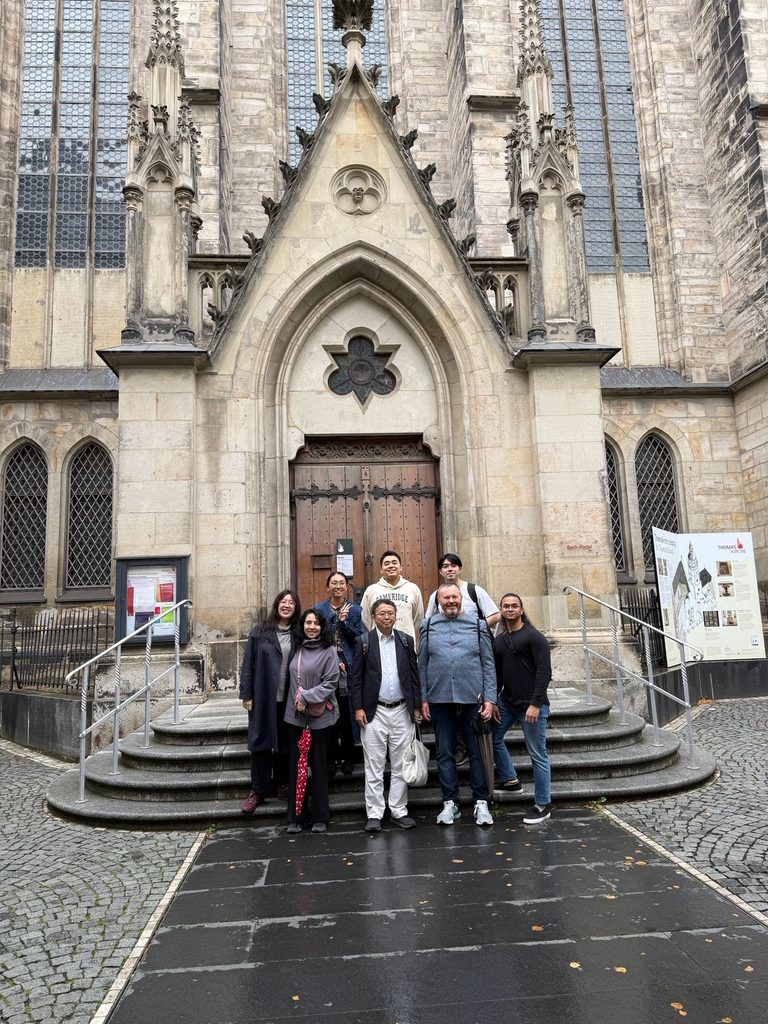
During our visit to Leipzig, we also visited St. Nicholas Church. Prof. Martin Leiner explained the important role religion played in the process of German unification. One of the church’s pillars, which had traditionally stood inside the building, was taken outside during the protests surrounding German reunification and became a symbol of the movement. The symbol represented something broader than the church itself. It represented religion as a source of collective identity and social mobilisation.
The interior of the church also contains paintings depicting Jesus breaking guns, reflecting the church’s opposition to violence. What I found particularly interesting was the difference between the German and Indonesian contexts. In Germany, people may be less likely to participate regularly in formal religious rituals, such as attending church for prayer, yet religious values can still appear in their moral outlook and everyday lives. In Indonesia, the relationship can sometimes look almost reversed: religious rituals remain highly visible and regularly practiced, while the deeper moral and reflective dimensions of faith may receive less attention.
The program gave me an opportunity to think about reconciliation beyond the boundaries of my own research. As a young academic, I am conscious of the risk of becoming trapped in an
The picture was taken on 2nd Oct 2026 during an excursion on the end of the Cold War at Leipzig.
Ivory tower, where academic concepts become detached from the realities they are supposed to explain. Meeting scholars, experts, and practitioners, discussing the research with them, and observing the German context directly challenged some of my assumptions. It also helped me see reconciliation less as an abstract theoretical concept and more as an ongoing social process shaped by education, memory, religion, history, and everyday human experience.